Wizz Air A321neo Seat Selection Guide (2026)
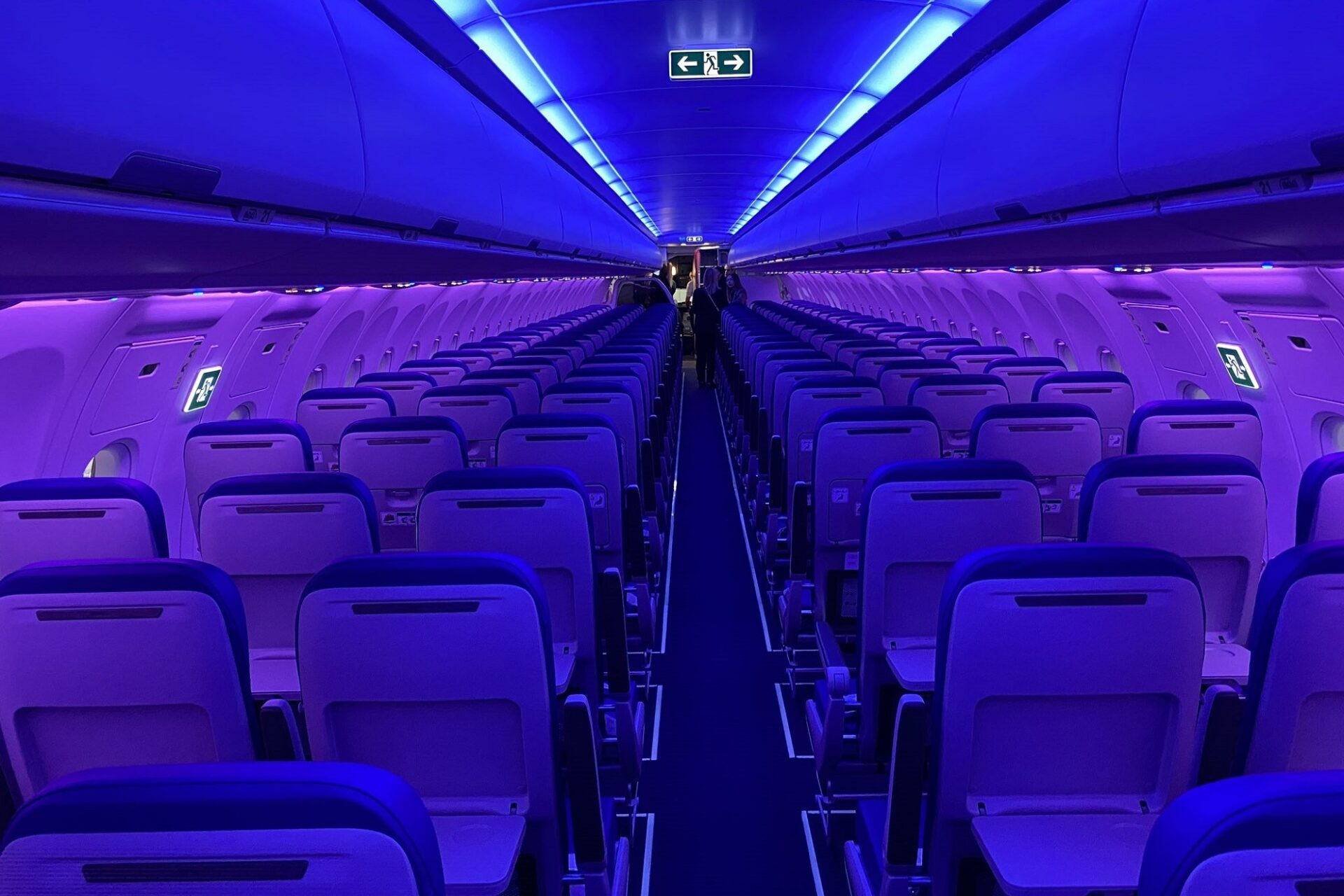
Wizz Air's Airbus A321neo is one of the densest single-aisle configurations in European aviation — 239 passengers in an all-Economy 3-3 layout with non-reclining Recaro SL3710 slimline seats. There's no business class, no premium economy, no seatback screens, no USB ports, and no Wi-Fi. What there is: a version lottery between the A321neo and the older A321ceo, a handful of exit rows with genuinely useful extra legroom, and a "WIZZ Class" product that blocks the middle seat in row 1 for a premium. Here's exactly which seats to pick and which to avoid.
Quick Reference
| Detail | A321neo (239 seats) | A321ceo (230 seats) |
|---|---|---|
| Configuration | All-Economy 3-3 | All-Economy 3-3 |
| Seat pitch | 28–29" | 28–29" |
| Seat width | ~18" | ~18" |
| Seat model | Recaro SL3710 | Varies |
| Recline | None (pre-reclined) | None (pre-reclined) |
| Bulkhead row | 1 | 1 |
| Exit rows | 18, 19 (overwing), 29 (rear) | 10–11 and 25–26 (two overwing pairs) |
| Last row | 40 | 39 |
| Seatback IFE | No | No |
| Wi-Fi | No | No |
| Lavatories | 3 (1 front, 2 rear) | 3 (1 front, 2 rear) |
| Power/USB | No | No |
The Version Lottery: A321neo vs A321ceo
Most Wizz Air flights now operate the A321neo — around three-quarters of the fleet is next-generation Airbus neo aircraft, and the A321neo makes up the vast majority at roughly 189 aircraft. However, Wizz Air still operates approximately 41 older A321ceo jets with a different 230-seat layout. These are being phased out by March 2029, with retirements already underway as of March 2026.
How to tell which you're getting: Check the seat map when booking. If the map shows 40 rows (239 seats), you're on an A321neo. If it shows 39 rows (230 seats), it's the older A321ceo. The cabin experience is broadly similar — both have non-reclining slimline seats in 3-3 — but the exit row locations differ. The A321neo has overwing exits at rows 18–19 and a rear exit at row 29. The A321ceo instead has two pairs of overwing exits, at rows 10–11 and rows 25–26, which is why seats 11A/11F and 25A/25F are missing on that variant.
Wizz Air also operates a small number of A320neo aircraft (186 seats, around 6 remaining) on shorter routes, plus a growing fleet of A321XLR aircraft for longer routes. The A321XLR uses the same 239-seat interior as the A321neo. This guide covers the A321neo (239 seats), which you'll get on the large majority of Wizz Air flights.
Cabin Layout: A321neo (239 Seats)
The entire cabin is all-Economy in a 3-3 configuration across 40 rows. There are no seat classes in the traditional sense, but Wizz Air sells several tiers of seating at booking:
- WIZZ Class (Row 1 only): A row 1 window or aisle seat with the adjacent middle seat (1B or 1E) blocked. Includes a complimentary snack and non-alcoholic drink, a large cabin bag, and priority boarding. Only available as an add-on to Smart or Plus fare bundles. Rolled out network-wide on 9 February 2026.
- First Row Seat (Row 1): Extra legroom at the bulkhead. No under-seat storage during takeoff and landing. Fast exit on arrival.
- Upfront Seats (Rows 2–4): Standard pitch but faster boarding and deplaning. No extra legroom compared to the rest of the cabin.
- Extra Legroom Seats (Exit rows 18, 19 and 29): Significantly more legroom than standard seats. No under-seat storage. Must be willing and able to assist in an emergency. Note that not every seat in these rows is equally good — see Best Seats below.
- Standard Seats (the rest of rows 5–40): 28–29" pitch with Recaro SL3710 non-reclining slimline seats.
Seat Characteristics
All seats are Recaro SL3710 slimlines with fixed backs — no recline anywhere on the aircraft. The seats are pre-reclined at a slight angle. Despite the stated 28" pitch, the slim seat design means legroom feels slightly more generous than the number suggests. Multiple passenger reports put the legroom experience on a par with easyJet's 29" pitch. Seat width is approximately 18", helped by the A321's wider fuselage compared to 737-based competitors like Ryanair, where the narrower cabin squeezes seat width.
There are no seatback screens, no power outlets, and no USB ports. Bring your own entertainment and a fully charged phone. There is no Wi-Fi. Food and drink are buy-on-board only.
Best Seats
Best Overall: 1A or 1F (WIZZ Class or First Row)
Row 1 has the most legroom of any seat on the aircraft. The bulkhead position provides generous knee clearance. If you book WIZZ Class, the middle seat (1B or 1E) is blocked, giving you extra width as well. Even without WIZZ Class, 1A and 1F are the most spacious seats on the plane.
Trade-off: No under-seat storage during taxi, takeoff and landing — all bags must go in the overhead bin. The tray table folds out from the armrest rather than the seat in front, which makes it slightly smaller and narrows the seat a touch.
Best Free Legroom: Row 19 (Overwing Exit)
Row 19 is the standout overwing exit row — every seat in it rates well, with roughly 35–37" of pitch. If you want exit-row legroom in a window seat, 19A and 19F are the picks, because they combine the extra space with a wall to lean against and an unobstructed view.
Row 18 is the other overwing exit row, but it's a step down: the wing sits alongside it, so the window seats (18A/18F) have a partially obscured view and rate lower than row 19's. In row 18, the centre and aisle seats (18C/18D) are the better choice than the windows. Across both rows, expect no under-seat storage and a busier aisle during boarding.
Best Rear Cabin: 29C or 29D (Rear Exit Row)
Row 29 is the rear emergency exit and offers excellent legroom, comparable to the overwing exits — and it's often overlooked by passengers who focus on the front. But there's a catch specific to this row: the window seats 29A and 29F are compromised (restricted/limited recline area and a poorer window position at the exit) and are best avoided. The seats that actually shine here are the centre and aisle seats — 29C and 29D for aisle access, or 29B/29E — which get the legroom without the window-area downsides.
Note on the right side: Seat 28F is removed on the A321neo (a crew/galley position sits there), so 29F faces that area. Combined with the exit-window compromise, that's another reason to favour the centre block of row 29 over 29F.
Best If You Don't Want to Pay Extra: 5A/5F or 8A/8F
If you're choosing a standard window seat, the front-cabin windows are the sweet spot — and the ones with the cleanest window alignment are rows 5, 8, 11 and 14 (both A and F). The very front pair, 5A/5F and 8A/8F, are the pick: you're close to the single front lavatory (a shorter queue than the rear), near the front for a quick exit, and well away from the rear galley. Both sides (A and F) rate equally, so choose by which side you prefer to board from or look out of. Rows 24, 32, 35 and 38 also have well-aligned windows if you'd rather sit further back.
Seats to Avoid
Row 40 (Last Row) — Avoid
Row 40 is the worst row on the aircraft. The fuselage tapers at the rear, making the seats narrower than standard, and you're immediately adjacent to the two rear lavatories and the rear galley — constant noise, foot traffic, and odours, particularly on longer routes. Seats 40A, 40B, 40C and 40F are the ones to skip outright.
Rear-Right Seats 39D/39E/39F — Caution
The back-right corner of the cabin (39D, 39E, 39F) sits in the rear lavatory-and-galley zone, with foot traffic building in the aisle on busy flights. The rest of row 39 and rows 37–38 are ordinary standard seats — not problem rows — so there's no need to avoid the whole rear section. In fact 38A and 38F are well-aligned window seats and a fine pick if you like sitting back there.
Rear-Exit Windows 29A/29F — Counterintuitive Skip
People instinctively target exit-row window seats, but on the rear exit the window seats are compromised (see Best Rear Cabin above). If you want row 29, take the centre/aisle seats instead.
Row 28E — Odd Layout
With seat 28F removed for the crew/galley position, the passenger in 28E sits on the edge of the cabin with an unusual gap to their right. This isn't necessarily bad, but it's worth knowing about.
Middle Seats Throughout (B and E)
On a fully sold flight — which most Wizz Air flights are — middle seats offer the worst experience. On an all-Economy aircraft with 28" pitch and no recline, being wedged between two strangers is the least comfortable option. If you're paying for a seat, prioritise a window (A/F) or aisle (C/D) over a better row number.
The "Check-In Chicken" Factor
Wizz Air assigns random seats to passengers who don't pay for seat selection, and the system tends to allocate less desirable seats (middles, rear rows) first. This has spawned a well-known hack called "check-in chicken," where passengers wait until close to the check-in deadline hoping the leftover seats will be better ones. It sometimes works — but the risk is that on an overbooked flight, late check-in can mean you're denied boarding entirely. For most travellers, paying for a specific seat is the safer option, especially on routes that consistently sell out.
WIZZ Class: Is It Worth It?
WIZZ Class rolled out network-wide on 9 February 2026 (after a December 2025 trial that the airline said exceeded expectations) and offers a row 1 seat with the adjacent middle seat blocked, a complimentary snack (a chocolate bar or crisps, not a meal) and a soft drink, plus a large cabin bag and priority boarding. The catch: it can't be bought on its own — you must first purchase a Wizz Smart or Wizz Plus fare bundle, then add WIZZ Class on top, and it's only available when the middle seat in row 1 hasn't already been sold.
The verdict: On short 1–2 hour flights within Europe, it's hard to justify the stacked cost of bundle + WIZZ Class for what amounts to a blocked middle seat and a chocolate bar. On longer routes — particularly the A321XLR services to Jeddah and Medina (6+ hours) — the extra space becomes much more valuable. Check the total cost against simply buying three standard seats together for a group, or against a competitor's fare with seat selection included.
A321neo vs Ryanair 737 MAX 8-200 vs easyJet A321neo
| Wizz Air A321neo | Ryanair 737 MAX 8-200 | easyJet A321neo | |
|---|---|---|---|
| Seats | 239 | 197 | 235 |
| Seat pitch | 28–29" | 28–29" | 29" |
| Seat width | ~18" | ~17.3–17.7" | ~18" |
| Recline | None | None | None |
| Exit row legroom | ~35–37" | ~35" | ~35" |
| Fuselage width | Wide (A321) | Narrow (737) | Wide (A321) |
| Lavatories | 3 | 3 | 3 |
| Power/USB | No | No | No |
The key differentiator: Wizz Air and easyJet both operate the wider Airbus A321, which provides a modest seat-width advantage over Ryanair's 737 — typically a few tenths of an inch. On flights over 3 hours, that small margin is more noticeable. Wizz Air's seat count (239) is the highest of the three, so the pitch may be marginally tighter, but the wider fuselage partially compensates.
Tips for Families
Wizz Air will assign seats to families with children, but there's no guarantee you'll be seated together unless you pay for adjacent seats. The airline does offer priority boarding for families with children under 6, which helps with overhead bin space. A few things to know:
- Car seats: Infants in approved car seats must sit in a window seat facing the rear.
- Bassinet seats: Not available — there are no bulkhead-mounted bassinets on Wizz Air.
- Adjacent seats: You must pay for seat selection to guarantee sitting together. The "sit together" add-on pairs you with your companion but doesn't let you choose where.
For families with young children, rows 2–4 (upfront) are the best option: close to the front lavatory, first off the aircraft, and away from the busy rear section.
Fleet & Route Context
Wizz Air is one of Europe's largest low-cost carriers with over 259 aircraft operating across subsidiaries in Hungary (W6), Malta (W4), the UK (W9), and Abu Dhabi (5W). The network spans Europe, North Africa, the Middle East, and Central/South Asia. All subsidiaries use the same A321neo interior configuration.
The A321XLR — same 239-seat cabin but significantly longer range — is in service from London Gatwick to Jeddah and Medina (6+ hours), making seat selection particularly important on these longer sectors. Wizz Air bases multiple XLRs at Gatwick, with a third arriving from September 2026. The XLR uses an identical seat map to the standard A321neo.
In early 2026, Wizz Air UK applied for US Department of Transportation authority to operate UK–US flights and received tentative approval in March 2026. However, the airline has said it has no plans for regular scheduled transatlantic service — it intends to fly the route on an ad-hoc basis for special events and group travel (for example around the 2026 FIFA World Cup) rather than as a daily, bookable service. If that ever changed, the dense 239-seat XLR cabin on 8+ hour flights would make exit-row seats among the most contested in European aviation.
Best Seats Summary
| Best For | Seat | Why |
|---|---|---|
| Overall best | 1A / 1F | Most legroom, first to deplane, WIZZ Class option |
| Best legroom value | 19A / 19F | Best overwing exit — every seat in row 19 rates well |
| Best rear cabin | 29C / 29D | Rear exit legroom without the compromised windows |
| Best free/standard | 5A/F, 8A/F | Front cabin, clean window alignment, close to lav, quick exit |
Frequently Asked Questions
Do Wizz Air seats recline?
No. All seats on the Wizz Air A321neo have fixed backs with a slight pre-recline angle. No seat on the aircraft reclines.
Is there a Wizz Air business class?
Not in the traditional sense. WIZZ Class, rolled out network-wide on 9 February 2026, offers a row 1 seat with the middle seat blocked, a snack, and a soft drink. It's an add-on to Smart or Plus fare bundles, not a separate cabin.
Which exit row is best on Wizz Air?
Row 1 for overall space and a fast exit (it's the bulkhead, not technically an exit). Row 19 is the best overwing exit — every seat rates well, including the windows. Row 18's windows are obscured by the wing, so pick its centre/aisle seats (18C/18D) instead. Row 29 (rear exit) has great legroom too, but take the centre/aisle seats — its window seats (29A/29F) are compromised.
What's the last row on Wizz Air A321neo?
Row 40. Avoid it — narrower seats and directly next to the rear lavatories and galley.
Is seat 28F available?
No. Seat 28F is removed on the A321neo, with a crew/galley position in its place.
Can I charge my phone on Wizz Air?
No. There are no power outlets or USB ports on Wizz Air aircraft. Bring a portable battery.
How do I know if my Wizz Air flight is an A321neo or A321ceo?
Check the seat map at booking. The A321neo has 239 seats across 40 rows. The older A321ceo has 230 seats across 39 rows with a different exit-row layout. The A321ceo is being phased out by 2029.
Is Wizz Air wider than Ryanair?
Yes, modestly. Wizz Air's A321neo has a wider fuselage than Ryanair's 737, giving a slightly wider seat. On longer flights this makes a small but noticeable difference.
Does Wizz Air have Wi-Fi?
No. As of 2026, there is no Wi-Fi on any Wizz Air aircraft.
Are Wizz Air seats comfortable?
The Recaro SL3710 slimline seats are thin and firm with no recline. They're functional for short European flights (1–3 hours) but can become tiring on longer routes. The wider Airbus cabin helps compared to 737-based competitors, and the pre-reclined angle is slightly more comfortable than a fully upright seat.
Comparable Aircraft
If you're comparing European low-cost carriers, check these guides:
- Ryanair Boeing 737-800 Seat Selection Guide — 189 seats, narrower cabin, no USB. Best: 2D/2E/2F (bulkhead), 17D/17E (exit row).
- Ryanair Boeing 737 MAX 8-200 Seat Selection Guide — 197 seats, Europe's densest 737. Hidden gem: 29A.
- easyJet Airbus A320 Seat Selection Guide — 186-seat SpaceFlex layout, same 3-3 no-recline concept but different exit row locations.
- Vueling A320 Seat Selection Guide — 180/186 seats, USB at every seat, A320ceo vs A320neo version lottery.