easyJet Airbus A320 Seat Selection Guide (2026)
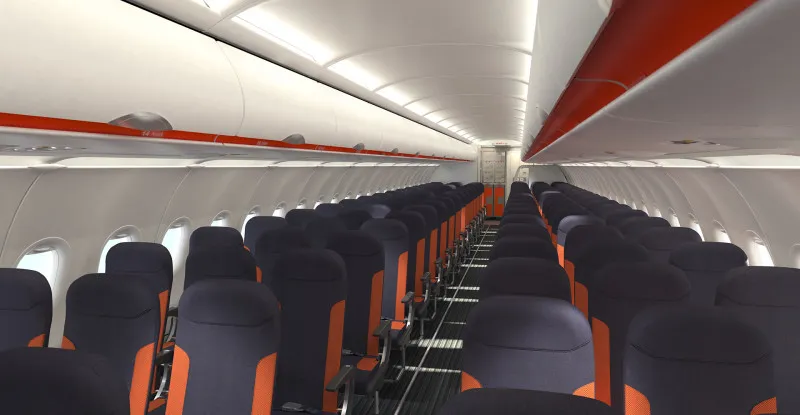
easyJet operates around 250 A320-family aircraft (both A320ceo and A320neo) across three AOCs — easyJet UK, easyJet Europe (Austrian AOC), and easyJet Switzerland. The A320 is the backbone of the fleet, with the newer A320neo gradually replacing older ceo variants. Both ceo and neo use an identical 186-seat cabin layout, so the passenger experience is the same regardless of engine type — though the neo has slightly larger overhead bins and quieter engines.
The airline has around 290 additional A320neo and A321neo aircraft on order through the early 2030s, progressively replacing older A319s and early A320ceos. For now, the A320 remains easyJet's workhorse on routes across Europe, North Africa, and the Middle East.
Quick Verdict
| Detail | Spec |
|---|---|
| Layout | All-Economy, 3-3 (ABC–DEF) |
| Total seats | 186 (rows 1–31) |
| Seat model | Recaro SL3510 slimline |
| Seat width | 17.7" (45 cm) |
| Standard pitch | 29" (74 cm) |
| Exit row pitch | ~35" (89 cm) — rows 12–13 |
| Recline | None — all seats are pre-reclined (fixed back) |
| IFE screens | None |
| Power/USB | None |
| WiFi | AirFi local content portal only (no internet) |
| Best legroom | Row 13 (exit) and row 1 (bulkhead/door) |
| Avoid | Row 31, row 30, and the row 12 window seats (draft) |
The 186-Seat SpaceFlex Configuration
Almost all easyJet A320s now use the 186-seat "SpaceFlex" configuration. This was achieved by relocating the rear lavatory into a combined galley-lavatory module, freeing up space for an extra row of seats at the back (row 31). The A320neo was delivered new in this configuration; older A320ceos have been progressively retrofitted, and easyJet began upgrading more of its remaining 180-seat A320ceos to SpaceFlex through 2026.
A small number of older or leased A320ceos still operate with 180 seats. The difference is simple: the 180-seat aircraft has 30 rows and no row 31 — the rear lavatories sit in their traditional position behind the last seat row, with rows 29–30 being the rearmost seats. These variants are increasingly rare and being phased out.
Seat Tiers & Pricing
easyJet sells three seat categories. None change the physical seat — it's the same Recaro slimline throughout — but the location and bundled perks differ.
XL Extra Legroom — Rows 1, 12, 13
The premium option. These seats offer genuinely more space (row 1 via the bulkhead/door gap, rows 12–13 via the overwing exits at ~35" pitch). The XL price includes Speedy Boarding (dedicated check-in and priority boarding), plus the right to bring a large cabin bag (56 × 45 × 25 cm) in the overhead bin. Pricing is dynamic, typically £10–£30+ per seat.
Up Front — Rows 2–6
Standard 29" pitch seats — no extra legroom — but you get Speedy Boarding, a large cabin bag, and the convenience of being among the first to deplane. Typically £8–£20+ per seat.
Standard — Rows 7–31
The default. Same seat, same pitch, no perks. You can pre-select for a small fee (typically £3–£10), or skip seat selection entirely and be assigned one at check-in for free.
Row-by-Row Analysis
Row 1 — XL Extra Legroom (Front Bulkhead/Door Row)
Row 1 is the first row in the cabin, positioned at the front door (left/ABC side) and forward bulkhead (right/DEF side). This creates an important asymmetry:
1A, 1B, 1C (left/door side): There is no bulkhead panel directly in front — the forward door creates open space, giving essentially unlimited knee room. This is the most spacious seating on the aircraft. The trade-off is that cabin crew use the forward jumpseat here during takeoff and landing, and 1A can feel cold due to proximity to the door seal.
1D, 1E, 1F (right/bulkhead side): A solid bulkhead panel sits in front of these seats. Legroom is still noticeably better than standard rows, but you cannot fully stretch your legs under it.
All of row 1 carries some trade-offs: the tray table is in the armrest (reducing effective width slightly, fixed armrests), there's no under-seat storage during takeoff and landing, and overhead bins may contain crew equipment. You're close to the forward galley and lavatory, and first off the plane (ABC side exits via the front door). Best pick: 1A for maximum space (accept the slight draft); 1C or 1D for a balance of legroom and aisle access.
Rows 2–6 — Up Front Zone
Standard 29" pitch with no extra legroom. The appeal is purely operational: Speedy Boarding, large cabin bag, and quick deplaning. These rows are forward of the wing, so ride quality is good and engine noise is lower. Best pick: Row 3 — the window seats 3A/3F have particularly clean window alignment. One note: 2A and 2F sit by the forward door and can have a slightly misaligned window, so if a guaranteed view matters, choose row 3 over row 2.
Rows 7–10 — Forward Standard Cabin
Solid mid-forward seats at 29" pitch. Quiet, away from galleys and lavatories, with good overhead bin availability if you board early. Best pick: 8A/8F — forward position, standard pricing, and well-aligned windows.
Row 11 — Pre-Exit Row (Approach with Caution)
Row 11 sits immediately ahead of the overwing emergency exit at row 12. To meet exit-clearance rules, the window and middle seats (11A/11B and 11E/11F) sit a touch more upright and tighter than the rest of the cabin, while the aisle seats (11C/11D) are normal. Verdict: The aisle seats are fine; for windows, rows 7–10 or 14–16 are better at the same price.
Rows 12–13 — XL Extra Legroom (Overwing Exit Rows)
The best legroom-to-value seats on the aircraft. At approximately 35" pitch, these exit rows offer roughly 6" more space than standard seats — a transformative difference on a 3–5 hour flight. But the two rows are not equal:
Row 13 is the standout — every seat in it rates well, including the windows. If you want exit-row legroom in a window seat, 13A and 13F are the picks (extra space, a wall to lean on, and an unobstructed view).
Row 12 is a step down. Its window and middle seats (12A, 12B, 12E, 12F) sit right beside the overwing exit doors, where passengers consistently report a noticeable cold draft, and rate lower as a result. In row 12, only the centre/aisle seats 12C and 12D are clean picks.
Exit row requirements: You must be 16 or older, physically able, not travelling with an infant, and willing to assist in an emergency. There's no under-seat storage during takeoff and landing, and tray tables are in the armrests. Best pick: anywhere in row 13; if you're in row 12, take 12C or 12D to dodge the draft.
Rows 14–29 — Rear Standard Cabin
The bulk of the aircraft. All seats are identical at 29" pitch, and rows 14–29 are ordinary standard seats with no particular drawback — the rear cabin doesn't become a problem until row 30. The A320neo is appreciably quieter than the ceo here. Well-aligned window seats sit at rows 20, 23 and 26 (A/F). Best pick: Rows 14–16 for the best balance of standard pricing and a forward-ish position.
Row 30 — Rear Cabin (Caution Zone)
Adjacent to the combined rear galley/lavatory module. Expect increased foot traffic, galley noise, and general bustle. Verdict: Avoid if possible; acceptable on a short 1–2 hour hop if nothing else is available.
Row 31 — Last Row (Worst on the Aircraft)
Row 31 only exists because easyJet relocated the rear lavatory to squeeze in one more row. The consequences: no windows on either side, narrower seats (the cabin tapers at the tail), maximum galley and lavatory noise, and last to deplane. This is comfortably the worst row on the aircraft. Seats 31A, 31B, 31C and 31F are the ones to skip outright; 31D and 31E are marginally less bad but still poor. Avoid unless the flight is very short and nothing else is available.
Best Seats — Quick Reference
| Pick | Seats | Why |
|---|---|---|
| Best legroom/space | 1A | Unlimited knee room (door side), first off the plane (accept slight draft) |
| Best all-round | Row 13 (any) | Best-rated row — exit-row legroom with no draft penalty |
| Best window with space | 13A or 13F | Exit-row legroom, wing view, no draft (unlike row 12) |
| Best value window | 8A or 8F | Forward cabin, clean window alignment, standard pricing |
| Best for couples | 14A + 14B | Just behind the exit rows, standard pricing, quiet |
Seats to Avoid
| Seat(s) | Why |
|---|---|
| Row 31 (all) | Worst on the plane — no windows, narrower, maximum galley/lav noise |
| Row 30 (all) | Adjacent to the rear galley-lav module — noise and foot traffic |
| 12A, 12B, 12E, 12F | Exit-row legroom but a persistent cold draft from the exit doors |
| 11A, 11B, 11E, 11F | Window/middle seats sit tighter and more upright for exit clearance |
| 1A (if cold-sensitive) | Door-side window seat can get chilly |
| 2A, 2F (for a view) | Window can be slightly misaligned by the forward door |
Cabin Notes & Insider Tips
- No recline anywhere. Every seat has a fixed, pre-reclined backrest. No one can recline into your space — but you can't adjust your seating angle either.
- No IFE, no power, no internet. No seatback screens, no USB ports, no AC power, and no internet-connected WiFi. AirFi provides only local content (games, destination info, retail menu). Charge devices fully before boarding and download entertainment in advance.
- Buy on board only. No complimentary food or drink. Crew typically run the trolley from both ends simultaneously, so mid-cabin seats may wait longest.
- Armrest tray tables in XL rows. Rows 1, 12, and 13 have tray tables built into the armrest (fixed, slightly narrower effective width).
- The A320neo is quieter. The CFM LEAP-1A engines produce noticeably less cabin noise than the older CFM56 on the A320ceo, particularly in the rear half.
- Left side (ABC) exits first. The front door is on the left side. Rows 1–3 ABC deplane fastest.
- New seats on the way. In March 2026, easyJet announced it will fit ultra-lightweight Mirus Kestrel slimline seats across its fleet over the coming years, promising a small legroom gain. Until your specific aircraft is refitted, expect the current Recaro SL3510.
Who Should Pay for What
- XL seats (rows 1, 12, 13) — worth the premium for flights over 2 hours, tall passengers, or anyone who values legroom. The bundled Speedy Boarding and large cabin bag make the maths work. Aim for row 13 to get the legroom without the row 12 draft.
- Up Front (rows 2–6) — makes sense for business travellers who need to deplane quickly, or anyone who wants guaranteed overhead bin space. Don't buy expecting extra legroom — it's the same 29" pitch.
- Standard seats — perfectly fine for short 1–3 hour flights. If you pre-select, aim for rows 7–16 to stay forward without paying Up Front prices, and target an A/F window at rows 8, 20, 23 or 26 for the cleanest views.
Comparable Guides on SeatCompare.ai
- easyJet Airbus A321neo Seat Selection Guide (2026) — 235 seats, different exit rows and tighter rear pitch.
- Wizz Air Airbus A321neo Seat Selection Guide (2026) — 239 seats, the densest single-aisle in Europe.
- Ryanair Boeing 737-800 Seat Selection Guide (2026) — Europe's other mega-LCC with 189 seats and zero recline.
- Ryanair Boeing 737 MAX 8-200 Seat Selection Guide (2026) — 197 seats, Europe's densest 737.
← See all aircraft seat guides
FAQ
Do easyJet A320 seats recline?
No. Every seat on the A320 has a fixed, pre-reclined backrest. Nothing reclines anywhere on the aircraft.
Is there WiFi on easyJet flights?
Not internet WiFi. easyJet's AirFi is a local wireless portal for games, destination information and the onboard retail menu only — you can't browse, email or stream.
Are there USB ports or power outlets?
No. There are no USB ports or AC power outlets on the easyJet A320. Bring a fully charged device and a power bank.
What's the difference between A320ceo and A320neo?
The cabin is identical — 186 seats in the same 3-3 SpaceFlex layout. The neo has newer CFM LEAP-1A engines (quieter, more fuel-efficient) and slightly larger overhead bins. Seat-wise, there's no difference.
Is XL Extra Legroom worth the price?
On flights over 2 hours, or if you're tall, yes — the ~35" exit-row pitch (rows 12–13) is a big upgrade, and the price bundles Speedy Boarding and a large cabin bag. Choose row 13 over row 12 to avoid the cold draft by the exit doors.
Which is the worst seat on the easyJet A320?
Row 31 — the extra SpaceFlex row at the very back. No windows, narrower seats, and maximum noise from the rear galley and lavatories.