Ryanair Boeing 737 MAX 8-200 Seat Selection Guide (2026)
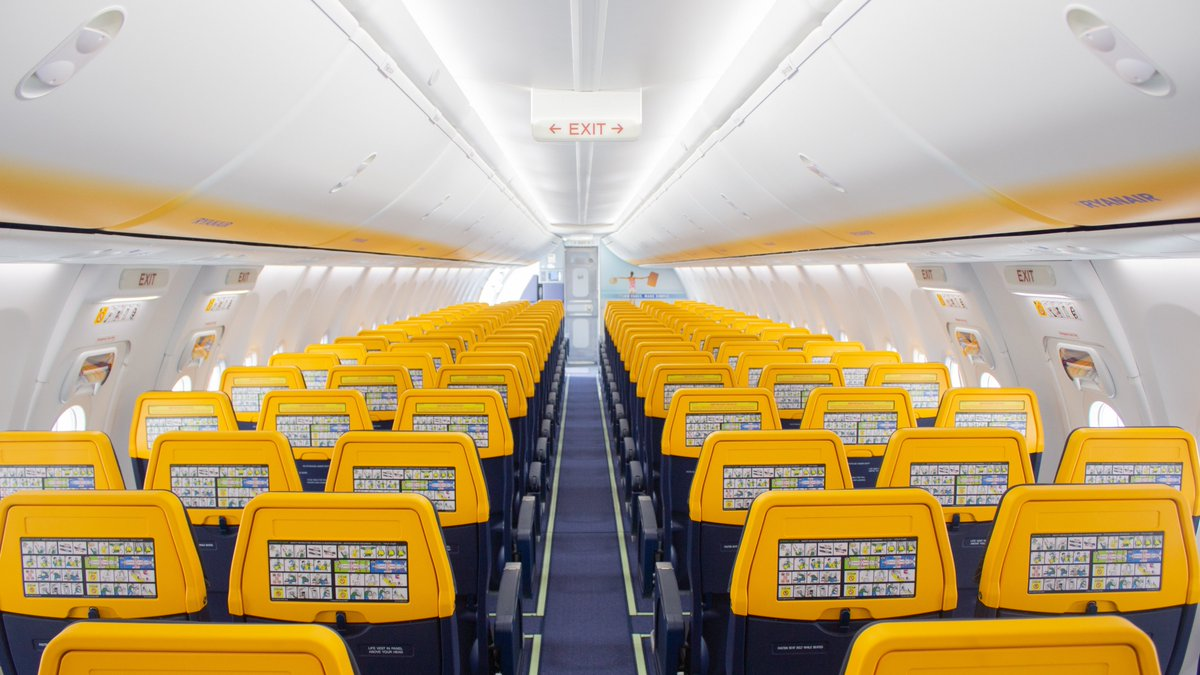
Ryanair's 737 MAX 8-200 — branded the "Gamechanger" — is the world's densest single-aisle aircraft from a major airline: 197 passengers in an all-Economy 3-3 layout at just 28–28.5 inch pitch. With 206 of these aircraft now in the fleet (as of February 2026) and more arriving monthly, there's a strong chance your next Ryanair flight will be on one.
The MAX 8-200 is unique to Ryanair Group. No other airline operates this variant. It's based on the standard 737 MAX 8 but adds a third pair of exit doors between the wings and the rear, which allows Boeing to certify the cabin for up to 200 passengers. Ryanair fits 197 seats — eight more than the 737-800 it replaces — achieved by tightening pitch from 29–29.5 inches down to 28–28.5 inches and shrinking the galley space significantly.
Despite the tighter pitch on paper, many passengers report the MAX actually feels comparable to the 737-800 thanks to ultra-thin Zodiac Z110 slimline seatbacks. The thinner seats claw back some of the lost pitch as usable knee room. Combined with Boeing's Sky Interior (larger bins, LED lighting, sculpted sidewall panels) and the noticeably quieter LEAP-1B engines, the MAX is a more modern experience than Ryanair's older 737-800s — just with less margin for error if you're tall.
💡 Aircraft swap warning: Ryanair frequently swaps the MAX 8-200 (197 seats, rows to 35) with the 737-800 (189 seats, rows to 33) on the same route. If you've paid for a specific seat, Row 17 is an exit row on both aircraft types — making it the only swap-proof choice for guaranteed extra legroom. Row 35 doesn't exist on a 737-800.
Quick Verdict
| Seat Zone | Rows | Seats | Pitch | Width | Recline |
|---|---|---|---|---|---|
| Front (extra legroom) | 1 (BC only), 2A, 2DEF | 6 | ~36–40" | 17" | None |
| Standard (forward) | 2BC–16 | 82 | 28.5" (ABC) / 29" (DEF) | 17" | None |
| Overwing Exit | 17–18 | 12 | 35" | 17" | None |
| Standard (mid) | 19–27 | 54 | 28" | 17" | None |
| Rear Exit | 28 (partial row) | 3 | 35" | 17" | None |
| Standard (rear) | 29–35 | 40 | 28" | 17" | None |
Total: 197 seats (no row 13 — rows skip from 12 to 14)
One Configuration, One Variant
Every 737 MAX 8-200 in the Ryanair Group — whether operated by Ryanair (FR), Ryanair UK (RK), Buzz (RR), or Malta Air (MAY) — uses the identical 197-seat layout. There is no version lottery on this aircraft type. All 206 aircraft have the same row numbering, same exit locations, same seats.
All MAX 8-200s come standard with Boeing Sky Interior: sculpted sidewall panels, larger overhead bins (compared to the 737-800), and LED mood lighting with colour transitions. The seats are Zodiac Z110 slimline throughout, the same model used on newer 737-800s but with tighter spacing.
Cabin Layout
This is where the MAX 8-200 gets unusual. The third pair of exit doors (unique to this variant) creates an irregular seating pattern in the rear cabin that doesn't exist on any other 737.
- Row 1 has only two seats: 1B and 1C (port/left side). There is no 1A — the fuselage curvature doesn't allow a window seat at this position. There is no 1D, 1E, or 1F — the right side is occupied by the forward galley and lavatory.
- Row 2 has an asymmetric layout. Seat 2A has exceptional legroom because there is no 1A in front of it — you're looking at empty floor space where a seat would normally be. Seats 2D, 2E, 2F are bulkhead seats facing the galley partition. Seats 2B and 2C are standard.
- Rows 3–16 are standard 3-3 seating (skipping row 13).
- Rows 17–18 are the overwing exit rows with 35" pitch — the traditional extra-legroom seats.
- Rows 19–27 are standard 3-3 seating at 28" pitch — the tightest section of the aircraft.
- Row 28 is where it gets complicated. This is the rear exit row created by the additional doors, and it's a partial row with only three passenger seats:
- No 28A — the left exit door occupies this position
- 28B and 28C exist — exit-row seats with extra legroom
- 28D exists — exit-row seat with extra legroom
- No 28E — replaced by a rear-facing crew jumpseat
- No 28F — the right exit door occupies this position (and 27F also doesn't exist due to this exit door's position)
- Rows 29–35 are standard 3-3 seating at 28" pitch, with row 35 as the last row.
Lavatories: 1 forward (right side, near rows 1–2), 2 rear (behind row 35). The rear lavatories on the MAX are notoriously tiny — even smaller than the 737-800's already compact facilities, because galley space was sacrificed to fit the extra seating rows.
Seat Pricing Tiers
The same dynamic pricing structure applies as on the 737-800. Ryanair doesn't distinguish between aircraft types in its pricing:
- Extra Legroom (1BC, 2A, 2DEF, rows 17–18, row 28, 29A/29F): €12–37 / £12–37. Includes priority boarding.
- Front Seats (rows 2BC–5): €7.50–22.50 / £7.50–22.50. Same tight pitch as standard but closer to the front door.
- Standard (rows 6–16, 19–27, 29–34): €4.50–20 / £4.50–20.
- Rear (row 35): Variable pricing. Proximity to rear lavatories.
Prices vary by route, season, and advance purchase. Seat selection also unlocks check-in from 60 days before departure, versus 24 hours for free random allocation.
Best Seats
Best Overall: 29A — The MAX's Secret Weapon
This is the single best seat on any Ryanair aircraft, and most passengers don't know it exists. Because seat 28A doesn't exist (it's replaced by the left rear exit door), seat 29A has no seat directly in front of it. The result is what seatmaps.com calls "near infinite legroom" — effectively 3–4 times the standard 28" pitch, with enough space to fully stretch your legs and even walk forward along the cabin wall to the exit without using the aisle.
The catch: 29A has a misaligned window — the nearest window is slightly behind your shoulder position, so you won't have a perfect view. There's also no underseat storage during takeoff and landing (exit-row rules apply). But for legroom, nothing else on any Ryanair aircraft comes close. 29A is the better of the two: 29F faces the rear-facing crew jumpseat at the 28E position, which some passengers find intrusive.
Best Guaranteed Exit Row: 17D or 17E
Centre seats in row 17 with 35" pitch — seven inches more than the standard 28". Row 17 is the safest bet for exit-row legroom because it's an exit row on both the MAX 8-200 and the 737-800. If Ryanair swaps your aircraft type, you still have extra legroom. Centre seats avoid the missing armrest issue that can affect exit-row window seats (17A, 17F). Tray table in armrest, no underseat storage during takeoff/landing.
Best MAX-Specific Exit Row: 18D or 18E
Row 18 is the second overwing exit row, also at 35" pitch. It only exists as an exit row on the MAX (on the 737-800, row 18 is a standard row). Slightly less swap-proof than row 17, but still excellent. If you can see rows 17–18 both marked as exit rows on your booking seat map, you're confirmed on a MAX.
Best for Front-of-Cabin Legroom: 2A
Seat 2A is a hidden gem. Because there's no 1A in front of it, 2A has substantially more legroom than any other standard forward-cabin seat. You can stretch forward into the empty space where 1A would be. It's priced as an extra-legroom seat and comes with priority boarding. The trade-off is minimal: you're on the left side near the front door, which is ideal for quick deplaning.
Best Bulkhead: 2D or 2E
The right-side bulkhead seats face the galley partition with generous knee room. No underseat storage during takeoff/landing, tray table in armrest. 2E is preferable to 2D (less aisle traffic) or 2F (less fuselage curvature). All three are good for tall passengers.
Best Standard Seat: Row 19 (any seat)
Row 19 sits directly behind the exit rows and benefits from the same subtle legroom advantage that row 18 gets on the 737-800 — exit-row passengers in row 18 have their seats positioned further forward than standard spacing. No exit-row restrictions apply, so you keep underseat storage and normal armrests. At 28" pitch it's not spacious, but it's the best non-premium option.
Best for Rear Deplaning: Row 35 (A or F)
If your airport uses rear stairs (common at smaller Ryanair bases), sitting at the back means you're first off through the rear door. Row 35 is the last row, directly in front of the rear lavatories, so it has the downsides of proximity to the toilet queue — but if speed of exit matters more than comfort, it works.
Seats to Avoid
12A — The MAX's Windowless Seat
The 737-800's infamous seat 11A (no window) shifts back one row on the MAX due to the denser layout. Seat 12A has no properly aligned window — the air conditioning duct blocks the window at this position, just as it does at 11A on the older aircraft. If you're prone to motion sickness or want to see outside, avoid 12A.
14A and 14F — Limited Window Views
Both window seats in row 14 have partially obscured or misaligned windows due to the fuselage's air conditioning duct routing. You'll have some light but not a proper view. These are the MAX equivalent of the 737-800's 12A/12F issue.
29A and 29F — Amazing Legroom, No Window View
Yes, 29A is listed as both a best seat AND an avoid seat. It has the most legroom of any Ryanair seat, but the window is misaligned — positioned behind your shoulder rather than beside you. If legroom is your priority, 29A is outstanding. If a window view matters to you, pick a different row. The same applies to 29F.
Row 35 — Last Row
The closest seats to the rear lavatories (directly ahead of them). Lavatory noise, odours, and a constant queue of passengers standing in the aisle behind you. The rear lavatories on the MAX are notably smaller than on the 737-800 due to the compressed galley space, which means more time per passenger and a longer queue. Seats are also narrower due to fuselage taper. Overhead bin access may be restricted (crew storage).
Rows 34–35 — Fuselage Taper
Both last rows are slightly narrower than mid-cabin seats due to the fuselage narrowing at the rear. Combined with lavatory proximity, these are the least desirable standard seats.
Row 28 — Awkward Exit Row
Row 28 only has three passenger seats (28B, 28C, 28D) due to the exit doors occupying the A and F positions and a crew jumpseat at E. These seats have exit-row legroom (35" pitch), but the arrangement is awkward: 28B is an aisle seat on the left with the exit door immediately to your left where a window would be, 28D is an aisle seat on the right facing a crew member in the rear-facing jumpseat at 28E, and 28C is wedged between them. If you want exit-row legroom with fewer complications, rows 17–18 are more straightforward.
Exit-Row Windows: 17A, 17F, 18A, 18F
As on the 737-800, the exit-row window seats have a missing or reduced armrest on the window side due to the exit door configuration. The overwing exit doors on the MAX also have very small windows — noticeably smaller than standard cabin windows — so the view from these seats is poor. If you want a proper window view with exit-row legroom, you can't have both on this aircraft.
The Aircraft Swap Factor
This is the single most important thing to understand about Ryanair seat selection. The airline operates two aircraft types (737-800 with 189 seats and MAX 8-200 with 197 seats) and swaps them frequently without guaranteed advance notice.
Key differences that affect your seat:
| Feature | 737-800 (189 seats) | MAX 8-200 (197 seats) |
|---|---|---|
| Last row | Row 33 | Row 35 |
| Overwing exit rows | 16–17 | 17–18 |
| Rear exit row | None | 28 (partial) |
| Standard pitch | 29–29.5" | 28–28.5" |
| Windowless seat | 11A | 12A |
| Row 1 layout | 1A, 1B, 1C | 1B, 1C only |
| Row 13 | Skipped | Skipped |
If your aircraft is swapped after booking:
- Row 17 exit-row passengers are safe on both types
- Rows 34–35 passengers on the MAX will be reassigned (these rows don't exist on the 738)
- Row 28 exit-row passengers will be reassigned to a standard seat
- Seat 2A extra-legroom passengers lose their advantage (2A is a standard seat on the 738)
- Row 16 on the 738 is an exit row; on the MAX it's a standard row
The safest strategy remains: book row 17 for exit-row legroom regardless of which aircraft shows up.
How to Tell Which Aircraft You Have
Check your seat map during booking or in the Ryanair app after booking. If the map shows rows up to 35, you're on a MAX. If it stops at 33, you're on a 737-800. You can also look for three pairs of exit rows (17/18 plus 28) vs two pairs (16/17) — the extra exit row is the MAX giveaway. Third-party tools like Flightradar24 can show the scheduled aircraft registration, from which you can identify the type.
Cabin Notes & Insider Tips
- The thin-seat effect is real. Despite 28" pitch being tighter than the 737-800's 29–29.5", many passengers report the actual knee room feels similar. The MAX's Zodiac Z110 slimline seats have ultra-thin seatbacks compared to older seats, which returns some of that lost inch as usable space.
- ABC vs DEF pitch difference. Measurements show the A-B-C side has 28.5" pitch in rows 2–16 while the D-E-F side has 29" in rows 3–16 — a half-inch difference. In the rear cabin (rows 19–35), pitch is 28" on both sides. DEF is marginally better for legroom in the forward cabin.
- No WiFi, no power, no screens. Identical to the 737-800: no onboard WiFi, no USB ports, no AC outlets, no seatback entertainment.
- No recline anywhere. All 197 seats are fixed in a pre-reclined position.
- Significantly quieter cabin. The LEAP-1B engines produce noticeably less cabin noise than the CFM56 engines on the 737-800, particularly in the rear cabin.
- Higher cabin pressure and humidity. The MAX maintains a lower cabin altitude (closer to sea level) than the 737-800, meaning better pressurisation. Passengers report feeling less fatigued on longer 3–4 hour routes.
- Overhead bins are larger. The Boeing Sky Interior bins are deeper than those on most 737-800s, accommodating larger roller bags more easily.
- Rear lavatories are tiny. The MAX's compressed rear galley means the two aft lavatories are extremely small — multiple reports mention barely being able to turn around.
- Ryanair avoids the "MAX" branding. You'll never see "MAX" printed on a Ryanair aircraft. The airline refers to it as the "Boeing 737-8200" or simply "Gamechanger." Look for the distinctive split-tip winglets (vs blended winglets on the 737-800) and the larger engine nacelles with a scalloped trailing edge.
Comparison: MAX 8-200 vs 737-800
| Feature | MAX 8-200 | 737-800 |
|---|---|---|
| Total seats | 197 | 189 |
| Standard pitch (forward) | 28–29" | 29–29.5" |
| Standard pitch (rear) | 28" | 29.5" |
| Exit row pitch | 35" (rows 17–18, 28) | 35" (rows 16–17) |
| Row 1 seats | 1B, 1C (2 seats) | 1A, 1B, 1C (3 seats) |
| Exit row pairs | 3 pairs (17/18, 28) | 2 pairs (16/17) |
| Windowless seats | 12A, 14A, 14F, 29A, 29F | 11A, 12A, 12F |
| Last row | 35 | 33 |
| Engines | CFM LEAP-1B | CFM56-7B |
| Cabin noise | Quiet | Moderate |
| Interior | Boeing Sky Interior (all) | Mixed (BSI on some) |
| Overhead bins | Larger (BSI standard) | Smaller (varies) |
| Average fleet age | ~3 years | ~13–15 years |
| WiFi | No | No |
| Power outlets | No | No |
| Seat recline | None | None |
The MAX is newer, quieter, and has better bins and pressurisation, but the tighter pitch (especially 28" in the rear cabin) makes seat selection even more important. The biggest advantage of the MAX is the extra set of exit rows, giving more extra-legroom options — and the remarkable seat 29A.
Frequently Asked Questions
Which is better for legroom: the MAX or the 737-800?▼
Is seat 29A really worth the hype?▼
How can I guarantee I'll be on a MAX?▼
Does the MAX feel cramped?▼
Is the MAX safe?▼
Do the rear lavatories have a window?▼
Comparable Aircraft
If you're comparing Ryanair's MAX 8-200 with other aircraft, these guides may be useful:
- Ryanair Boeing 737-800 Seat Selection Guide — The other half of the Ryanair fleet. 189 seats, slightly more pitch, same zero amenities.
- Southwest Airlines Boeing 737 MAX 8 Seat Selection Guide — The US low-cost MAX comparison. Same engines, very different cabin philosophy.
- Southwest Airlines Boeing 737-800 Seat Selection Guide — Another LCC 737-800. Assigned seating from January 2026.
See all aircraft seat guides →
Key Facts
| Aircraft | Boeing 737-8200 (MAX 8-200) |
| Fleet size | 206 aircraft (February 2026) |
| Operated by | Ryanair, Ryanair UK, Buzz, Malta Air |
| Configuration | 197 Economy (3-3) |
| Standard pitch | 28–29" (forward), 28" (rear) |
| Exit row pitch | 35" (rows 17–18, 28) |
| Seat width | 17" (17.7" standard) |
| Recline | None |
| WiFi | No |
| Power | No |
| IFE | No |
| Interior | Boeing Sky Interior |
| Last updated | February 2026 |