Southwest Airlines Boeing 737 MAX 8 Seat Selection Guide (2026)
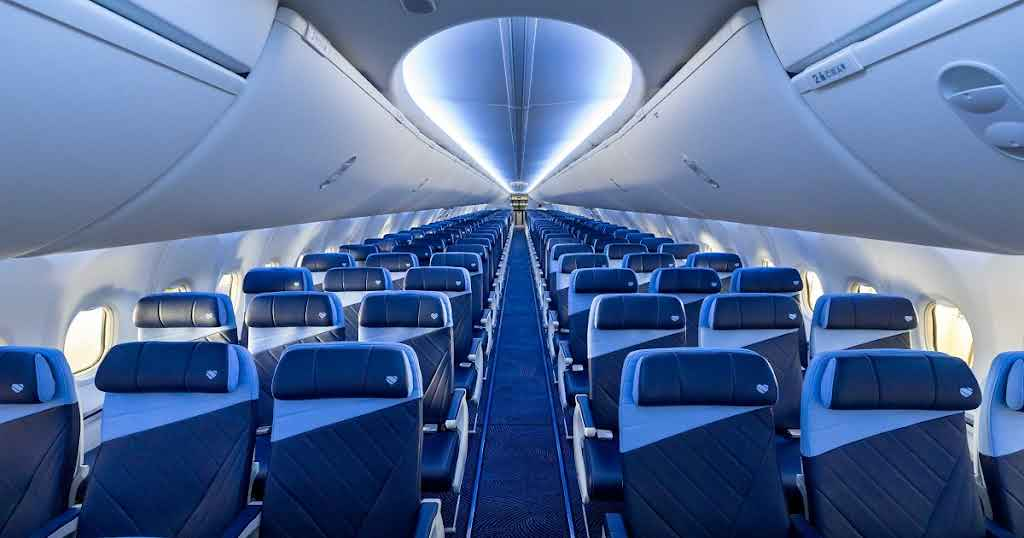
Southwest's Boeing 737 MAX 8 is the airline's newest and fastest-growing aircraft — ~300 in service and climbing, making Southwest the world's largest MAX 8 operator. It carries 175 passengers in the same all-Economy 3-3 layout as the 737-800, with the same seat map and zone structure. Since January 27, 2026, every seat is assigned and the cabin is divided into three zones: Extra Legroom, Preferred, and Standard.
The MAX 8 is the aircraft you want to draw. It's significantly quieter than both the 737-700 and 737-800 thanks to CFM LEAP-1B engines, the fleet averages just 3.5 years old, and — critically — most MAX 8s have USB charging, unlike the 737-800 which mostly doesn't. The cabin layout is identical to the 737-800, so the seat strategy is the same, but the onboard experience is noticeably better.
Two interior versions: The majority have the Heart interior (Collins Meridian seats, Boeing Sky Interior). New deliveries from late 2025 onward have the Elevate interior (RECARO R2 seats, device holders, redesigned tray tables). Both have USB-A and USB-C power — a major advantage over the 737-800. The seat zone structure and advice below applies to both.
Row 1 quirk: On both the Heart and Elevate interiors, Row 1 only has three seats (1D, 1E, 1F). There is no 1A, 1B, or 1C. The real difference between the two interiors is at the exit row: Elevate has all six seats in row 15, Heart has only four.
Our verdict (seats checked 20 October 2026): Best value is 2A or 2F (Extra Legroom, window, rated well on both interiors). Most legroom on the Heart interior is 16A/16F; on Elevate, row 15 and 16 all rate well. Avoid rows 29–30 and 10A. Which interior? Heart has no 15A/15F; Elevate has all six seats in row 15.
Quick Verdict
| Zone | Rows | Seats | Pitch | Perks |
|---|---|---|---|---|
| Extra Legroom | 1–5, 6ABC, 14–16 | 46 | 34" | Premium beverages, enhanced snacks, earlier bin access |
| Preferred | 6DEF, 7–13 | 45 | 31" | Forward cabin, faster deplaning |
| Standard | 17–30 | 84 | 31" | Standard service |
Cabin Overview
The MAX 8 fleet has two interior types, but both are a step up from the 737-800:
Heart Interior (majority of fleet): Boeing Sky Interior with curved ceiling panels and LED mood lighting, Boeing Space Bins, Collins Meridian slimline seats with 4-way adjustable headrests. USB-A and USB-C power at every seat — this is the key amenity advantage over the 737-800 Heart, which has no power at all.
Elevate Interior (new deliveries from late 2025): RECARO R2 seats with multi-adjustable headrests, built-in device holders, redesigned tray tables with dual cupholders, USB-A and USB-C power (standard from factory), larger pivot-style overhead bins, and refreshed Boeing Sky Interior lighting. The Extra Legroom seats on Elevate aircraft have a distinctive sky blue sunray design to visually distinguish them.
Both interiors: Entertainment is streaming-only via the Southwest app on your own device — no seatback screens. WiFi is free for Rapid Rewards members via T-Mobile (free to join). The LEAP-1B engines make the MAX 8 the quietest aircraft in the Southwest fleet — noticeably less cabin noise than the 737-700 or 737-800.
The Three Seat Zones (Post-January 27, 2026)
Southwest sells three seat types at booking. The physical seats are identical in all three zones — the difference is pitch (legroom) and cabin position.
Extra Legroom (Rows 1–5, 6ABC + Exit Rows 14–16)
- Pitch: 34 inches — 3 inches more than Standard/Preferred
- Seats: 46 seats (note: Row 1 has only 3 seats on Heart; Row 15 has only 4 seats on Heart)
- Perks: Complimentary premium beverages (including alcohol), Wonderful Pistachios snack on flights 251+ miles, earlier bin access
- Boarding: Groups 1–2
- Access: Included with Choice Extra fare; A-List Preferred members select free at booking; A-List members can upgrade free within 48 hours of departure; available as paid upgrade on all other fares
Preferred (Rows 6DEF + 7–13)
- Pitch: 31 inches — same as Standard
- Seats: 45 seats
- Perks: Forward cabin position for faster deplaning, same standard snacks
- Boarding: Groups 3–5
- Access: Included with Choice Preferred fare; A-List members select free at booking; available as paid upgrade
Note: Row 6 is a split row — 6A/6B/6C are Extra Legroom with 34" pitch, while 6D/6E/6F are Preferred with 31" pitch.
Standard (Rows 17–30)
- Pitch: 31 inches
- Seats: 84 seats
- Boarding: Groups 6–8
- Access: Choice fare gets free Standard seat at booking; Basic fare assigned at check-in (you get what's left)
Best Seats on the 737 MAX 8
1D, 1E, 1F — First to Deplane, Extra Legroom
Row 1 only has three seats on either interior — all on the right side (D/E/F). These are good seats, though our checks rate them ‘be aware’ rather than best: Extra Legroom pitch, first row so you're first off the plane, and the premium beverage service starts here. 1D gets the aisle, 1F gets the window.
The trade-offs: No underseat storage during takeoff/landing, tray table in the armrest (slightly narrower effective width), and proximity to the forward galley/lav. But for most passengers, being first to deplane outweighs these drawbacks.
2A, 2B, 2C — Extra Legroom Window Side
The left side of row 2 is where 1ABC would normally be — but since those seats don't exist on either interior, row 2 ABC are effectively the first full row on the left side. You get 34" Extra Legroom pitch and you're second off the plane, but the tray table is in the armrest and there is no underseat storage for takeoff and landing. 2A is the prime window seat and rates well; 2B and 2C are fine but rated ‘be aware’ for the narrower armrest tray.
16A and 16F — Unlimited Legroom
On the Heart interior these two window seats behind the overwing exit have virtually unlimited legroom, because 15A and 15F are deleted entirely to meet FAA exit clearance requirements. You get a tray table in the armrest, full recline, and more legroom than any other seat on the aircraft. Our checks rate 16A/16F ‘be aware’ on Heart because of that narrower armrest tray, but they remain the most legroom you can buy. On the Elevate interior 15A/15F exist, so 16A–16F all rate well but none has an open space in front.
The catch: The armrest-mounted tray table makes the seat slightly narrower. And because 16A/16F are classified as Extra Legroom, they require a paid upgrade or status/fare entitlement.
Rows 3–5 (Extra Legroom, Front of Cabin)
Solid Extra Legroom seats with 34" pitch, quick deplaning, and premium service. Rows 3–4 are particularly good for families who want a full row of three together in Extra Legroom.
Row 6 A, B, C (Extra Legroom — Split Row)
6A/6B/6C are the last Extra Legroom seats before the Preferred zone begins. 34" pitch with a standard window seat at 6A. Note that the other side of the aisle (6D/6E/6F) is Preferred with 31" pitch — so this row is split between zones.
14A–14F (Extra Legroom Exit Row — If You Don't Need Recline)
Row 14 has 34 inches of pitch and is designated Extra Legroom, but these seats do not recline because Row 15 is the overwing exit row behind them. For short flights under 3 hours, this is a non-issue. For longer flights, you may want recline.
16B, 16C, 16D, 16E (Exit Row — Reclines)
Unlike 16A/16F with their unlimited legroom, the middle and aisle seats in row 16 have standard-ish pitch. However, the seats in front of them (15B, 15C, 15D, 15E) don't recline, so you effectively get extra usable space. Plus, row 16 middle/aisle seats do recline. Decent picks for aisle passengers who want to stretch.
Seats to Avoid
Row 13 (All Seats) — No Recline
Row 13 is the last row before the overwing exit at row 14. Because of the exit row behind it, no seat in row 13 reclines. On the Elevate interior 13A and 13F are rated ‘avoid’ and the rest of the row ‘be aware’. It's classified as Preferred (31" pitch) but is the worst Preferred row. Row 12 reclines normally; Row 14 at least has Extra Legroom pitch to compensate.
Row 15 B, C, D, E — The Trade-Off Seats
Row 15 only has four seats (15A and 15F don't exist). These four middle/aisle seats have Extra Legroom designation and extra pitch, but they do not recline, have armrest-mounted tray tables (narrower), no underseat storage during takeoff/landing, and fixed armrests. Our checks nonetheless rate all of row 15 well because of the legroom, so treat it as a trade-off rather than a seat to avoid; row 14 has the same no-recline without the narrower seat.
Rows 29–30 (All Seats) — Last Rows
Rated ‘avoid’ for every seat in rows 29–30 (on Heart, 30A/30F are only ‘be aware’). Near the rear lavatories and galley, limited or no recline, engine noise (though the MAX is quieter here than the 737-800), and you'll be last to deplane. If you're assigned a Basic fare seat here, it's the airline's way of encouraging you to buy up next time.
Seat 10A — No Window
10A has a missing window and is rated ‘avoid’ on both interiors. On the Heart interior 7A and 7F have misaligned windows, and 11A/11F and 12A/12F sit over the wing so the view is mostly wing. If you specifically want a window view, avoid 10A; otherwise these are standard Preferred seats.
The Exit Row Deep Dive (Rows 13–16)
This is the most complex section of the cabin and where most passengers get confused. Here's exactly what happens at each row:
| Row | Seats | Zone | Pitch | Reclines? | Notes |
|---|---|---|---|---|---|
| 13 | A B C D E F | Preferred | 31" | No | Last row before exit — no recline |
| 14 | A B C D E F | Extra Legroom | 34" | No | First exit row — extra pitch but no recline |
| 15 | — B C D E — | Extra Legroom | 34" | No | Overwing exit — 15A/15F deleted on Heart (Elevate has all six). Armrest trays, narrower. |
| 16 | A B C D E F | Extra Legroom | 34" | Yes | Heart: 16A/16F = unlimited legroom. 16BCDE = standard Extra Legroom with recline. |
Bottom line: If you're paying for Extra Legroom in the exit area, 16A or 16F are the clear winners. 14A–F are acceptable for short flights. 15BCDE still rate well in our checks despite no recline.
Fare & Seat Selection Strategy
Basic Fare
You won't choose your seat until check-in. You'll likely end up in rows 22–30. Check in exactly at the 24-hour mark to get the best remaining Standard seat. Target row 17–20 if available — still Standard zone but further from the rear lavs.
Choice Fare
You can select any Standard seat at booking. Target rows 17–19 for the best Standard seats (forward of the rear section, away from lavs). You can pay to upgrade to Preferred or Extra Legroom.
Choice Preferred or Choice Extra
Choice Preferred includes a Preferred seat. Choice Extra includes an Extra Legroom seat. For Choice Extra, immediately target 16A or 16F for legroom, or 1D/1E/1F for fastest deplaning, then 2A/2B/2C.
A-List Members
A-List can select Preferred and Standard seats free at booking, and upgrade to Extra Legroom free within 48 hours of departure. Set a reminder for 48 hours before departure and grab 16A/16F if available.
A-List Preferred Members
Can select any seat including Extra Legroom at booking. Book early and lock in 16A or 16F immediately.
Best Seats by Traveller Type
| Traveller | Best Seats | Why |
|---|---|---|
| Tall passengers | 16A, 16F | Unlimited legroom on Heart — no seat in front |
| Quick deplane | 1D, 1E, 1F | First row, first off |
| Solo window | 2A, 3A, 4A | Extra Legroom + window + quick deplane |
| Solo aisle | 1D, 2C, 3C | Extra Legroom + aisle + near front |
| Couples | 2A+2B, 3A+3B | Extra Legroom together + window/middle pair |
| Families (3) | 2ABC, 3ABC | Front Extra Legroom row of three together |
| Families (4+) | 3ABC + 3DEF | Full row across the aisle in Extra Legroom |
| Smooth ride | Rows 14–16 | Over the wing, least turbulence |
| Nervous flyers | 15B/C, 16A/F | Exit row + over-wing stability |
| Budget (Standard) | 17A/F, 18A/F | First Standard rows — decent position, over-wing |
Why the MAX 8 Is the Best Southwest Aircraft to Draw
If you have a choice of aircraft (by choosing different flight times on the same route), the MAX 8 is the best option for three reasons:
Quietest cabin. The CFM LEAP-1B engines are significantly quieter than the CFM56-7B engines on the 737-700 and 737-800. This is most noticeable in the rear cabin — rows 25–30 on a MAX 8 are more tolerable than the same rows on a -800.
USB power at every seat. Most MAX 8s have USB-A and USB-C at every seat (all Elevate interiors do, and most Heart interiors have been retrofitted). The 737-800 Heart interior — which is the vast majority of -800s — has no power at all.
Newest fleet. The average MAX 8 is just 3.5 years old, compared to 10+ years for the 737-800 and nearly 20 years for the 737-700. Newer aircraft means fresher cabins, better-maintained seats, and fewer in-flight issues.
The one thing the MAX 8 doesn't beat is the 737-700's Extra Legroom pitch — the -700 gets 35 inches vs 34 on the MAX 8. But in every other respect, the MAX 8 wins.
Cabin Features & Amenities
- Seats: Collins Meridian slimline (Heart) or RECARO R2 (Elevate), 17" width, ~2" recline
- Pitch: 34" Extra Legroom / 31" Preferred & Standard
- In-seat power: USB-A and USB-C at every seat (most aircraft; verify on older Heart interiors)
- IFE: No seatback screens — streaming via Southwest app on your device
- WiFi: Free for Rapid Rewards members via T-Mobile; $8/device for non-members
- Overhead bins: Boeing Space Bins (Heart) / larger pivot-style bins (Elevate)
- Lavatories: 1 forward + 2 rear (3 total)
- Headrests: 4-way adjustable
- Device holders: Elevate interior only (built into seatback)
Key Facts
| Aircraft | Boeing 737-8 (737 MAX 8) |
| Engines | CFM International LEAP-1B |
| Total seats | 175 |
| Configuration | All Economy, 3-3 |
| Extra Legroom pitch | 34 inches (rows 1–5, 6ABC, 14–16) |
| Standard/Preferred pitch | 31 inches |
| Seat width | 17 inches |
| Recline | ~2 inches (pre-reclined on some aircraft) |
| Lavatories | 3 (1 forward, 2 rear) |
| Fleet size | ~300 active (world's largest MAX 8 fleet) |
| Average fleet age | ~3.5 years |
| Entered service | October 2017 (first in North America) |
| Interior versions | Heart (majority) / Elevate (new deliveries from late 2025) |
| IATA code | 7M8 |
Last updated: 20 October 2026. Seat ratings checked seat by seat against live cabin data.
Elevate Interior Differences
New MAX 8 deliveries from late 2025 onward have the Elevate interior. The key amenity upgrades are RECARO R2 seats with a slimmer profile and multi-adjustable headrests, built-in device holders, redesigned tray tables with dual cupholders, USB-A and USB-C power at every seat (standard from factory rather than retrofitted), larger pivot-style overhead bins, and a refreshed lighting package.
Layout differences from Heart:
- Row 1: Only 1D/1E/1F exist, same as Heart
- Row 15: All 6 seats exist (15A through 15F) — unlike Heart where 15A/15F are deleted
- 16A/16F: Still Extra Legroom but no longer have "unlimited" legroom since 15A/15F are present
- All other rows, zones, and pitch measurements are identical to the Heart interior
How to tell which interior you have: If you see a built-in device holder on the seatback and sky blue sunray striping on the Extra Legroom headrests, you're on an Elevate. If the seat has a plain headrest and no device holder, it's Heart. You can also check the aircraft registration (tail number) against delivery records — any MAX 8 delivered after October 2025 is Elevate.
How to Check Your Aircraft Type
Southwest doesn't always prominently display aircraft type during booking, but you can find it:
- At booking: Look for the aircraft type in the flight details (it may say "Boeing 737 MAX 8" or "7M8")
- On FlightAware/Flightradar24: Search your flight number to see the scheduled aircraft
- At the gate: The aircraft type is displayed on gate monitors
- Visual ID: The MAX 8 has split-tip winglets (upward and downward) vs the 737-800's blended winglets (upward only). The MAX 8 engine nacelles are also noticeably larger.
The IATA code for the Southwest 737 MAX 8 is 7M8. If you see 73W (737-700) or 738 (737-800), you're on a different aircraft with a different seat map (though the 737-800 map is identical).
Best Seats Summary
| Category | Seats | Key Advantage |
|---|---|---|
| Best Overall | 2A / 2F | Extra Legroom + window + second to deplane, rated well |
| Best Window Side | 2A | Extra Legroom + window, rated well (2B/2C are ‘be aware’) |
| Best Legroom | 16A, 16F | Unlimited legroom (no seat in front) |
| Best Standard | 17A/17F, 18A/18F | First Standard rows, decent cabin position |
| Worst Seats | Row 13, Rows 29–30 | No recline (13) / Near lavs, last off (29–30) |
Frequently Asked Questions
Which Southwest 737 MAX 8 seats have the most legroom?
16A and 16F have virtually unlimited legroom because seats 15A and 15F don't exist on the Heart interior (removed for overwing exit clearance). All Extra Legroom seats (rows 1–5, 6ABC, 14–16) have 34" pitch vs 31" in Preferred and Standard.
Is the MAX 8 seat map the same as the 737-800?
Yes. Both have 175 seats in the same configuration with identical zone layouts, row numbers, and exit row structure. The differences are amenities (the MAX 8 has USB power, quieter engines, and a newer cabin), not the seat map itself.
Does the MAX 8 have power outlets?
Most do. All Elevate interior MAX 8s have USB-A and USB-C at every seat. Most Heart interior MAX 8s have been retrofitted with USB power as well — check your seat for a port. This is the biggest amenity advantage over the 737-800, which mostly lacks power.
How can I tell if I'm on a MAX 8 vs 737-800?
IATA code 7M8 = MAX 8, 738 = 737-800. Visually, the MAX 8 has split-tip winglets (extending both up and down) and larger engine nacelles. The 737-800 has blended winglets (upward only). You can also check FlightAware or Flightradar24.
Why doesn't row 1 have seats A, B, and C?
The forward galley sits on the left-hand side of the first row, so there is no room for three seats there. Row 1 only has 1D, 1E, and 1F. The forward galley takes the left-hand side of the row on both interiors.
Is the MAX 8 quieter than the 737-800?
Significantly. The CFM LEAP-1B engines on the MAX 8 are a generation newer than the CFM56-7B on the 737-800 and produce noticeably less cabin noise. This is particularly evident in rear-cabin seats (rows 25–30) and is one reason frequent flyers prefer the MAX 8.
What's the difference between Extra Legroom and Preferred?
Extra Legroom has 34" pitch and includes premium beverages and Wonderful Pistachios snack. Preferred has 31" pitch (same as Standard) but is positioned forward in the cabin for faster deplaning. The seats themselves are physically identical.
Comparable Aircraft
- Southwest Airlines 737-800 Seat Guide — Same seat map, older fleet, most lack USB power
- Southwest Airlines 737-700 Seat Guide — Smaller (137 seats), best Extra Legroom pitch at 35"
- Southwest Airlines Assigned Seating Guide (2026) — Complete overview of the new system, fare bundles, and loyalty perks
- Southwest Frequent Flyer Guide (2026) — A-List benefits, Companion Pass, and credit card seating perks
- American Airlines 737 MAX 8 Seat Guide — AA's MAX 8 with First Class and Main Cabin Extra
- United Airlines 737 MAX 8 Seat Guide — United's MAX 8 with First and Economy Plus