Southwest Airlines Boeing 737-700 Seat Selection Guide (2026)
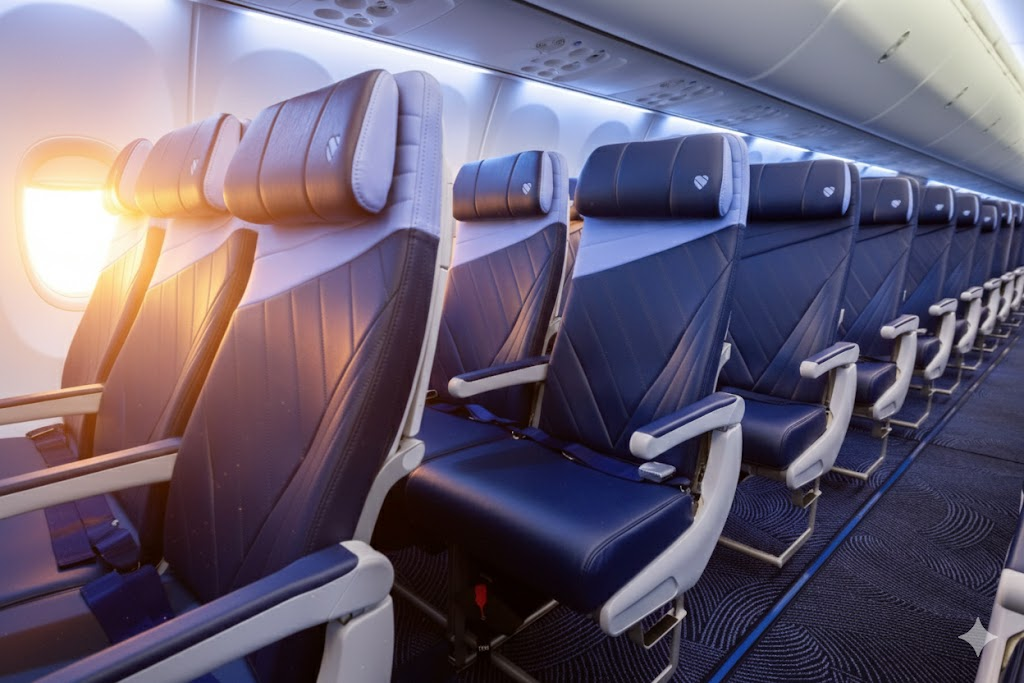
Southwest's Boeing 737-700 is the smallest aircraft in the fleet — 137 passengers in an all-Economy 3-3 layout. It's also the one with the best Extra Legroom seats in the entire Southwest fleet: a full 35 inches of pitch, which is 5 inches more than Standard — no other Southwest aircraft type matches this.
Row numbering quirk: The 2025 retrofit renumbered the cabin — rows skip from 9 directly to 14. There are no rows 10, 11, 12, or 13. Don't be alarmed when the numbers jump.
Since January 27, 2026, every seat is assigned and the cabin is divided into three zones: Extra Legroom, Preferred, and Standard. The 737-700 fleet completed its retrofit in late 2025, with one row removed from the old 143-seat layout to create the dedicated Extra Legroom section at the front.
There's no version lottery on the 737-700. All ~300 aircraft received new Recaro seats during the 2025 retrofit, with USB-C charging, built-in device holders, and redesigned tray tables with dual cupholders. The only thing you won't find is an AC power outlet — bring a USB-C cable.
Quick Verdict
| Category | Recommendation |
|---|---|
| Best Overall | 15A, 15F — exit row, no seat in front, most legroom on any Southwest aircraft |
| Best Solo Window | 2A, 3A, 4A — Extra Legroom + window + quick deplane |
| Best for Couples | 2A+2B, 3A+3B — Extra Legroom window/middle pair |
| Best for Families | 3ABC, 4ABC — full row in Extra Legroom |
| Avoid | Row 14 (no recline), Rows 22–23 (rear lavs), 8F (no window) |
Cabin Overview
All 737-700s now fly with the retrofitted interior featuring Recaro seats in dark blue with a light blue accent on the headrests (Extra Legroom seats have more prominent light blue striping to distinguish them visually). Overhead bins are the pivot-style Boeing Space Bins, and seatback pockets include water bottle holders.
Entertainment is streaming-only via the Southwest app on your own device — there are no seatback screens. WiFi is free for Rapid Rewards members (sign up before boarding — it's free to join). There's no AC power outlet, but every seat has USB-C charging that's powerful enough for laptops.
The Three Seat Zones
Southwest sells three seat types at booking. The physical seats are identical across all zones — the difference is pitch (legroom) and cabin position.
Extra Legroom (Rows 1–6 + Exit Row 15)
Pitch: 35 inches (5 inches more than Standard)
The 737-700 offers the most generous Extra Legroom in the Southwest fleet. While the 737-800 and MAX 8 get 3–4 extra inches, the 737-700 gets a full 5 inches — the result of removing an entire row during the retrofit to redistribute the space.
Extra Legroom is included with the Choice Extra fare or available as a paid upgrade on other fares. Perks include earlier bin access (boarding Groups 1–2), enhanced snacks, and complimentary premium beverages.
The front section (rows 1–6) puts you first off the plane. The exit row (row 15) gives you the same pitch plus the best legroom seat on any Southwest aircraft — more on that below.
Preferred (Rows 7–9 and Row 14)
Pitch: 31 inches (same as Standard)
Preferred seats have the same legroom as Standard but sit in the forward-mid cabin — you'll deplane faster than half the aircraft. Included with the Choice Preferred fare. You board in Groups 3–5.
Row 14 is the last row before the overwing exit at row 15. Be aware: row 14 seats may have limited or no recline due to FAA clearance requirements for the exit row behind them. Seat 14A does not exist on most 737-700s — the exit door structure eliminates it. Row 14 also has only partial seating on the left side (14B and 14C are present).
Rows 7–9 are the better Preferred options — standard pitch, no recline restrictions, and close to the forward exit for deplaning.
Standard (Rows 16–23)
Pitch: 31 inches
The back of the cabin. Standard seats are what you'll get if you buy a Basic fare and don't select a seat — Southwest assigns these at check-in. You board in Groups 6–8 and deplane last.
This isn't necessarily a disaster. Rows 16–17 sit directly behind the overwing exit and offer a smooth ride over the wing. But the last two rows (22–23) are genuinely worth avoiding.
Best Seats
15A and 15F — The Best Legroom Seats on Any Southwest Aircraft
These are the best seats on the 737-700, full stop. Row 15 is the overwing exit row, and seats 15A and 15F are window seats with no seat directly in front of them — seat 14A doesn't exist (the exit door structure eliminates it), and the same applies on the F side. The result is virtually unlimited legroom. You could fully stretch your legs without touching anything.
These are classified as Extra Legroom seats and priced accordingly (typically $38–$41), but they're worth every penny if legroom is your priority. They're the most expensive seats on the aircraft because they combine exit-row space with the "no seat in front" bonus.
Rows 2–4 (Extra Legroom Front Section)
The sweet spot for most travelers. You get 35" of pitch, you're near the front for fast deplaning, and you avoid row 1's quirks (no tray table, no under-seat storage during takeoff/landing). Window seats (A and F) give you a wall to lean against plus cabin views. Aisle seats (C and D) give you easy mobility.
- Best for solo travelers: 2A, 3A, 4A (window + Extra Legroom + fast deplane)
- Best for couples: 2A+2B or 3A+3B (window/middle pair in Extra Legroom)
- Best for families of 3: 3ABC or 4ABC (full row in Extra Legroom)
Rows 5–6 (Extra Legroom Rear Section)
Still 35" pitch but slightly further from the exit. Good backup options if rows 2–4 are taken. Row 6 is the last Extra Legroom row before the Preferred section begins.
Row 15 — The Full Exit Row
All six seats in row 15 are Extra Legroom, but the real prizes are 15A and 15F (the windows). The centre and middle seats (15B, 15C, 15D, 15E) still get exit-row pitch but don't have the "no seat in front" bonus. Note that exit row passengers must be able-bodied and willing to assist in an emergency — you'll be asked to confirm this.
Row 1 — Caveat Emptor
Row 1 has Extra Legroom pitch and you're literally the first person off the plane. But there are real trade-offs: no tray table (the bulkhead wall eliminates it), no under-seat storage during takeoff and landing (bags go in the overhead bin), and proximity to the forward galley and lavatory means more foot traffic and noise. If you need a surface for your laptop or a drink, skip row 1.
Seats to Avoid
Row 14 — The No-Recline Trap
Row 14 is directly in front of the overwing exit at row 15. FAA regulations require seats in front of emergency exits to be fixed upright or have severely limited recline. On a 2-hour domestic flight this is tolerable; on a 5-hour coast-to-coast it's uncomfortable. Row 14 is classified as Preferred, not Extra Legroom, so you don't get extra pitch to compensate. To make matters worse, seat 14A doesn't exist — the exit door structure eliminates it. If you're assigned row 14, at least grab 14F for the window.
Rows 22–23 — The Back of the Bus
The last two rows combine every disadvantage: proximity to the rear lavatory and galley (foot traffic, noise, odors), limited or no recline, reduced overhead bin space (rear bins fill first from back-boarding passengers), you're the last to deplane, and if you're on a Basic fare and didn't choose a seat, this is likely where you'll end up. Row 23 is the worst — avoid all six seats.
Seat 8F — The Missing Window
Seat 8F has a blank fuselage panel where a window should be. If you specifically want a window seat for the view (or to lean against for sleeping), pick 8A instead or move to a different row.
Middle Seats (B and E) Throughout
This applies to every row. Southwest's 737-700 is 3-3, and the middle seats are 17 inches wide with armrest competition on both sides. If you have any choice at all, avoid B and E.
Choosing by Fare and Status
Basic Fare
You don't choose — Southwest assigns your seat at check-in, typically from the remaining Standard seats in the back. If you want any say in where you sit, you need at least Choice.
Choice Fare
Select a Standard seat at booking. Target rows 16–17 for over-wing stability, or 18–19 for a balance of position and distance from the rear lavs.
Choice Preferred Fare
Select a Preferred seat at booking. Rows 7–9 are the best options — decent position, no recline restrictions, and close enough to the front exit. Avoid row 14 (limited recline in front of the exit).
Choice Extra Fare
Select an Extra Legroom seat at booking. Go straight for 15A or 15F for the best legroom on any Southwest aircraft. If those are taken, target rows 2–4 window (A or F) for the best combination of legroom and fast deplaning.
A-List Members
Select Preferred or Standard seats free at booking. Can upgrade to Extra Legroom free within 48 hours of departure — set a reminder and grab 15A, 15F, or 2A if available.
A-List Preferred Members
Select any seat including Extra Legroom at booking. Lock in 15A or 15F immediately when booking. If those are gone, 2A or 3A.
Quick Reference: Best Seats by Traveller Type
| Traveller | Best Seats | Why |
|---|---|---|
| Tall passengers | 15A, 15F | Most legroom on any SW aircraft — exit row, no seat in front |
| Solo window | 2A, 3A, 4A | Extra Legroom + window + quick deplane |
| Solo aisle | 2C, 3C, 4C | Extra Legroom + aisle + quick deplane |
| Couples | 2A+2B, 3A+3B | Extra Legroom together, window/middle pair |
| Families (3) | 3ABC, 4ABC | Full Extra Legroom row together |
| Families (4+) | 3ABC + 3DEF | Full row across the aisle in Extra Legroom |
| Quick deplane | 1A, 1C, 1D, 1F | First row, first off (but no tray table) |
| Smooth ride | 15A/F, 16A/F | Over the wing, least turbulence |
| Nervous flyers | 15A, 15F | Exit row + over-wing stability |
| Budget (Standard) | 16A/F, 17A/F | First Standard rows — decent position, over-wing |
Key Facts
| Aircraft | Boeing 737-7H4 |
| Total seats | 137 (reduced from 143 pre-retrofit) |
| Configuration | All Economy, 3-3 (seats A-B-C, D-E-F) |
| Row numbering | Rows 1–9, then 14–23 (rows 10–13 skipped) |
| Extra Legroom seats | Rows 1–6 + exit row 15 |
| Extra Legroom pitch | 35 inches (5" more than Standard — best in Southwest fleet) |
| Standard/Preferred pitch | 31 inches |
| Seat width | 17 inches |
| Recline | ~2 inches (except row 14: limited/none) |
| Lavatories | 2 (1 forward, 1 rear) |
| Power | USB-C at every seat (no AC outlets) |
| IFE | Streaming via Southwest app (no seatback screens) |
| WiFi | Free for Rapid Rewards members |
| Fleet size | ~300 aircraft |
| Interior | Recaro seats with device holders, dual cupholders, water bottle holders |
| Boarding | 8 numbered groups (replaces A/B/C system) |
737-700 vs 737-800 vs MAX 8: Which Is Better?
The 737-700 is the oldest and smallest aircraft in the Southwest fleet, but it has one clear advantage: the best Extra Legroom pitch. At 35 inches, it offers a full 5 extra inches over Standard — the 737-800 and MAX 8 only offer 3–4 extra inches in their Extra Legroom zones.
The trade-off is capacity. With only 137 seats compared to 175 on the 737-800/MAX 8, the 737-700 flies shorter and thinner routes. You're more likely to see it on flights under 3 hours between smaller cities.
The 737-700 also has only 2 lavatories versus 3 on the 737-800, which means more queuing on longer flights.
If you're specifically seeking Extra Legroom value, the 737-700 is actually the best aircraft to be assigned to.
How to Check Your Aircraft Type
Southwest doesn't prominently display aircraft type during booking, but you can find it:
- At booking: Look for the aircraft type in the flight details (it may say "Boeing 737-700" or "73W")
- On FlightAware/Flightradar24: Search your flight number to see the scheduled aircraft
- At the gate: The aircraft type is displayed on gate monitors
- On the boarding pass: Some boarding passes show aircraft type
The IATA code for the Southwest 737-700 is 73W. If you see 738 (737-800) or 7M8 (MAX 8), you're on a different aircraft with a different seat map.
FAQ
Why do the row numbers skip from 9 to 14?
The 2025 retrofit renumbered the cabin. Rows 10–13 were eliminated to create the dedicated Extra Legroom section. The numbering goes 1–9, then jumps to 14–23.
Are 15A and 15F really the best seats on any Southwest aircraft?
Yes. They combine exit-row pitch (35") with no seat directly in front — seat 14A and the equivalent on the F side don't exist due to the exit door structure. No other Southwest seat type offers this combination.
Does the 737-700 have power outlets?
USB-C at every seat, but no AC power outlets. The USB-C ports are powerful enough for laptop charging. Bring a USB-C cable.
How can I tell if I'm on a 737-700 vs 737-800?
Look for the IATA code: 73W = 737-700 (137 seats), 738 = 737-800 (175 seats). The 737-700 is noticeably shorter. You can also check FlightAware or Flightradar24 by searching your flight number.
Is row 14 worth it?
Only if you have no other options. It's classified as Preferred (31" pitch) but has limited or no recline because the exit row is directly behind it. Seat 14A doesn't exist. If assigned row 14, grab 14F for the window.
Comparable Aircraft
- Southwest 737-800 Seat Guide — The 175-seat workhorse with Heart vs Elevate interior lottery
- Southwest Assigned Seating Guide (2026) — Complete overview of the new system, fare bundles, and loyalty perks
- Southwest Frequent Flyer Guide (2026) — A-List benefits, Companion Pass, and credit card seating perks