United 737 MAX 8 Seat Selection Guide (2026)
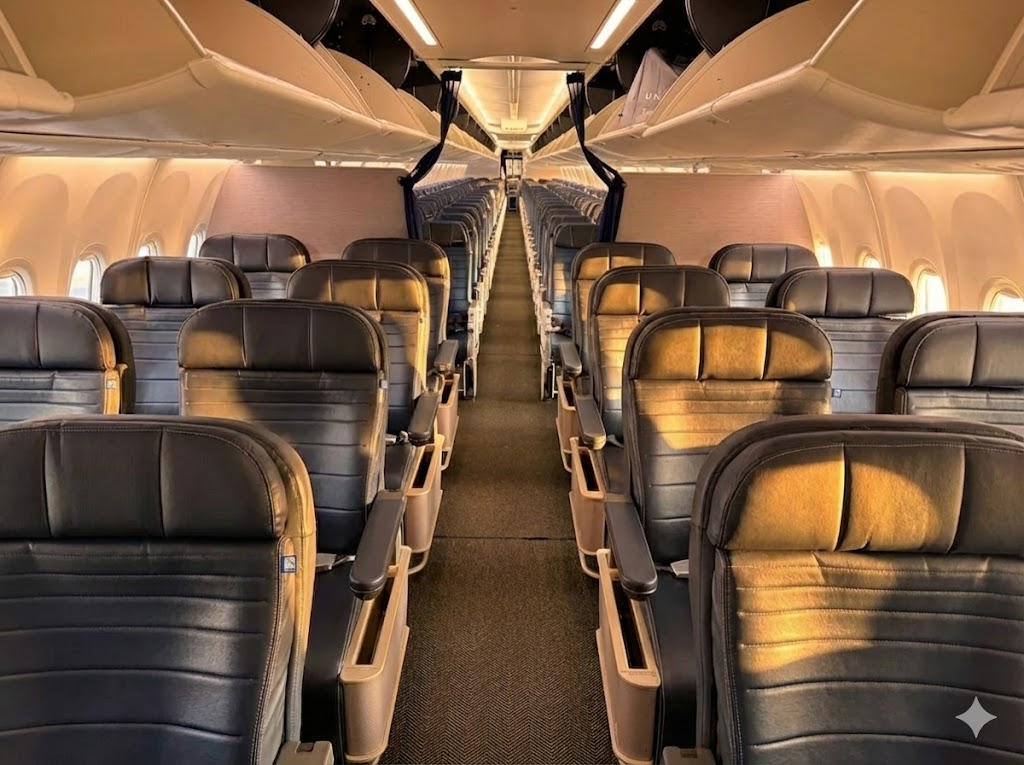
United's Boeing 737 MAX 8 is a core "United Next" aircraft flying domestic and short-haul routes. On paper it's a simple two-cabin jet, but seat selection matters more than you'd expect: the Economy Plus zone is large (54 seats) and the very best legroom rows come with real trade-offs — no recline, a missing window, or an awkward exit-door armrest. This guide gets you to the right seat and steers you clear of the traps.
Quick Verdict
| Aircraft | Boeing 737 MAX 8 (United code 37E) |
| Total seats | 166 — 16 First, 150 Economy (54 Economy Plus) |
| Layout | First 2–2 · Economy 3–3 |
| Version lottery | Low — United's MAX 8 is consistent fleet-wide |
| Best overall | 21A / 21F (exit row: top legroom + normal recline) |
| Best First | 2A / 2F or 3A / 3F |
| Seats to avoid | Rows 37–38 (lavatory + galley), row 11 (no window), row 15 (no recline) |
| IFE | Seatback HD screens throughout (13" First / 10" Economy) + streaming |
| Power | 110V AC + USB-A at every seat; Bluetooth audio |
| WiFi | Viasat Ka-band (reliable browsing/streaming), fleet-wide |
How to Tell You're on the MAX 8
United flies several 737 and A320-family jets that look similar on a boarding pass. Confirm the MAX 8 by:
- Total seats: 166 confirms the MAX 8 (the MAX 9 is larger at 179).
- Aircraft code: shows as "7M8" or "B38M" in your itinerary.
- Cabin pattern: First ends at row 4 → gap → Economy Plus begins at row 7.
- Row numbering: the cabin runs to row 38, with rows 9, 13, 16–19 and 33 not used (16–19 is the overwing exit zone).
Seat maps can still shift with a last-minute aircraft swap, so glance at the map again after any schedule change.
United First (Rows 1–4)
Sixteen Safran cradle recliners in a 2–2 layout, roughly 37" pitch, 20.4" width, 4" recline, with a 13" HD seatback screen, 110V AC + USB-A power, Bluetooth audio, and an adjustable headrest. Seats are lettered A / B on the left and E / F on the right (A and F are windows; B and E are aisles).
Best seats — First
- Best overall: 2A / 2F or 3A / 3F — windows, not bulkhead, not the divider row.
- Best for couples: 2A+2B or 2E+2F (row 3 equivalent).
- Quietest: Row 2 — furthest from both the forward galley and the cabin divider.
- Extra knee room: 1A / 1F — bulkhead space, but see trade-offs below.
Seats to approach with caution
- Row 1 (bulkhead): extra knee room, but no underseat storage (bags go in the bin for taxi, takeoff and landing) and the seats carry seatbelt airbags. Screen sits in the armrest.
- Row 4: closest to the divider and the coach boarding stream — the least restful First row.
Economy Plus (Rows 7–15 and 20–21)
United's extra-legroom economy: same seat as standard Economy but a meaningful pitch bump to about 34" (rising to ~39" in the exit rows), 17" width, 3" recline. This is the best-value zone on the aircraft — if you dodge a few specific rows.
Best seats — Economy Plus
- Best overall: 21A / 21F — exit row: maximum legroom and normal recline; nothing directly ahead.
- Best aisle: 21C / 21D — exit-row legroom with instant aisle access.
- Best for couples: 21B / 21E — exit-row legroom in the middle pair.
- Best solo/quiet: 8A/8F, 10A/10F — forward E+ windows, away from galley and lavatory traffic.
Seats to approach with caution
- Row 7 (bulkhead): extra space, but the tray table and screen live in the armrest (narrower effective width) and the armrests don't raise. Stowage rules are stricter.
- Row 11: this row has no window — a common MAX 8 quirk. Fine for aisle-lovers, frustrating if you want to look out.
- Row 15: sits just ahead of an overwing exit, so these seats do not recline.
- Row 20 (exit row): great legroom, but the window and middle seats (20A/B/E/F) don't recline because an exit is behind them. The aisle seats, 20C and 20D, do recline.
Exit-row rules apply at rows 20 and 21: bags fully stowed for takeoff and landing, and you must meet the physical exit-row requirements. The door structure at 21A/21F can make the armrest feel slightly tight — a small price for the best legroom on the jet.
Economy (Rows 22–38)
Standard 3–3 Economy at about 30" pitch, 17" width, 2" recline, with a 10" seatback screen and power at every seat. Forward is quieter and deplanes faster; the rear collects lavatory and galley traffic.
Best seats — Economy
- Best overall: 22A / 22F — front of Economy: quiet, quick to deplane.
- Best solo: 22A, 23A (or 22F, 23F) — forward windows, minimal traffic.
- Best for couples: 22A+22B or 22E+22F.
- Quietest: Rows 22–24 — furthest from the rear galley and lavatories.
Seats to avoid
- Rows 37–38: immediately beside the rear lavatories — expect noise, odor and queuing; row 38 also backs onto the galley and has reduced recline. The worst seats on the aircraft.
- Row 36: one row better, but still close enough to catch lavatory traffic.
Known Quirks at a Glance
| Issue | Detail |
|---|---|
| Row 11 has no windows | Entire row lacks a window — the standout row to avoid if the view matters |
| Row 15 doesn't recline | Sits directly ahead of the overwing exit |
| Row 20 reclines only on the aisle | 20C/20D recline; 20A/B/E/F do not (exit behind) |
| Row 7 bulkhead trade-offs | Extra space, but tray-in-armrest and fixed armrests narrow the seat |
| 21A / 21F armrest | Exit-door structure makes the armrest feel slightly tight |
| Busy rear cabin | Lavatory queues and galley activity build from row 36 back |
Quick-Pick Summary
| You are… | Book |
|---|---|
| Chasing maximum legroom | 21A / 21F (or 21C/21D for the aisle) |
| Solo and want quiet | 8A/8F or 10A/10F in Economy Plus |
| A couple in Economy Plus | 21B + 21E (exit row) or 8A+8C forward |
| Flying up front | 2A / 2F or 3A / 3F in First |
| On a budget, want a fast exit | 22A / 22F at the front of Economy |
| Wanting a window at all costs | Any window except row 11 |
| Prioritizing recline | Avoid rows 15 and 20 (window/middle) |
FAQ
Does the MAX 8 have seatback screens?
Yes — this United MAX 8 has HD seatback screens throughout (13" in First, 10" in Economy), plus streaming to your own device and Viasat Ka-band WiFi.
Which row has no window?
Row 11. It's the one to avoid if a window matters to you.
Are the exit rows worth it?
Usually yes. Row 21 is the sweet spot — maximum legroom and full recline. Row 20 has the same legroom but the window and middle seats don't recline (the aisle seats do).
Is row 7 a good bulkhead?
It's a trade-off seat: extra space up front, but the tray table sits in the armrest (narrower seat) and the armrests are fixed.
Which Economy seats should I avoid?
Rows 37–38, hard against the rear lavatories and galley. Row 36 is a step better but still catches the traffic.
How do I know it's the MAX 8 and not the MAX 9?
Check for "7M8" or "B38M" in your booking and a 166-seat map (the MAX 9 has 179).