Ryanair Boeing 737-800 Seat Selection Guide (2026)
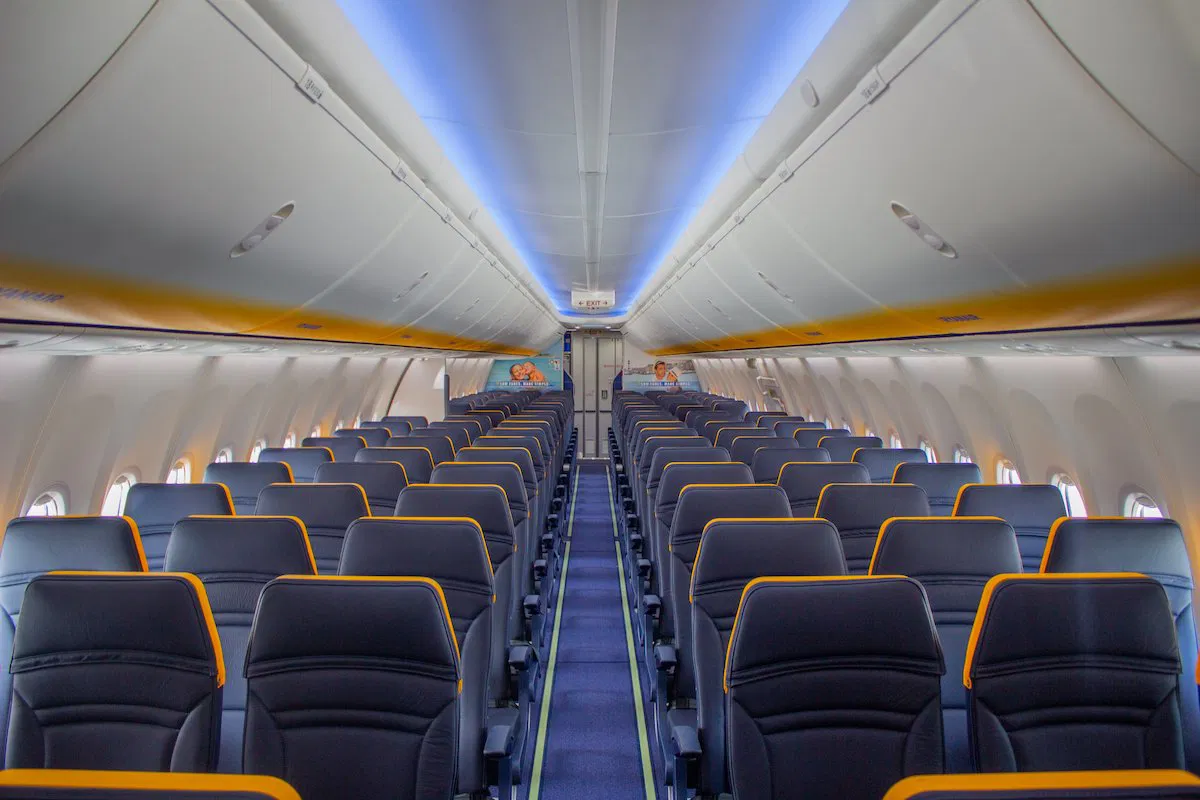
Ryanair's 737-800 is the workhorse of Europe's largest airline — roughly 396 aircraft making it the world's biggest 737-800 operator. Every one of these aircraft has the same all-Economy layout: 189 Zodiac Z110 slimline seats in 3-3 configuration, no seat reclines, no power outlets, no WiFi, no seatback screens. It's bare-bones by design.
But that doesn't mean all 189 seats are equal. The difference between the best and worst seat on this aircraft is enormous — from over 35" of legroom at the exit rows to a cramped, windowless 29" in the middle of the cabin. Ryanair charges between €5 and €37 for seat selection, and knowing where to sit can make the difference between a tolerable 3-hour flight and a miserable one.
The aircraft swap is real. Ryanair frequently swaps 737-800s (189 seats) and 737 MAX 8-200s (197 seats) on the same route with minimal notice. The seat maps are significantly different — exit rows move, row numbering changes, and the MAX has an extra pair of exits. If you've paid for a specific seat, Ryanair will try to place you in an equivalent position, but there are no guarantees. Row 17 is an exit row on both types, making it the safest bet if you want extra legroom regardless of aircraft swap.
💡 Key detail: Row 1 only exists on the left side (1A, 1B, 1C). There is no row 1 on the right side — the forward lavatory and galley occupy that space. The first DEF seats are row 2, where 2D/2E/2F sit behind a bulkhead partition. This asymmetric layout is one of the most important things to understand about this aircraft.
Quick Verdict
| Zone | Rows | Seats | Pitch | Width | Recline |
|---|---|---|---|---|---|
| Extra Legroom (front) | 1 (ABC only) | 3 | ~40" | 17" (tray in armrest) | None |
| Extra Legroom (bulkhead) | 2 (DEF only) | 3 | ~34" | 17" (tray in armrest) | None |
| Front Seats | 2–5 (ABC), 3–5 (DEF) | 24 | 29–29.5" | 17.7" | None |
| Standard (forward) | 6–15 | 60 | 29–29.5" | 17.7" | None |
| Exit Row | 16–17 | 12 | ~35" | 17" (tray in armrest) | None |
| Standard (rear) | 18–33 | 87 | 29.5" | 17.7" (33 narrower) | None |
Total: 189 seats. No seat on any Ryanair aircraft reclines.
The Cabin Layout
The Asymmetric Front
This catches many passengers off guard. Row 1 has only three seats: 1A (window), 1B (middle), and 1C (aisle) on the left side. The right side of the cabin starts at row 2, where 2D (aisle), 2E (middle), and 2F (window) sit behind a bulkhead wall. This means 1A/1B/1C and 2D/2E/2F are both "front row" seats but with different characteristics.
Pitch Asymmetry
An unusual quirk specific to Ryanair's 737-800: the left side (ABC seats) and right side (DEF seats) don't have identical pitch throughout the forward cabin. Per detailed cabin measurements, rows 2–15 on the ABC side have 29.0" pitch, while rows 3–15 on the DEF side have 29.5" — half an inch more. It's marginal, but on an aircraft this tight, every fraction counts. The rear cabin (rows 18–33) is consistent at 29.5" on both sides.
Seat Types
Most of the fleet is fitted with Zodiac Aerospace Z110 slimline seats — the standard European low-cost seat. These have thin padding, a rigid seatback with no recline, and short armrests. Some older aircraft still have Weber C100 seats, which have even less padding and no seatback pocket. There's no way to tell which seat type you'll get until you board.
All seats with extra legroom (row 1, row 2DEF, rows 16–17) have tray tables built into the armrests rather than folding down from the seat in front. This makes the effective seat width narrower than the standard 17.7" — closer to 17" usable width.
Best Seats
Extra Legroom — Front
Best: 2D/2E/2F (bulkhead right side) — These are arguably the best seats on the aircraft for the price. The bulkhead partition provides generous knee space (~34" pitch), you're in the second row so you deplane quickly, and 2D (aisle) gives you easy access. The trade-off: tray table in the armrest (narrower seat), no underseat storage during takeoff/landing, and you're behind the right-side partition so there's a slight enclosed feeling. Seat 2F deserves special mention — it's reportedly the only seat on the aircraft with a usable storage pocket (in the wall), making it a hidden gem.
Very good: 1A/1C — Row 1 has the most raw legroom on the plane (~40" pitch). Seat 1C (aisle) is the better pick — you'll deplane first and have easy access. Seat 1A (window) has a good view but is slightly narrower due to fuselage curvature. 1B (middle) is only worth it if you want legroom badly enough to sit between two strangers. The major drawback: the forward lavatory and galley are immediately adjacent, so expect constant foot traffic, flushing sounds, and galley clatter. You also board last since everyone files past you.
Extra Legroom — Exit Rows
Best: 17D/17E — The centre exit row seats in row 17 give you roughly 35" of pitch with no door-related armrest issues. They're the cleanest extra-legroom option at the overwing exits. You're also equidistant from both exits, which is useful for deplaning.
Very good: 16D/16E and 17A/17F — All exit row seats have excellent legroom. The window seats (16A, 16F, 17A, 17F) have a shortened or missing window-side armrest because of the exit door mechanism — some passengers find this uncomfortable, others don't notice. If the armrest issue bothers you, stick to aisle and middle exit seats.
Good: 16A/16F — Same legroom as 17A/17F with the same armrest trade-off. Row 16 deplanes slightly faster through the front door.
Standard Seats
Best: Row 18 (especially 18D/18E/18F) — The first row behind the exit rows reportedly gets slightly more legroom than standard rows, without any of the exit-row compromises (normal armrests, normal tray table, underseat storage). It's the best-value standard seat on the aircraft.
Good: Rows 3–5 (especially D seats) — These "front seats" cost more than standard but let you deplane quickly. Rows 3–5 DEF have 29.5" pitch vs 29.0" for ABC — pick the right side. Seat 4D or 5D (aisle) are solid choices for a quick exit.
Budget pick: Rows 19–25 (D seats) — Mid-rear aisle seats. Far enough from the lavatories at row 33 to avoid the worst traffic, close enough to the overwing exits. Consistent 29.5" pitch. If you're not paying for a seat and get randomly assigned, this is the sweet spot.
Seats to Avoid
Missing and Misaligned Windows
11A: NO WINDOW. The most notorious seat on any Ryanair aircraft. Due to air conditioning duct placement behind the fuselage wall, seat 11A has a completely blank wall where the window should be. Ryanair now displays a warning during booking ("this seat has no window"), but it's easily missed. If you need a window — for views, light, or to avoid motion sickness — avoid 11A at all costs.
12A: NO WINDOW or severely limited view. Similar issue to 11A. At best you'll get a sliver of the window from the row ahead. Not a true window seat.
12F: NO WINDOW or severely limited view. The right-side equivalent. These three seats (11A, 12A, 12F) are the worst window seats on the aircraft.
Last Row
Row 33 (all seats): The worst row on the plane, full stop. Narrower seats due to fuselage taper, directly adjacent to the rear lavatories and galley. Constant foot traffic, lav door noises, galley smells, and you'll be the last to deplane. If you're randomly assigned here, it's Ryanair's way of encouraging you to pay for a seat next time.
Exit Row Compromises
16A, 16F, 17A, 17F: While these have great legroom, the window-side armrest is shortened or absent due to the exit door structure. For passengers who rely on an armrest (especially on the window side for leaning), this can make the seat genuinely uncomfortable despite the legroom. The tray table is in the opposite armrest, making that one immovable and narrower.
Other Seats to Think Twice About
- 1A/1B/1C (if you dislike noise): Yes, these have the best legroom, but the galley and lavatory proximity is significant. On a full flight with a buy-on-board service running, the forward galley area is busy for the entire flight.
- Rows 31–33 (especially window seats): Fuselage taper begins to affect seat width. Window seats are noticeably narrower. Combined with lavatory proximity, these are the least desirable standard seats.
- Row 15 (A and F): While not terrible, these window seats are immediately in front of the overwing exit rows, so the window alignment can be affected by the wing structure. Views may be partially blocked by the wing root.
Aircraft Swap: 737-800 vs MAX 8-200
This is a critical consideration for Ryanair passengers who pay for specific seats. Ryanair operates both 737-800s (189 seats) and 737 MAX 8-200s (197 seats) and swaps them frequently on the same routes. The MAX 8-200 has eight more seats, an extra pair of exit doors, and a different row numbering system.
Key differences if you get swapped to a MAX 8-200:
- What stays the same: Row 17 is an exit row on both types. This is the single safest seat choice for extra legroom regardless of aircraft swap. The overall 3-3 layout remains identical, and no seats recline on either type.
- What changes: The MAX has exit rows at rows 17/18 AND rows 28/29 (the 737-800 only has exits at 16/17). Row numbering in the rear cabin shifts. The MAX has 197 seats vs 189, with rows extending further back. The MAX also has USB-C power at every seat — the 737-800 has nothing.
- What to do: If aircraft swap risk concerns you, choose row 17 (exit row on both types) or rows 2–5 (front seats on both types). Avoid rows 28–29 if booked on the 737-800 — these become exit rows on the MAX, and your seat assignment may shift.
Amenities (or Lack Thereof)
Power and Connectivity
737-800: Nothing. No USB ports, no AC outlets, no WiFi. Bring a portable battery charger. This is one of the biggest differences vs the MAX 8-200, which has USB-C charging at every seat.
IFE
No seatback screens, no streaming entertainment system. Download content to your device before boarding.
Buy-on-Board
Ryanair operates a trolley service selling food, drinks, and duty-free items. The trolley typically starts from the front, so front-row passengers get first pick. If you're in the rear, popular items may sell out before reaching you. Row 2 passengers are served first and can be at the car hire desk while row 33 is still waiting.
Lavatories
Three lavatories total: one forward (next to row 1), two rear (behind row 33). That's one lavatory per 63 passengers — expect queues on flights over 2 hours. The forward lav is typically less busy (fewer passengers in the front section), but it sits right next to row 1.
Ryanair Seat Selection: Pricing Strategy
Ryanair's seat pricing varies by route, demand, and how far in advance you book. As a rough guide:
- Extra Legroom (rows 1, 2DEF, 16–17): £12–£37 / €12–€37. Includes priority boarding and guaranteed overhead bin space. The most expensive option but the biggest comfort upgrade.
- Front Seats (rows 2ABC–5): £7.50–£22.50 / €7.50–€22.50. Includes priority boarding. Same pitch as standard but you deplane first. Worth it if you have a tight connection.
- Standard (rows 6–33): £4.50–£20 / €4.50–€20. Prices vary by row position. Forward standard rows cost slightly more.
- Random allocation (free): Don't pay and check in between 24 and 2 hours before departure. You'll be randomly assigned — often a middle seat in the back half. Ryanair uses random allocation to incentivise paid seat selection, so expect the least desirable seats.
Tip: If you're travelling with others and don't want to pay, Ryanair will almost certainly separate you. The only way to guarantee sitting together is to pay for adjacent seats.
Ryanair Group Airlines
Ryanair Holdings operates several subsidiary airlines that share the same 737-800 fleet and identical cabin configurations: Buzz (Poland-based), Malta Air (Malta-based), Lauda Europe (Austria-based, flies A320s too), and Ryanair UK. If your flight is operated by any of these, the seat advice in this guide still applies — it's the same aircraft, same seats, same layout.
The Bottom Line
On an aircraft where every seat is hard, non-reclining, and has no entertainment, the differences come down to legroom, noise, and deplaning speed. Here's the hierarchy:
- Tier 1 — Worth paying for: 2D/2E/2F (bulkhead), 17D/17E (exit row centre). These are the sweet spots: significant legroom upgrades without major drawbacks.
- Tier 2 — Good value: 1C (front aisle, if noise doesn't bother you), 16D/16E (exit aisle), row 18 (post-exit bonus legroom).
- Tier 3 — Fine for the price: Rows 3–5 D (front aisle, quick deplane), rows 19–25 D (mid-rear aisle, quiet).
- Tier 4 — Avoid if possible: 11A, 12A, 12F (no windows), row 33 (last row), 1B (front middle seat next to lav).
For flights under 2 hours, almost any seat is survivable. For 3+ hour Canary Islands or Eastern Mediterranean routes, the exit row or front bulkhead seats become much more worthwhile.
Key Facts
| Fleet size | ~396 aircraft |
| Engines | CFM56-7B |
| Total seats | 189 |
| Layout | 3-3 (all Economy) |
| Seat width | 17.7" (17" at extra legroom) |
| Recline | None — all seats fixed |
| Power | None |
| WiFi | None |
| IFE | None |
| Lavatories | 3 (1 forward, 2 rear) |
| Seat type | Zodiac Z110 slimline (some Weber C100) |
Frequently Asked Questions
Do any Ryanair seats recline?
No. Every seat on every Ryanair aircraft (both 737-800 and MAX 8-200) is in a fixed, pre-reclined position. This is actually a benefit in one sense — the person in front of you can never recline into your space.
Is there power on board?
Not on the 737-800. The MAX 8-200 has USB-C at every seat. Since Ryanair swaps aircraft frequently, you can't rely on getting the MAX. Bring a portable charger.
Is there WiFi?
No. Ryanair has no WiFi on any aircraft as of early 2026.
What happens if my flight is swapped to a MAX?
Ryanair will attempt to seat you in an equivalent position, but there's no guarantee of the exact same seat number. Row 17 is an exit row on both types. Front rows (2–5) are comparable.
Why is the left side (ABC) tighter than the right (DEF)?
Due to the asymmetric forward galley and lavatory placement, the row spacing works out slightly differently. The ABC side of rows 2–15 has approximately 29.0" pitch, while the DEF side of rows 3–15 has 29.5".
Are rows 32 and 33 really that bad?
Yes. The fuselage narrows at the tail, making window seats physically narrower. You're beside the rear lavatories (constant queue and noise), and you deplane last. On a packed flight, row 33 is the worst experience on the aircraft.
Last updated: February 2026. Fleet data sourced from ch-aviation and Ryanair corporate disclosures. Seat measurements from community surveys and independent verification. Always check your specific seat map on ryanair.com after booking, as minor variations exist across the fleet.