Vueling A320 Seat Selection Guide (2026)
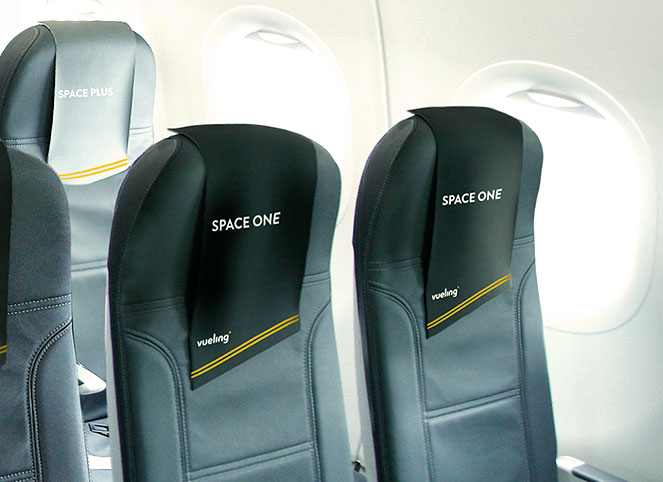
Vueling's Airbus A320 is the workhorse of Spain's largest airline, operating over 300 routes from Barcelona, Paris Orly, London Gatwick, and bases across southern Europe. The fleet includes both older A320ceo and newer A320neo aircraft with meaningfully different cabins — one has USB charging and no recline, the other may recline but lacks USB. Here's exactly which seats to pick and which to avoid on both versions.
Quick Reference
| Detail | A320neo (186 seats) | A320ceo (180 seats) |
|---|---|---|
| Configuration | All-Economy 3-3 | All-Economy 3-3 |
| Seat model | Recaro SL3510 | Varies (older slimlines) |
| Recline | None (pre-reclined) | Some aircraft recline |
| Rows 1–4 pitch | ~30" | ~30" |
| Standard pitch | ~29" | ~29" |
| Exit rows 12 & 14 pitch | ~35" | ~35" |
| Seat width | ~17.7" | ~17.7" |
| USB | Yes (all seats) | Some aircraft only |
| AC power | Rows 1–4 only | Rarely |
| Wi-Fi | Yes (when working) | Some aircraft |
| Seatback IFE | No | No |
| Lavatories | 3 (1 front, 2 rear) | 3 |
The Version Lottery: A320neo vs A320ceo
This matters. Vueling operates roughly 91 older A320ceo aircraft alongside 22 newer A320neo jets — so the majority of flights are still on the older type. There's no way to guarantee which you'll get at booking, and the differences are meaningful:
- A320neo (186 seats): Newer Recaro SL3510 slimline seats that do not recline. USB sockets at every seat. AC power in rows 1–4. LED mood lighting. Airbus SpaceFlex rear galley design frees space for an extra row — which is why it has 186 seats vs 180. That extra row (the last row) has narrower seats and no windows — avoid it.
- A320ceo (180 seats): Older interior with varied seat types. Some aircraft have seats that recline, which is better for comfort but means the passenger in front can invade your already-tight space. USB and power availability is inconsistent. No SpaceFlex design, so the rear cabin has a slightly different layout.
How to tell: Check the seat map at booking. If it shows 31 rows (186 seats), you're on an A320neo. If it shows 30 rows (180 seats), it's an A320ceo. Vueling also operates A321s (220 seats, 40 rows) and a handful of A319s (144 seats) — all with the same seat tier system but different row counts.
Both types share the same exit row structure: rows 12 and 14 are the overwing exits. Row 13 is skipped.
Cabin Layout
The entire cabin is all-Economy in a 3-3 configuration. Vueling sells four tiers of seating:
- Space One (Row 1): Bulkhead row with ~20% more space than standard. Includes priority boarding and a large cabin bag. Tray table in the armrest, making the seat roughly 5cm narrower than other seats. No under-seat storage during takeoff and landing.
- Space Plus (Rows 2–4): ~30" pitch — about 1" more than standard rows. Includes priority boarding and a large cabin bag. AC power sockets available on A320neo aircraft. Standard tray tables on the seat in front.
- Space (Exit rows 12 and 14): ~35" pitch — significantly more legroom. No under-seat storage. Must be able to assist in an emergency. Row 13 does not exist.
- Standard (Rows 5–11, 15–30/31): ~29" pitch on both aircraft types.
Seat Characteristics
Vueling uses Recaro SL3510 slimline seats on A320neo aircraft — the same seat frame used by easyJet. These are thin, firm, and do not recline. The pre-reclined angle is slight. Multiple reviews note the seats feel less padded than competitors, with one reviewer describing them as among the least comfortable LCC slimline seats in Europe despite using the same seat frame as easyJet.
Seat width is approximately 17.7" — identical to easyJet and Wizz Air, and benefiting from the Airbus wide-body fuselage compared to 737-based carriers. All A320neo seats have USB charging ports. Rows 1–4 also have universal AC power sockets. This is a genuine advantage over Ryanair, Wizz Air, and most European LCCs. Wi-Fi is available on some aircraft but is unreliable — do not count on it working.
Best Seats
Best Legroom for the Price: 12A/12F and 14A/14F (Exit Rows)
Exit rows 12 and 14 offer approximately 35" of pitch — a full 6" more than standard seats. At typically €10–15 per seat, this is the best value upgrade on the aircraft. Window seats A and F give you the exit legroom plus a wall to lean against. Row 14 is the better of the two, and the reason is recline, not the view forward: row 12 has the exit-row legroom but cannot fully recline because row 14 sits behind it, while row 14 has the legroom and a full recline. Row 11 is the trap — it takes the recline restriction and gets no extra legroom for it.
Trade-off: No under-seat storage. Bags must go in the overhead bin. The window view is partially obscured by the wing. The overwing area also tends to be slightly noisier.
Best Overall Comfort: 3A/3F or 4A/4F (Space Plus)
Rows 3–4 window seats offer 30" pitch (a modest but noticeable improvement over 29"), plus USB and AC power on neo aircraft. You're close to the front lavatory, first off the plane, and away from the busy rear galley.
Why not row 2? The overhead bins above rows 1–2 are sometimes reserved for crew equipment (safety demo props, first aid kit). Passengers in row 2 have reported being told to stow bags further back in the cabin, defeating the purpose of paying for an upfront seat.
Best If You Don't Pay: 5A/5F or 6A/6F
If assigned a random seat or paying only for standard selection, aim for rows 5–6 on the window. You're still in the front half, close to the forward lavatory, and first section to deplane. On the A320neo, rows 5–11 have the same 29" pitch as the rear, but you avoid the noise, odour, and congestion of the aft galley and lavatories.
Space One (Row 1) — Good but Overpriced
Row 1 has the most raw legroom as a bulkhead row, but the tray table is in the armrest, making the seat approximately 5cm narrower. There's no under-seat storage during taxi/takeoff/landing. At €25+ per seat, the premium over a Space exit row seat (€10–15) is hard to justify when exit rows 12/14 offer comparable legroom without the narrower seat. Row 1 is best for fast deplaning — you're literally first off.
Seats to Avoid
Last Row (Row 31 on A320neo, Row 30 on A320ceo) — Avoid
The final row — particularly on the A320neo with SpaceFlex — has narrower seats due to the fuselage taper and integrated rear galley. No windows. Directly adjacent to the lavatories. This is the worst seat on the aircraft.
Rows 28–30 (Rear Section) — Caution
The rear of the cabin is the lavatory queue zone. Constant foot traffic, galley noise, and odours. On full flights (which most Vueling flights are), this area becomes congested.
Row 1A — Specific Warning
Multiple passenger reports flag 1A as the worst seat in row 1. The proximity to the forward galley and crew area means constant disturbance — crew passing, galley noise, and reduced privacy. If you're booking Space One, prefer 1F (window, right side) or 1C/1D (aisle) instead.
Middle Seats (B and E) Throughout
Standard LCC advice applies: on a full 186-seat aircraft with 29" pitch and non-reclining slimlines, middle seats are uncomfortable. Prioritise window (A/F) or aisle (C/D) over a "better" row with a middle seat.
Vueling vs Ryanair vs easyJet vs Wizz Air
| Vueling A320neo | Ryanair 737 MAX 8-200 | easyJet A320neo | Wizz Air A321neo | |
|---|---|---|---|---|
| Seats | 186 | 197 | 186 | 239 |
| Standard pitch | 29" | 28–29" | 29" | 28–29" |
| Exit row pitch | ~35" | ~35" | ~35" | ~35–37" |
| Seat width | ~17.7" | ~17.2" | ~17.7" | ~18" |
| Recline | No (neo) | No | No | No |
| USB | Yes | No | No | No |
| AC power | Rows 1–4 | No | No | No |
| Wi-Fi | Yes (patchy) | No | No | No |
| Fuselage | Wide (A320) | Narrow (737) | Wide (A320) | Wide (A321) |
Vueling's standout advantage is USB power at every seat and AC power in rows 1–4. No other major European LCC offers this consistently. If you need to work or charge devices, Vueling is the clear winner. The trade-off is that Vueling's seat padding is subjectively thinner than easyJet's despite using the same Recaro frame.
The IAG Connection: Earning Avios
Vueling is part of International Airlines Group (IAG) alongside British Airways, Iberia, and Aer Lingus. This means you can earn Avios on Vueling flights through an Iberia Plus account. The earning rates vary by fare type, but even Basic fares earn some Avios. If you're collecting Avios through BA or Iberia, always link your loyalty account when booking Vueling — it's free points on a budget flight.
Tips for Families
Families with children: Vueling offers a Family fare bundle that includes priority boarding and checked bags. You must pay for adjacent seats to guarantee sitting together.
- Best family seats: Rows 2–4 (Space Plus) for the combination of quick exit, proximity to the forward lavatory, and modest extra legroom. Avoid exit rows — children cannot sit there.
- Bassinet seats: Not available on Vueling.
- Car seats: Check Vueling's current policy, as requirements vary.
Fleet & Route Context
Vueling is Spain's largest airline by fleet size with approximately 141 aircraft, headquartered at Barcelona El Prat. It's the dominant carrier at Barcelona — Spain's busiest airport — and operates over 300 routes across Europe, North Africa, and the Middle East.
The fleet is transitioning: 50 Boeing 737 MAX aircraft are on order through parent IAG, with deliveries starting late 2026. This will make Vueling the first IAG carrier to operate Boeing narrowbodies alongside Airbus, introducing a third seat map type.
Vueling also operates 18 A321-200s and 4 A321neo aircraft with ~220 seats on higher-demand routes. The seat tier system is the same, but exit row locations and row counts differ — check the seat map at booking if your aircraft shows as an A321.
Best Seats Summary
| Best For | Seat | Why |
|---|---|---|
| Best legroom value | 12A/F, 14A/F | Exit rows, ~35" pitch, €10–15 |
| Best overall comfort | 3A/F, 4A/F | 30" pitch, USB + AC power, quick exit |
| Best free/standard | 5A/F, 6A/F | Front cabin, close to lav, quick exit |
| Fastest deplaning | 1C / 1D | Aisle seats row 1, first off |
Frequently Asked Questions
Do Vueling seats recline?
On the newer A320neo: no, all seats have fixed backs. On older A320ceo aircraft: some seats do recline. Check the seat map — 186 seats means neo (no recline), 180 seats means ceo (may recline).
Does Vueling have USB charging?
Yes — all seats on A320neo aircraft have USB ports. Rows 1–4 also have AC power sockets. Older A320ceo aircraft may not have USB.
Does Vueling have Wi-Fi?
Some aircraft offer Wi-Fi, but reliability is inconsistent. Do not rely on it for work or streaming.
Which exit row is better — row 12 or row 14?
Row 14. Both rows have roughly 35" of pitch, but row 12 cannot fully recline because row 14 is directly behind it, and row 14 can. Row 11, immediately ahead of the first exit, is the one to avoid: it inherits the recline restriction without any of the legroom.
Where is row 13?
It doesn't exist. Vueling skips row 13 — exit rows are numbered 12 and 14.
Is Space Plus worth it?
For the legroom alone, not really — it's only about 1" more than standard (30" vs 29"). You're paying mostly for the cabin bag, priority boarding, and front-of-cabin position. If legroom is the priority, exit row seats (rows 12/14) offer significantly more room for less money.
Is Space One (row 1) worth it?
Only if fast deplaning is your priority. The tray table in the armrest makes the seat narrower, and there's no under-seat storage. Exit row seats offer comparable legroom without those trade-offs.
Can I earn Avios on Vueling?
Yes. Link your Iberia Plus account when booking. All fare types earn Avios, though rates vary.
What's the last row on Vueling A320?
Row 31 on the A320neo (186 seats) or row 30 on the A320ceo (180 seats). Avoid both — narrower seats, no windows, adjacent to lavatories and galley.
Is Vueling a budget airline?
Yes — Vueling is a low-cost carrier, but it's positioned slightly above Ryanair and Wizz Air. It's owned by IAG (British Airways, Iberia parent) and offers perks like Avios earning, USB charging, and Wi-Fi that most European LCCs don't. Think of it as the easyJet of southern Europe.
Comparable Aircraft
If you're comparing European low-cost carriers, check these guides:
- Ryanair Boeing 737-800 Seat Selection Guide — 189 seats, narrower 737 cabin. Best: 2D/2E/2F (bulkhead), 17D/17E (exit row).
- Ryanair Boeing 737 MAX 8-200 Seat Selection Guide — 197 seats, Europe's densest 737. Hidden gem: 29A.
- easyJet Airbus A320 Seat Selection Guide — 186-seat SpaceFlex layout, same Airbus cabin width but different exit row setup.
- Wizz Air A321neo Seat Selection Guide — 239 seats, densest A321 in the sky. Exit rows 1, 18–19, 29.