Air France A320 Seat Selection Guide (2026)
✈️ Quick Verdict
Aircraft: Airbus A320 — two configurations, 34 aircraft between them
Config: 174 seats — the "Euro" cabin, 26 aircraft · 178 seats — the "Métro" cabin, 8 aircraft
Layout: 3-3 throughout, one seat type · Business is a moving curtain and a blocked middle seat, not a different chair
Version lottery: Yes — and it moves the exit rows. Exits at rows 11 and 12 on the Euro; rows 12 and 14 on the Métro
The one-look test: check the back of the seat map. Ends at row 30, six across → Euro. Ends at row 32 with only two seats → Métro
Best in Economy — Euro: all of row 12, plus 11C and 11D — extra legroom that still reclines
Best in Economy — Métro: all of row 14, plus 12C and 12D
Seats to avoid — Euro: rows 29 and 30 (narrower seats hard against the lavatories) · 10A, 10B, 10E, 10F (no recline, no extra room)
Seats to avoid — Métro: 32A and 32B (two-seat stub row at the lavatory, no window at 32A) · 11A, 11B, 11E, 11F
IFE: no screens in either cabin · WiFi: Ku-band satellite, fitted fleetwide · Power: USB-A under the seat on retrofitted frames, nothing on some older ones, no AC anywhere
Four seats apart, and the exit rows are in different places
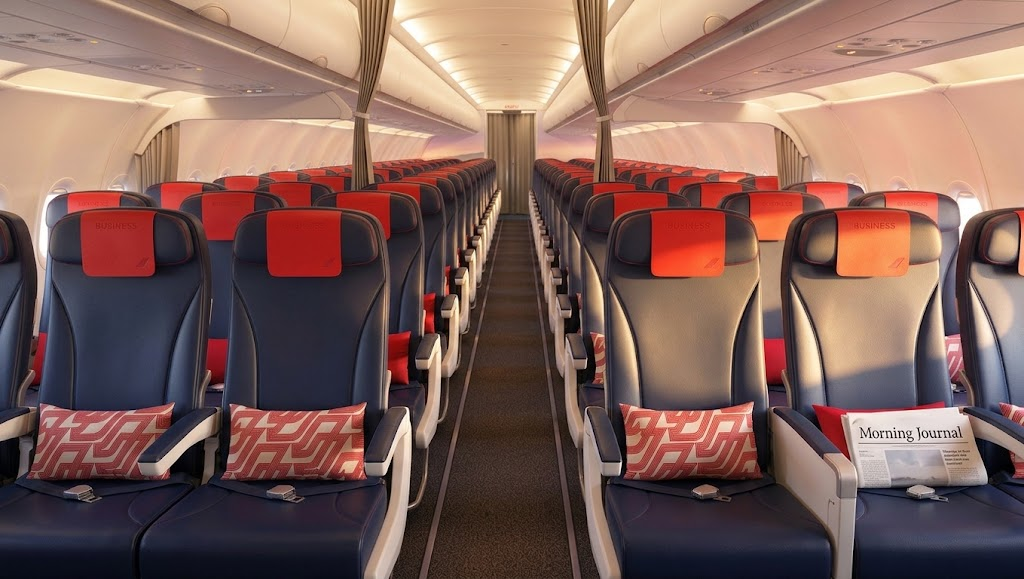
Air France flies 34 A320s in two cabins. Twenty-six of them are the 174-seat "Euro" layout; eight are the 178-seat "Métro". Both are 3-3 all the way down in a single seat type, with a curtain near the front that Air France slides forward or back depending on how much business demand a given flight has. There is no separate business seat — the product is a blocked middle, a better meal and a moving curtain.
Four seats between two cabins sounds like nothing, and if the difference were only capacity it would be. It isn't. The extra rows push the whole economy cabin one row back on the Métro, and the overwing exits move with it. On the Euro the exit pair is rows 11 and 12. On the Métro it is rows 12 and 14. Everything that matters about a short-haul narrowbody seat — the legroom, the recline, which seat is worth paying for — is attached to those two rows.
Row 12 is the clearest example. On the Euro it is the best economy row on the aircraft: extra legroom on all six seats, and no exit behind it, so every seat reclines. On the Métro row 12 is the first exit row — it has the legroom, but 12A, 12B, 12E and 12F cannot fully recline. Same seat number, same airline, same route, opposite answer.
What the same seat number is worth on each aircraft
| Seat | On the Euro (174) | On the Métro (178) |
|---|---|---|
| 10A | First economy row. No extra legroom, and no recline — exit behind | Still inside the business curtain zone |
| 11A | Extra legroom, exit row. No full recline | First economy row. No extra legroom, and no recline |
| 11C | Extra legroom and full recline — one of the two best aisle seats | An ordinary aisle seat |
| 12A | Best economy seat on the aircraft — extra legroom, full recline | Extra legroom, exit row. No full recline |
| 12C | Extra legroom, full recline | Extra legroom and full recline — one of the two best aisle seats |
| 14A | Ordinary row, and the window rates below its neighbours | Best economy seat on the aircraft — extra legroom, full recline |
Neither cabin has a row 13. Both jump straight from 12 to 14, which is why the Métro's second exit row is numbered 14 rather than 13 — it is physically the next row along.
How to tell which version you're on
The seat total is not much use: 174 against 178 is a difference you will not notice on a booking page, and neither number is printed anywhere you look. There are three reliable tells, and the first one takes a second.
1. Look at the back of the seat map
This is the fastest and it is unambiguous. The Euro's last row is row 30, and it is a full six seats across. The Métro runs two rows further, to row 32, and that last row has only two seats — 32A and 32B. The row above it, row 31, is missing its C seat. If the tail of the map narrows to a stub, you are on a Métro.
2. Look at row 1
The Euro's row 1 is a full six seats. The Métro's row 1 has only D, E and F — there is no 1A, 1B or 1C. That gives the Métro's front row an unusual property, covered below.
3. Look up, once you're aboard
The Euro cabins have been fitted with larger Safran ECOS shelf bins — deep, low-lipped overhead lockers whose doors do not swing out into the aisle. The Métro keeps the standard A320 bins. If you are already boarding, that is the difference you can see from the door. It also means the Euro is the one to be on if you are travelling with a roll-aboard on a full flight.
The business cabin is a curtain, and the seat count proves it
Air France's short-haul business is the standard European arrangement: the same seat as everyone else, with the middle of each row left empty, and a curtain that moves according to how many business fares sold. On the Euro that curtain can go back as far as row 9, and on the Métro as far as row 10.
The arithmetic is worth seeing, because it explains a number that confuses people. The Euro's front zone contains 54 physical seats — nine rows of six. The most Air France will ever sell as business is 36: nine rows of four, with B and E blocked. The Métro's front zone has 57 physical seats and a cap of 38, which is nine rows of four plus 1D and 1F. Whenever you see 54 or 57 quoted as the business capacity of an Air France A320, that is the seat frame count, not the number of people who can buy it.
On the day, the curtain sits wherever demand put it. If you are in economy and the curtain lands just ahead of you, you get the front of the aircraft at an economy fare, which is the best outcome available on either jet.
Front-row notes
- Row 1 on both cabins loses its underseat storage and puts the tray table in the armrest, which costs you a little seat width. That is the standard bulkhead trade.
- 1D, 1E and 1F on both cabins sit against a galley — noise and light during the service.
- 1C on the Euro has a bulkhead that is only 55% solid, so there is genuine extra floor space on its right-hand side. It is the best of the Euro's six front-row seats.
- 1D and 1F on the Métro are unusual: with no A, B or C seats at row 1 at all, there is nothing across the aisle from you. Only two of the three are sold, so if business is open and the curtain is behind row 1, these are the roomiest seats Air France sells on the A320. The galley is the price.
Economy on the Euro — rows 10 to 30
Row 12 is the row to take. All six seats have extra legroom, and because there is no exit behind it, all six recline normally. It is the only row on the aircraft with both.
11C and 11D are next. Row 11 is the first exit row: 11A, 11B, 11E and 11F get the legroom but cannot fully recline, because the path to the door has to stay clear. The two aisle seats sit outside that path, so they keep both.
Row 10 is the trap. It is the first row of economy, it sits directly behind the business curtain zone, and on a seat map it looks like a good place to be. But 10A, 10B, 10E and 10F are in front of the first exit, so they carry the recline restriction — without the extra legroom that rows 11 and 12 get. It is the worst combination on the aircraft: standard pitch, fixed seatback. 10C and 10D are unaffected and are perfectly ordinary aisle seats.
Behind the exits, rows 14 to 27 are the standard cabin. Two things to know. The rows here are drawn noticeably tighter than the rows ahead of the exits — if legroom is the deciding factor and rows 11 and 12 are gone, prefer a low row number over a high one. And 18A, 18F, 21A and 21F have the best windows in the cabin, while 14A, 14F, 17A and 17F rate below their neighbours on window alignment.
The back is where the Euro is genuinely bad. Row 28 has the lavatory queue behind it. Rows 29 and 30 are the two worst rows on either aircraft — every seat in both is flagged as slightly narrower than standard and immediately adjacent to the lavatory, with noise, odour and queuing traffic. 30B, 30C, 30D and 30E add the rear galley on top. That is twelve seats to step past.
Economy on the Métro — rows 11 to 32
The same shapes, one row back. Row 14 is the row to take — extra legroom on all six, full recline on all six. 12C and 12D are the exit-row aisle seats that keep their recline. 12A, 12B, 12E and 12F get the legroom without it.
Row 11 is the Métro's trap — first economy row, no extra legroom, and 11A, 11B, 11E and 11F cannot fully recline because row 12 is an exit. Exactly what row 10 is on the Euro.
Through the middle of the cabin, 20A and 20F have windows set behind the seat — you have to lean back to see out. 21A, 21F, 24A, 24F, 29A and 29F have the best windows on the aircraft. The Métro's rows are drawn at a constant spacing from the front of the cabin to the back, so unlike the Euro there is no penalty for sitting further aft.
Except at the very end. Row 31 has no C seat, and 31A and 31F have no window at all — wall only. 31D and 31E back onto the galley. Then row 32, which is two seats: 32A and 32B, hard against the lavatory door, with 32A also windowless. They are the last two seats on the aircraft in every sense.
Cabin features — both versions
| Euro — 174 seats | Métro — 178 seats | |
|---|---|---|
| Aircraft | 26 | 8 |
| Rows | 1–30 (no 13) | 1–32 (no 13) |
| Business curtain reaches | Row 9 — max 36 sold | Row 10 — max 38 sold |
| Exit rows | 11 and 12 | 12 and 14 |
| Best economy row | 12 | 14 |
| Row 1 | Six seats | Three — D, E, F only |
| Last row | 30 — six seats, all rated poorly | 32 — two seats, 32A windowless |
| Overhead bins | Larger Safran ECOS shelf bins | Standard |
| Rear-cabin spacing | Tighter behind the exits | Constant front to back |
| Screens | None — neither cabin | |
| WiFi | Ku-band satellite, fitted across both sub-fleets | |
| Power | USB-A under the seat on retrofitted frames; some older aircraft have none. No AC. | |
Neither cabin has seatback screens. Air France's short-haul entertainment is whatever you brought, so the power question matters more than it usually would — and it is the one thing about this aircraft you cannot check in advance. Charge before you board.
Quick-pick summary
| If you are… | On the Euro | On the Métro |
|---|---|---|
| Paying for legroom | Row 12 — any seat | Row 14 — any seat |
| Legroom on the aisle | 11C or 11D | 12C or 12D |
| Wanting a good window | 18A, 18F, 21A, 21F | 21A, 21F, 24A, 24F, 29A, 29F |
| Hoping the curtain lands behind you | Rows 7–9 | Rows 8–10 |
| Off the aircraft fastest | 10C or 10D | 11C or 11D |
| Travelling with a big carry-on | Anywhere — the ECOS bins are the deep ones | Board early |
| Avoiding the worst of it | Not rows 28, 29 or 30 | Not rows 31 or 32 |
Frequently asked questions
What is the difference between Air France's Euro and Métro A320?
Four seats on paper — 174 against 178 — but the real difference is that the Métro's economy cabin starts one row further back, which moves the overwing exit rows from 11 and 12 to 12 and 14. The Métro also has a three-seat row 1 and runs two rows further at the back; the Euro has larger Safran ECOS overhead bins.
Which is the best seat in economy on an Air France A320?
Row 12 on the Euro, row 14 on the Métro. On both aircraft that is the second exit row: it has the extra legroom, and because there is no exit behind it, all six seats still recline. Everything else in the cabin gives up one or the other.
How do I tell which A320 I'm booked on?
Look at the back of the seat map. The Euro ends at row 30 with a full six seats. The Métro runs to row 32 and its last row has only two, 32A and 32B, with row 31 missing its C seat. If you would rather look at the front: the Métro's row 1 has no A, B or C.
Is Air France's short-haul business class a different seat?
No. It is the same seat as economy with the middle of the row blocked and a curtain in front, moved forward or back to match demand. The curtain can reach row 9 on the Euro and row 10 on the Métro. That means at most 36 or 38 business seats are ever sold, even though the front zone contains 54 and 57 seat frames respectively.
Which seats should I avoid?
On the Euro: rows 29 and 30 — all twelve seats are slightly narrower than standard and sit immediately against the lavatories — plus 10A, 10B, 10E and 10F, which cannot fully recline and get no extra legroom for it. On the Métro: 32A and 32B, the two-seat stub row at the lavatory, and 31A and 31F, which have no window at all.
Is there wifi and power?
Ku-band satellite wifi is fitted across both sub-fleets. Power is less certain: retrofitted frames have USB-A sockets under the seat, some older aircraft have nothing at all, and there is no AC outlet on either version. There are no seatback screens in either cabin.
Related Guides
- Air France Airbus A220-300 Seat Selection Guide (2026)
- Air France Boeing 787-9 Seat Selection Guide (2026)
- Lufthansa A320 Seat Map & Best Seats (2026)
- easyJet Airbus A320 Seat Selection Guide (2026)
- Vueling A320 Seat Selection Guide (2026)
- Air France A321 Seat Selection Guide (2026)
- Air France A319 Seat Selection Guide (2026)