Iberia Airbus A330-200 Seat Selection Guide (2026)
✈️ Quick Verdict
Aircraft: Airbus A330-200 — 19 aircraft, more than twice Iberia's A330-300 fleet, one configuration
Config: 288 seats — 19 Business Plus, 269 Turista. No premium economy
Layout: Business Plus staggered 1-2-1, rows 1–5 · Turista 2-4-2, rows 21–56
Seat letters: A C / D E G H / J L — B, F, I and K are skipped. There is no seat 5J, rows 21 and 22 have no centre block, and rows 52–55 have no G
Version lottery: No. All nineteen aircraft carry the same cabin
Best in Business: 2L — window-side stagger with the best window in the cabin · 1J and 5C · 1E and 1G for a couple
Best in Turista: 23D and 23H — centre bulkhead, 29in of clear floor · 23A and 23L · 22A with 22C for two
Seats to avoid: Rows 39 and 40 — fourteen seats, all rated avoid · 38J and 38L · 4H, 4L and 5G in Business · 21A and 21L (an exit door in half the seat width)
IFE: Panasonic eX2, audio and video on demand · WiFi: Gogo 2Ku satellite, 10–40 Mbps, fleetwide
Fourteen seats in a row, all of them rated avoid
Somewhere around the middle of a 269-seat cabin, a booking map for Iberia's A330-200 shows rows 38, 39 and 40 as ordinary Turista. They are the same price as row 37 and the same price as row 42. Nothing distinguishes them.
Rows 39 and 40 are, in their entirety, immediately adjacent to a lavatory bank — every one of the eight seats in row 39 and every one of the six in row 40, plus 38J and 38L behind them on the right. Fourteen consecutive seats, plus two, carrying the same flag: noise, odours and a permanent queue standing over you. That is the largest uninterrupted block of bad seats on the aircraft, and it sits in the middle of the cabin rather than at the back where a passenger would look for it.
The tell is row 40's width. Row 40 has six seats where every row around it has eight — the J and L positions simply do not exist, because the lavatories occupy that space. If you are looking at a seat map and see a row that suddenly loses its right-hand pair, that is where the toilets are, and the two rows in front of it are the ones to skip. 39A and 39L also have badly placed windows, so the two seats you might take specifically for the view are the worst of the fourteen.
Row 41, immediately behind, is the compensation: it is the bulkhead row with extra legroom for all eight seats. It still catches lavatory traffic from ahead — every seat in it is flagged for that — but you get real space in exchange. 41C is the cleanest seat in the row: extra legroom, no seat back in front, and nothing against it beyond the tray table living in the armrest.
The four-seat mini cabin most people never see
Turista starts at row 21, and rows 21 and 22 are unlike anything else in the cabin. They have no centre block at all — four seats wide, A and C on the left, J and L on the right, with open floor where the D-E-G-H bank would be. Two small pairs of seats sitting on their own at the front of a 269-seat cabin.
22A and 22C are the best pair of seats in Turista for two people travelling together. A two-seat pair with an aisle on one side and a window on the other, no middle seat, no four-across bank beside you, at the very front of economy. 22J and 22L are the identical pair on the right. The only flag anywhere in row 22 is a bassinet position one row ahead, and it applies to the aisle seats 22C and 22J — 22A and 22L carry nothing at all. They are ordinary Turista seats at ordinary Turista prices, and structurally they are the closest thing to a premium pair on the aircraft.
Row 21 is the same mini cabin one row forward, and it is the trap. All four seats carry extra legroom with no seat back in front — and 21A and 21L each have an exit door extending into about half the seat width, 30 to 35cm ahead of them. You are paying attention to the legroom and not to the fact that half of it has a door in it. 21C and 21J are the two to take in row 21: same extra legroom, no door, and 21C only picks up galley noise from ahead.
The bulkhead row a seat map shows as ordinary economy
Because rows 21 and 22 have no centre seats, the centre block of Turista does not begin until row 23 — and that means 23D, 23E, 23G and 23H are facing a bulkhead with nothing in front of them at all.
All four have 74cm — 29 inches — of clear floor to the wall. That is not "extra legroom" in the sense of an inch or two; it is nearly a full seat pitch of open space, in the centre of the cabin, at standard Turista price. Every one of the four is rated good. 23D and 23H are the picks: both get a partial bulkhead covering only about 75% of the seat, so they also have genuine open floor on one side. 23E and 23G are bassinet positions — take them only if the infant is yours.
The costs are the standard bulkhead costs: no underseat storage, so your bag goes overhead for the flight, and the tray table and screen live in the armrest, which narrows the seat. On a nine-hour flight to Latin America that trade is worth making.
23A and 23L are the window version of the same row — rated good, with the best-aligned windows in the forward cabin. They sit behind row 22 rather than a bulkhead, so no extra legroom, but they are the two best plain window seats in Turista.
Business Plus — 19 seats, and three of them back onto the lavatories
Iberia's A330-200 business cabin is a staggered 1-2-1 across rows 1 to 5, every seat with direct aisle access, fully lie-flat. Published specs give 78 inches of bed length and around 22 inches of width. There are no privacy doors on the A330 — those are on the newest A350-900s only.
It is nineteen seats, not twenty. Rows 1 to 4 carry four seats each; row 5 carries C, E and G only. There is no seat 5J. If you are counting rows to work out how far back you are, that missing seat is why the arithmetic does not come out.
How the stagger works
Because the cabin staggers, the seat letters alternate row to row and the two positions are genuinely different seats.
- Even rows (2 and 4) use A and L. These sit hard against the fuselage with the side console between you and the aisle — the enclosed, private half of the cabin. If privacy matters, book an A or an L.
- Odd rows (1, 3 and 5) use C and J. These sit further inboard, closer to the aisle, less enclosed, and easier to get in and out of.
- The centre pair alternates too. In odd rows it is E and G, which sit close together — the couple's seats. In even rows it is D and H, which are pushed apart by the stagger, so each is effectively a solo seat with a console beside it.
The back right corner of the cabin is where the lavatories are. 4H and 4L sit immediately against the lavatory door, and so does 5G, which also has the galley behind it. All three are rated avoid. 5E picks up both the lavatory and the galley without being right against the door, and 3J catches lavatory traffic from behind. That is five of nineteen seats compromised, all of them in the same corner — and in a five-row cabin, "row 4" does not read as "the back".
2L is the best seat in the cabin. Window-side stagger, so it is the enclosed position; rated good; and it carries the best-aligned window in Business Plus. 1J is the equivalent on the aisle-side stagger with an equally good window, and 5C is the third — the last row on the left, clear of the lavatories, which are all on the right, and with a perfectly placed window. 2A, 1C, 3C and 4A are the next tier, all rated good.
Travelling as a couple? Take 1E and 1G or 3E and 3G — the odd-row centre pairs sit close together, both rated good, and both have their own aisle so neither of you is ever climbing over the other. Avoid 5E and 5G, which are the same pair one row back and both compromised. Travelling alone and want to be left alone? 2A, 2L or 4A — the even-row window seats, enclosed by the console.
Turista — 2-4-2 across rows 21 to 56
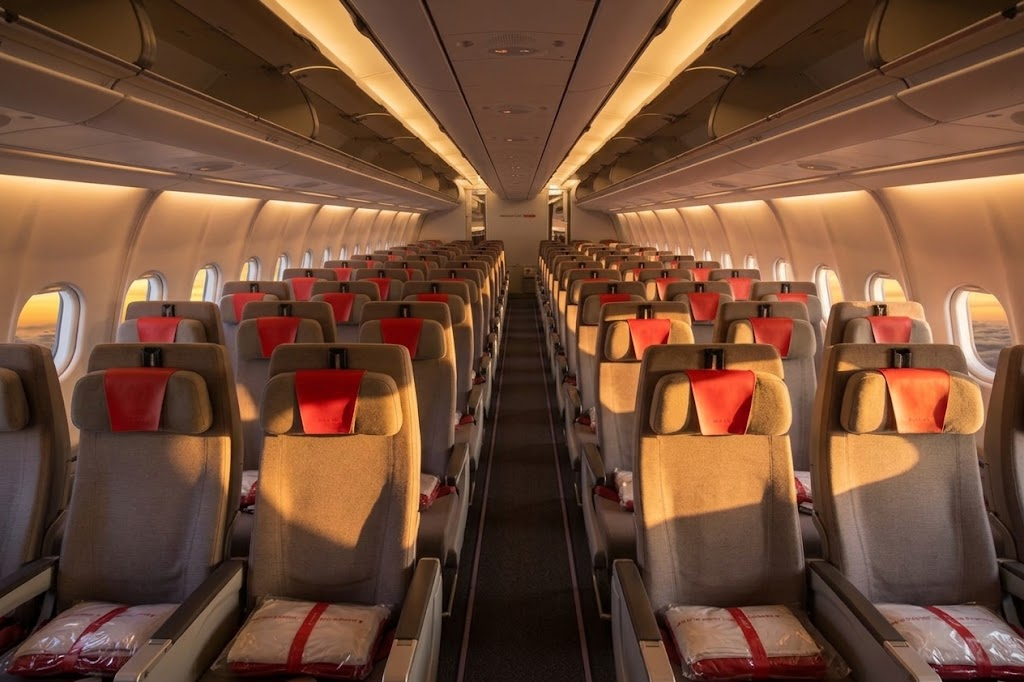
Iberia quotes 31 inches of pitch and 18.1 inches of width in Turista, which for a 2-4-2 A330 is at the generous end of what European long-haul offers — and an inch more pitch than Iberia's own A350-900. The 2-4-2 itself is the structural advantage: every window seat is one seat from an aisle, so nobody in the cabin is more than one person deep, and 52% of the cabin has direct aisle access.
Where the good windows are
Window alignment moves around this cabin more than most. The best-aligned window seats are 23A, 23L, 46A, 46L, 48A, 48L, 53A and 53L. 21A and 21L are perfectly aligned too, but they are the two seats with the exit door in them — take the window, not the row. The ones to skip if a view is what you want are 27A, 27L, 32A, 32L, 43A and 43L, where the window sits badly relative to the seat, plus 39A and 39L, which have the window problem on top of the lavatory problem.
Between them, rows 24 to 37 and 42 to 51 are the clean stretches — no flags of any kind across most of both blocks. If you want an unremarkable seat and nothing else, that is where to look.
The back of the aircraft
From row 52 the fuselage narrows and the cabin loses its G column, running seven across rather than eight — A, C / D, E, H / J, L. Row 56 is the last row and it is three seats: 56D, 56E and 56H only. None of the rear rows carries a flag, which is unusual: the rear lavatories on this aircraft do not sit behind the last row, so rows 52 to 56 are quieter than the back of most widebodies. 53A and 53L are genuinely good window seats back there.
Cabin features
| Business Plus | Turista | |
|---|---|---|
| Seats | 19 | 269 |
| Rows | 1–5 | 21–56 |
| Layout | Staggered 1-2-1 | 2-4-2 |
| Pitch | 78in, fully flat | 31in |
| Width | ~22in | 18.1in |
| Direct aisle access | 100% | 52% |
| Privacy doors | No — A350-900 only | — |
| IFE | Panasonic eX2 on demand | Panasonic eX2 on demand |
| WiFi | Gogo 2Ku, 10–40 Mbps | Gogo 2Ku, 10–40 Mbps |
| Seats rated avoid | 3 — 4H, 4L, 5G | 16 — 38J, 38L, rows 39–40 |
Quick-pick summary
| Travelling as | Take | Why |
|---|---|---|
| Solo in Business | 2L, then 2A or 4A | Even-row window stagger — enclosed by the console, and 2L has the cabin's best window |
| Couple in Business | 1E and 1G, or 3E and 3G | Odd-row centre pairs sit close together; both seats keep their own aisle |
| Legroom in Turista | 23D or 23H | 29in of clear floor to the bulkhead, plus open floor on one side, at standard price |
| Couple in Turista | 22A and 22C, or 22J and 22L | A pair on its own in a four-seat-wide mini cabin — no middle seat, no bank beside you |
| Window in Turista | 23A, 23L, 46A, 48A or 53A | The best-aligned windows in the cabin, and one seat from an aisle in 2-4-2 |
| Family of four | Centre block, rows 24–37 | D-E-G-H seats four across, no aisle crossings, and the whole block is unflagged |
| Wants the back and quiet | Rows 52–55 | Seven across, no lavatory behind the last row — unusually clean for a rear cabin |
| Anyone | Not rows 39 or 40, not 38J or 38L, not 21A or 21L | A fourteen-seat lavatory block in mid-cabin, and an exit door in half a seat |
Entertainment, power and WiFi
Entertainment is Panasonic eX2 with audio and video on demand at every seat in both cabins. Connectivity is Gogo 2Ku Ku-band satellite WiFi, fitted across the whole A330-200 fleet and rated at 10 to 40 Mbps — enough to stream, and consistent, since there is no partially-equipped sub-fleet to gamble on.
Frequently asked questions
Does Iberia fly more than one A330-200 cabin?
No. All nineteen aircraft carry the same 288-seat layout: 19 Business Plus and 269 Turista, with no premium economy. Whatever the booking shows is what you get — which is not true of Iberia's A350-900, where two sub-fleets run 348 and 352 seats.
How is the A330-200 different from Iberia's A330-300?
Fleet size first: nineteen A330-200s against eight A330-300s, so the -200 is more than twice as likely to be the aircraft you are on. The cabins differ too — the A330-300 carries 292 seats in three classes including a premium economy cabin, while the A330-200 is two-class with no premium economy at all and a smaller 19-seat business cabin. Both use the same staggered 1-2-1 business seat.
Which Turista seats should I avoid?
Rows 39 and 40 outright — all fourteen seats sit against a mid-cabin lavatory bank — along with 38J and 38L behind them. Also 21A and 21L, which have an exit door extending into about half the seat width despite being sold as extra-legroom seats, and 27A, 27L, 32A, 32L, 43A and 43L if a window view matters to you.
Are the extra-legroom rows worth it?
Row 23's centre four are the best value on the aircraft: 29 inches of clear floor to the bulkhead at standard Turista price, with 23D and 23H also getting open floor on one side. Row 41 has real legroom too but every seat catches lavatory traffic from ahead — 41C is the cleanest of the eight. Row 21 has the legroom and, in the A and L seats, a door in it.
Does Iberia's A330-200 business class have doors?
No. The staggered 1-2-1 Business Plus seat on the A330 is fully lie-flat with direct aisle access for all nineteen seats, but the privacy doors are on Iberia's newest A350-900s only. The even-row A and L seats are the most enclosed positions available on this aircraft, because the side console sits between the seat and the aisle.
Where does Iberia fly the A330-200?
It is Iberia's long-haul workhorse out of Madrid, concentrated on Latin America and the shorter North American routes — the flights where a 288-seat widebody fits better than a 350-seat A350. With nineteen aircraft it is the most common Iberia long-haul type after the A350.