Iberia A321XLR Seat Selection Guide (2026)
✈️ Quick Verdict
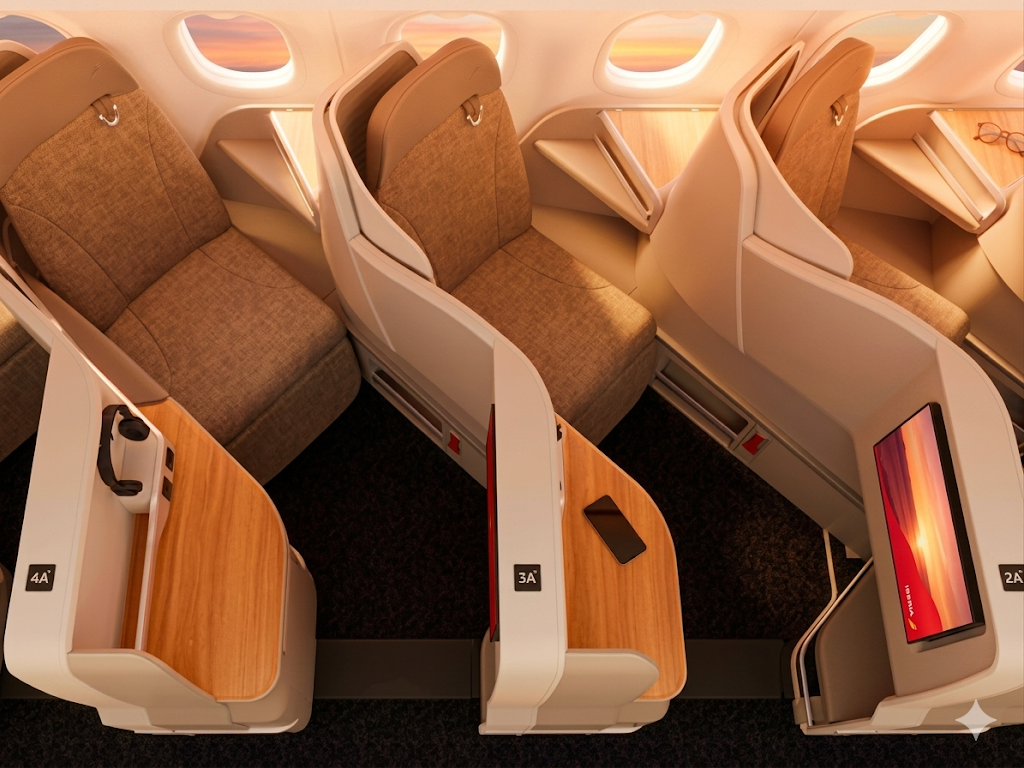
Iberia's A321XLR is a 182-seat narrowbody (14 Business + 168 Economy) flying Madrid to the US East Coast and the Caribbean. Business is Thompson Vantage Solo in a 1-1 reverse herringbone — best seats are 2A–6A and 2F–6F; 1A/1F are the worst Business seats (narrow entry, Y-belt, no stowage). Economy best picks are 29A/29F (39" exit row that reclines) and 28A/28F (40" exit row, no recline). Avoid row 27 (no recline, no pitch bonus) and rows 47–48 (rear lavs).
At a Glance
| Aircraft | Airbus A321XLR (IATA: 32Q) |
| Fleet size | 3 active, 8 on order |
| Configuration | 14J + 168M = 182 seats |
| Business layout | Thompson Vantage Solo, 1-1 reverse herringbone, lie-flat, all-aisle-access |
| Economy layout | Recaro slimline, 3-3, 30–31" pitch |
| Version lottery | No internal sub-variants — all frames spec identical. Route-level lottery applies. |
| Best Business | Rows 2–6 A/F (mid-cabin, full feature set) |
| Best Economy | 28A/28F (40" exit row) or 29A/29F (39" exit row, reclines) |
| Seats to avoid | 1A/1F, 27A–F (no recline), rows 47–48 (rear lavs) |
| IFE | 18" 4K Panasonic in Business (flip-out); 12" HD in Economy |
| Power | USB-A, USB-C and AC outlets throughout |
| WiFi | Yes — paid, Airbus Airspace standard |
The Route-Level Version Lottery
Unlike most version-lottery guides, Iberia's A321XLR fleet itself is uniform — every frame is the same 14J/168M Thompson Vantage Solo spec, so there's no "which seat am I getting" anxiety within the type. The lottery is at the route level: on several Madrid–USA and Madrid–Caribbean sectors, Iberia rotates between the A321XLR (182 seats, narrowbody), the A330-300 (292 seats, 2-2-2 older Business) and the A350-900 (348 seats, 1-2-1 Recaro suites with doors). Which aircraft you get depends on the date, season and sometimes same-day swap.
Routes where the A321XLR currently flies include Madrid–Boston, Madrid–Washington Dulles (IAD), Madrid–Newark (EWR, launched 2026), Madrid–JFK (select rotations), and Madrid–Santo Domingo. Madrid–Boston in particular is year-round A321XLR territory. Madrid–IAD and Madrid–EWR are also XLR-dominant. Madrid–JFK tends to run on the A350-900 or A330-300, with the XLR as a sub-fleet filler.
If you care about the product, check your seat map in advance and watch for equipment swaps close to departure. The A350-900 is the strongest Business product in the fleet; the A321XLR is a step down on privacy (no door) but has an arguably more modern seat than the ageing A330-300 2-2-2 layout.
Business Class (Rows 1–7)
Iberia's A321XLR Business cabin uses the Thompson Aero Vantage Solo — the same reverse-herringbone 1-1 seat JetBlue Mint uses on its A321LR transatlantic fleet and that Aer Lingus has on its A321LR. Every seat is a lie-flat solo suite with direct aisle access and the passenger's head angled toward the window, feet toward the aisle.
Seven rows, two seats per row (A on the left, F on the right), for 14 seats total. One dedicated lavatory and galley forward of Row 1. No cabin door, no closing privacy divider — this is a suite-feel seat without a true suite's enclosure.
✅ Best Business Seats
Rows 2–6 A/F — full-spec Vantage Solo suites with normal entry geometry, standard stowage, airbag seatbelts. These are the cleanest picks. No meaningful difference between them on a 14-seat cabin; pick by window alignment and proximity to galley noise (rear rows are slightly closer to the Economy curtain).
Row 7 A/F — last row of Business, farthest from the forward galley, but closest to the Business/Economy cabin divider and boarding traffic during turnaround.
🚫 Business Seats to Avoid
Row 1 A/F — counter-intuitively the worst Business seats on the aircraft. Bulkhead row has a Y-belt (four-point restraint for crash safety in place of the standard airbag seatbelt), no under-seat stowage at your feet, and a noticeably narrower entry geometry than the other rows. Even average-build passengers have reported struggling to slide in and out. The extra console table doesn't compensate. Avoid unless you want the bassinet position (Row 1 is the designated infant bassinet row).
Business cabin features
| Seat | Thompson Aero Vantage Solo, reverse herringbone 1-1 |
| Bed length | ~78" flat |
| IFE | 18" 4K Panasonic, flip-out (must be stowed for taxi/takeoff/landing) |
| Power | USB-A, USB-C, AC universal |
| Cabin width at seat | ~62" (fuselage to aisle) |
| Lavatories for 14 pax | 1 (forward, shared with crew) |
| Pre-departure drink | Not currently served |
Economy Class (Rows 21–48)
Iberia skips rows 8–20 on the cabin layout, so Economy starts at Row 21 and runs to Row 48 — that's 28 rows of 3-3 Recaro slimline seating. Pitch sits at 30–31" for most of the cabin, with two 40"-class bulkhead/exit positions giving meaningful extra legroom.
Note there's no Premium Economy, no extra-legroom economy brand, and no blocked-middle Euro-business style layout rearward. Once you're past Row 7, you're in regular Economy until the cabin ends.
✅ Best Economy Seats
Row 28 A/B/C and D/E/F — first overwing exit row. 40" pitch, which is widebody-premium territory on a narrowbody. Tray table lives in the armrest (seat is slightly narrower as a result), and the seat does not recline (exit-row requirement). Best use: tall passengers on the day flight Westbound (MAD–USA).
Row 29 A/B/C and D/E/F — second exit row. 39" pitch, tray in armrest, but this row does recline — best of both worlds. Often the strongest pick overall in Economy.
Row 21 A/B/C and D/E/F — forward bulkhead. ~40" pitch but with Y-belt restraint (like Row 1 in Business), no under-seat stowage, bassinet designation for infants, and tray in armrest. Good for tall solo travellers travelling without bags-at-feet; less ideal if you're travelling with a child or want under-seat gear access during the flight.
🚫 Economy Seats to Avoid
Row 27 A/B/C and D/E/F — the sleeper-trap of the cabin. No recline (because it sits directly in front of the overwing exit), and you don't get the 40" exit-row pitch as compensation. You get the worst of both: standard pitch, no recline.
Rows 47 and 48 — last two rows of the aircraft. Adjacent to rear lavatories and rear galley, with the usual traffic/noise/odour issues on an 8-hour transatlantic flight. Row 48 is typically the last row and may have reduced recline.
Middle seats (B and E) in rows 22–26 and 30–46 — long-haul middle seats at 30–31" pitch are a hard sell. If Economy is your only option and you can't secure an exit row, aim for window or aisle in the forward half of the cabin.
Economy cabin features
| Seat | Recaro slimline, 3-3 |
| Pitch | 30–31" standard; 39" at Row 29; 40" at Rows 21 and 28 |
| Width | ~17.7" |
| Recline | Standard rows recline; Rows 27, 28 do not |
| IFE | 12" HD seatback, USB-A and USB-C |
| Power | AC outlets shared between seat pairs |
| Lavatories | 2 at rear |
Cabin Features at a Glance
| Feature | Business | Economy |
|---|---|---|
| Rows | 1–7 | 21–48 |
| Seats | 14 | 168 |
| Layout | 1-1 reverse herringbone | 3-3 |
| Pitch | Lie-flat (~78" bed) | 30–31" (40" rows 21, 28; 39" row 29) |
| IFE screen | 18" 4K | 12" HD |
| Power | USB-A, USB-C, AC | USB-A, USB-C (AC on select rows) |
| WiFi | Paid, full coverage | Paid, full coverage |
| Direct aisle access | Every seat | Aisle seats only |
Quick-Pick Summary
| Traveller type | Best pick | Why |
|---|---|---|
| Solo (Business) | 3A or 5A | Mid-cabin, full-spec Vantage Solo, no bulkhead quirks |
| Couple (Business) | 3A + 3F or 5A + 5F | Opposite sides of aisle, same row — closest you get to "together" on a 1-1 layout |
| Solo (Economy) | 29A or 29F | 39" pitch + recline + window |
| Tall in Economy | 28A or 28F | 40" pitch exit row (trade: no recline) |
| Family with infant | Row 1 (Business) or Row 21 (Economy) | Bassinet-designated rows |
| Quick deplane | 2A/2F (Business); 21A/21D (Economy) | First off at the forward door |
| Budget transatlantic | Row 29 Economy | Best legroom + recline combo in the non-premium cabin |
How to Tell You're Booked on the A321XLR
Madrid–Boston, Madrid–IAD (Washington) and Madrid–EWR (Newark) are almost exclusively A321XLR in 2026. Madrid–JFK is mostly A350-900 with occasional XLR coverage. Madrid–Santo Domingo is also A321XLR.
Three ways to confirm:
- Seat map check. Pull up the seat map on iberia.com or in the Iberia app. 182 total seats with a 1-1 forward cabin = A321XLR. If you see 1-2-1 in Business, it's the A350. If you see 2-2-2 in Business, it's the A330-300.
- Aircraft type code. Iberia's booking flow and boarding pass show the aircraft as "Airbus A321neo XLR" or equipment code 32Q.
- SeatPredict / swap-risk check on SeatCompare.ai. The XLR sub-fleet is small (3 growing to 8), so equipment swaps to or from the A330-300 are more common on these routes than on A350-dominant sectors.
If the seat map shows 292 or 348 seats, Iberia has swapped you onto a widebody — generally an upgrade for the seat product.
Comparable Guides
- Iberia A330-300 Seat Selection Guide — the widebody alternative on the same routes
- Iberia A350-900 Seat Selection Guide — the flagship alternative on Madrid–JFK/ORD
FAQ
Which Madrid–USA routes use the A321XLR?
As of 2026, Madrid–Boston (year-round), Madrid–Washington Dulles, Madrid–Newark, select Madrid–JFK rotations, and Madrid–Santo Domingo. Madrid–Puerto Rico (SJU) and additional South Atlantic routes are planned as the fleet grows to 8 aircraft.
Is Iberia's A321XLR Business class as good as the A350-900?
No, but it's close on seat quality and loses mainly on cabin feel. The A321XLR Vantage Solo is lie-flat with direct aisle access but has no door and no premium-row feature. The A350-900 has Recaro suites with doors, a larger cabin, and a more premium service flow. The A321XLR beats the older A330-300 (2-2-2 with trapped window passengers). Business meal service and amenity kit are the same across aircraft types.
Why is Row 1 worse than rows 2–7?
Row 1 is the bulkhead. It has a Y-belt (four-point restraint) instead of an airbag seatbelt, a different seat-base construction, no under-seat stowage, and a narrower entry aperture to slide into the seat. It's also the designated bassinet row for infant passengers, so you may have an infant in the footwell space. Unless you want the bassinet position or the extra console table, pick any other row.
Is 30–31" Economy pitch too tight for an 8-hour flight?
Opinion splits. For average-build passengers up to ~5'10", it's workable for an 8-hour flight, especially on the eastbound night sector where you'll sleep. For taller passengers, aim for Row 28 (40" pitch, no recline) or Row 29 (39" pitch, recline) — a $50–$80 seat fee is usually money well spent. Row 21 is another option but comes with the Y-belt/bassinet caveats.
Does the A321XLR have WiFi?
Yes. Iberia's XLRs are fitted with a paid WiFi system with full cabin coverage. Connection quality on narrowbody transatlantic operations is generally solid; speeds vary by over-ocean segment. Pricing follows Iberia's standard tiered structure.
What's the chance of an equipment swap?
Higher than average relative to widebody-only routes, because the A321XLR sub-fleet is small. Equipment swaps typically go XLR → A330-300 (you upgrade in raw cabin size but get the older 2-2-2 Business seat) or occasionally XLR → A350-900 (clean upgrade). Swaps to a smaller or less-equipped narrowbody are not typical on these sectors. SeatCompare.ai's SeatPredict flags the swap risk for any booked Iberia flight.