Air China Boeing 747-8 Seat Selection Guide (2026)
✈️ Quick Verdict
Aircraft: Boeing 747-8 — 365 seats over two decks: 12 First + 54 Business + 66 Premium Economy + 233 Economy
Decks: main deck 335 seats · upper deck 30 Business seats, rows 80–87
The thing nobody tells you: the row numbers run backwards to the cabins. Business is rows 11–15 and sits in the nose; First is rows 1–3 and sits behind it
Best seats — First: rows 1, 2 and 3, any seat. All twelve are rated green with direct aisle access
Best seats — Business: rows 11, 12 and 13 on the main deck — four abreast with no centre pair, all twelve rated green
Best seats — economy: 60B, 60C, 60J, 60K and the same seats in rows 61 and 62 — the tapered tail rows, rated green with no seat beside them
Seats to avoid: row 37 in Premium Economy, all six rated red · rows 38, 39 and 64 in economy · 87J and 87L on the upper deck
IFE: Panasonic eX3 · Wi-Fi: fitted
First, the row numbers: they run backwards
Air China numbers its 747-8 First Class cabin rows 1, 2 and 3, and its main-deck Business cabin rows 11 to 15. On almost any other aircraft that would tell you First is at the front. Here it is not. Business fills the nose and First sits behind it, ahead of Premium Economy.
This matters when you are reading a seat map or working out where you will be. The nose of a 747 is the narrowest, quietest part of the main deck, and on this aircraft it is Business that gets it. First is a three-row cabin further back, between the Business cabin and the Premium Economy section. Both are ahead of the wing.
Our seat map for this aircraft is ordered the way the cabins physically sit, not the way the numbers run.
First Class: twelve seats, rows 1 to 3, and nothing wrong with any of them
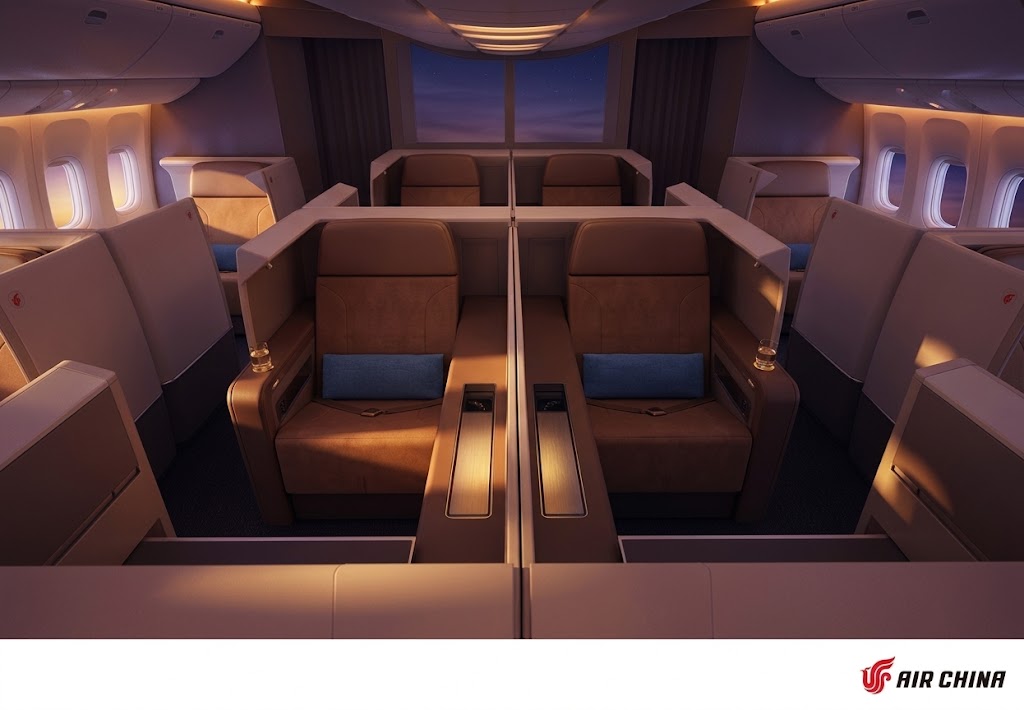
The First cabin is a 1-2-1 lettered A | D H | L, three rows, twelve seats. All twelve are rated green and all twelve are recorded with direct aisle access and nobody to climb over. There is no bad seat and no meaningful ranking between them.
If you are travelling alone, A or L gives you the window side. If you are travelling as two, D and H are the centre pair, each with its own aisle. Row 1 is closest to the nose, row 3 closest to the galley and lavatory bank behind — if you want the quietest of the three on an overnight, take row 1 or 2.
Business, main deck: rows 11 to 13 have no centre pair
The main-deck Business cabin is nominally 2-2-2, lettered A C | D H | J L, but only rows 14 and 15 actually have six seats across. Rows 11, 12 and 13 sit in the narrowing nose and have four seats across — A C J L and nothing in the middle.
All twelve of those seats are rated green and all twelve are recorded with direct aisle access and nobody to climb over. That makes rows 11 to 13 comfortably the pick of the main-deck Business cabin, and it is a genuine structural advantage rather than a marginal one: in rows 14 and 15 the window seats A and L do not have direct aisle access, because you climb past C or J to reach the aisle.
| Rows | Seats across | Direct aisle access | Verdict |
|---|---|---|---|
| 11, 12, 13 | Four — A C J L, no centre pair | All four seats | Book here. All twelve rated green |
| 14, 15 | Six — A C | D H | J L | C, D, H and J only | D and H are the green centre pair. A and L mean climbing over a neighbour |
If rows 11 to 13 are gone, 14D, 14H, 15D and 15H are the next best — the centre pair, each with an aisle, and the only seats in those two rows rated green.
The upper deck: 30 seats and almost nothing to say about them
The upper deck is a separate Business cabin of 30 seats, rows 80 to 87, in a single-aisle 2-2 lettered A C | J L. There is no centre section and no middle seat anywhere on the deck. A and L are the windows, C and J the aisles.
What is striking about the upper deck is how little there is to warn about. Across all 30 seats there are exactly two notes: 87J and 87L sit immediately beside the lavatory at the back of the deck. Every other seat on the deck is unremarked. On an aircraft whose main deck carries 335 people, a 30-seat cabin up its own staircase with its own lavatory and one pair of problem seats is the quietest place on board.
The upper-deck door sits between rows 82 and 83, splitting the deck into a forward group of three rows and an aft group of five. Row 87 is J and L only.
Book anywhere except row 87. If you want the front of the deck, rows 80 to 82; if you want to be furthest from the stairs, rows 84 to 86.
Premium Economy: 3-4-3, and row 37 is the one to refuse
Premium Economy is rows 31 to 37 and it is worth being clear about what that means: it is 3-4-3, ten seats across, the same abreast count as economy. Lettered A B C | D E F H | J K L, with no G. You are buying pitch and service, not a narrower row, and the two seats in the middle of the centre block are still middle seats with a neighbour on each side.
Row 37 is rated red across all six of its seats. It is A B C J K L only — no centre block — the recline is gone, there is lavatory traffic, and 37A and 37L have no window at all. It is the last row of the cabin and it has every problem the cabin has.
Row 31 is the bulkhead with the extra legroom and is rated amber across all ten seats: nothing under the seat in front, and lavatory traffic. Rows 32, 33 and 34 are the unremarked middle of the cabin and are the ones to pick. Row 36 has four seats rated red.
Economy: the best seats are at the very back
Economy is rows 38 to 64 in a 3-4-3, A B C | D E F H | J K L, and the row shape changes several times as the fuselage narrows.
| Rows | Shape | Notes |
|---|---|---|
| 38 | A B C | J K L — six seats | The economy bulkhead. Four of six rated red, lavatory traffic, and misaligned windows at 38A and 38L |
| 39–46 | Full ten across | Row 39 has six seats rated red. Rows 40–46 are the ordinary middle of the cabin |
| 47, 48, 49 | A B C | J K L — six seats | A three-row stretch with no centre block. Limited recline in 47 and 48. 48A has no usable window; 48L and 49A get a reduced view from a plugged window nearby |
| 50–58 | Full ten across | The best-behaved part of the cabin. One green window seat per row at 50, 51, 55, 56 and 58 |
| 59 | A B C D E F H — seven seats | No J K L |
| 60, 61, 62 | B C D E F H J K — eight seats, no A and no L | The pick. 60B, 60C, 60J, 60K and the same four seats in 61 and 62 are rated green with direct aisle access, and B and K have no seat beside them |
| 63, 64 | D E F H — four centre seats only | The rear doors take the outboard positions. Row 64 is rated red across all four, with a lavatory immediately behind |
The tail rows are the interesting find. Rows 60, 61 and 62 lose their A and L seats to the narrowing fuselage, and the result is that B and K end up with nobody beside them and the spare underseat storage to themselves — and all four of B, C, J and K in each of those rows are rated green with direct aisle access. On a 233-seat economy cabin, twelve seats stand out, and they are all in the last three rows that have outboard seating.
Row 63 immediately behind is D E F H only, and row 64 is the same four seats rated red with a lavatory behind. So the good part of the tail stops at row 62.
Quick-pick summary
| You are | Book | Why |
|---|---|---|
| In First | Row 1 or 2, any seat | All twelve First seats are green with aisle access; rows 1–2 are furthest from the galley behind |
| In Business, want the best | 11A, 11C, 11J, 11L or rows 12–13 | Four abreast, no centre pair, all twelve green with direct aisle access |
| In Business, want quiet | Upper deck, rows 84–86 | A 30-seat deck with two recorded problem seats in total, and you are not in either |
| In Business as a couple | 14D/14H or 15D/15H, or any upper-deck A/C or J/L pair | The centre pair with an aisle each; or a two-seat pair with no middle anywhere |
| In Premium Economy | Rows 32, 33 or 34 | The unremarked middle of the cabin. Row 31 costs you underseat storage; row 37 is red throughout |
| In economy, want space | 60B, 60K, 61B, 61K, 62B or 62K | Green, direct aisle access, and no seat beside you |
| In economy, want a window | 50, 51, 55, 56 or 58 — the A or L seat | The green window seats in the well-behaved middle of the cabin |
| Anyone | Avoid 37, 38, 39, 64 and 87J/87L | The red rows on each deck |
FAQ
Is First Class really behind Business on the Air China 747-8?
Yes. Business occupies the nose in rows numbered 11 to 15; First is rows 1 to 3 immediately behind it, ahead of Premium Economy. The row numbers and the physical order disagree, which is unusual and worth checking on the seat map before you assume a low row number means the front of the aircraft.
How many Business seats are there in total?
Fifty-four — 24 on the main deck in rows 11 to 15, and 30 on the upper deck in rows 80 to 87. They are the same cabin class but physically separate, up a staircase, with their own lavatory and galley.
Is the upper deck better than the main-deck Business cabin?
For quiet, yes — it is a self-contained 30-seat deck with only two problem seats on it. For seat geometry, rows 11 to 13 on the main deck are the standout, because they are four abreast with no centre pair and every seat has direct aisle access. The upper deck is 2-2 throughout, so A and L are window seats you reach past C or J.
Is Air China Premium Economy worth it on this aircraft?
It is 3-4-3 — ten across, the same as economy — so you are buying pitch and service rather than a wider row, and the centre-block middles are still middles. Rows 32 to 34 are the ones to book. Avoid row 37 entirely: all six seats are rated red, the recline is gone, and 37A and 37L have no window.
Which economy seats have no window?
37A and 37L in Premium Economy have no window at all, and 48A has no usable window — the window section beside it is plugged. 48L and 49A get a reduced view from a plugged window nearby rather than no view at all. All of them sell as ordinary window seats.
Where does Air China fly the 747-8?
Out of Beijing on its long-haul trunk routes — New York JFK, Los Angeles, San Francisco, Frankfurt, Paris and London have all seen the type — plus some high-density domestic flying. It is one of only two passenger 747-8 fleets still operating with a First Class cabin. Aircraft assignment changes, so confirm the type at booking and again at check-in.