Korean Air 747-8 Seat Selection Guide (2026)
✈️ Quick Verdict
Aircraft: Boeing 747-8 · 3 in the fleet · 6 First + 48 Prestige + 314 Economy = 368 seats
Layout: First 1-1 (rows 1–3) · Prestige 2-2-2 main deck (rows 7–11) and 2-2 upper deck (rows 16–21) · Economy 3-4-3 (rows 28–65)
Version lottery: No — all three aircraft carry Kosmo Suites 2.0 in First and Prestige Suites in business.
Best seats: 28A/29A/30A in Economy · 16A/16J on the upper deck · 2A/2J in First
Seats to avoid: 64D–65G (centre-only tail rows, no window) · 11D/11E in Prestige · 49B/49C/49H/49J
IFE: Thales TopSeries on demand · WiFi: None recorded on this type · Routes: about half of Seoul–Los Angeles, plus Seoul–Tokyo Narita and Hong Kong
The flagship is the one without internet
Korean Air's 747-8 is the most glamorous aeroplane the airline flies. It has a nose full of First Class suites, a private upper deck reached by a spiral staircase, and it is one of a handful of passenger 747s still carrying people anywhere in the world. It operates roughly half of Korean's Seoul–Los Angeles flights, which is an eleven-hour crossing in each direction.
It also has no WiFi. There is no connectivity fit recorded for the type at all — the 747-8's entertainment specification is the Thales TopSeries system and nothing else — while Korean's A321neo, an aircraft that spends its days doing two-hour hops to Beijing, carries Viasat Ka-band. Passenger accounts of the long Pacific sectors describe the same thing.
Plan for no connectivity and download everything before you board. Korean Air has been fitting connectivity across the fleet, so this could change on any given airframe — but with three aircraft and no published fit, the sensible assumption on the 747-8 is that eleven hours to Los Angeles is eleven hours offline.
First Class: rows 1, 2 and 3 in the nose
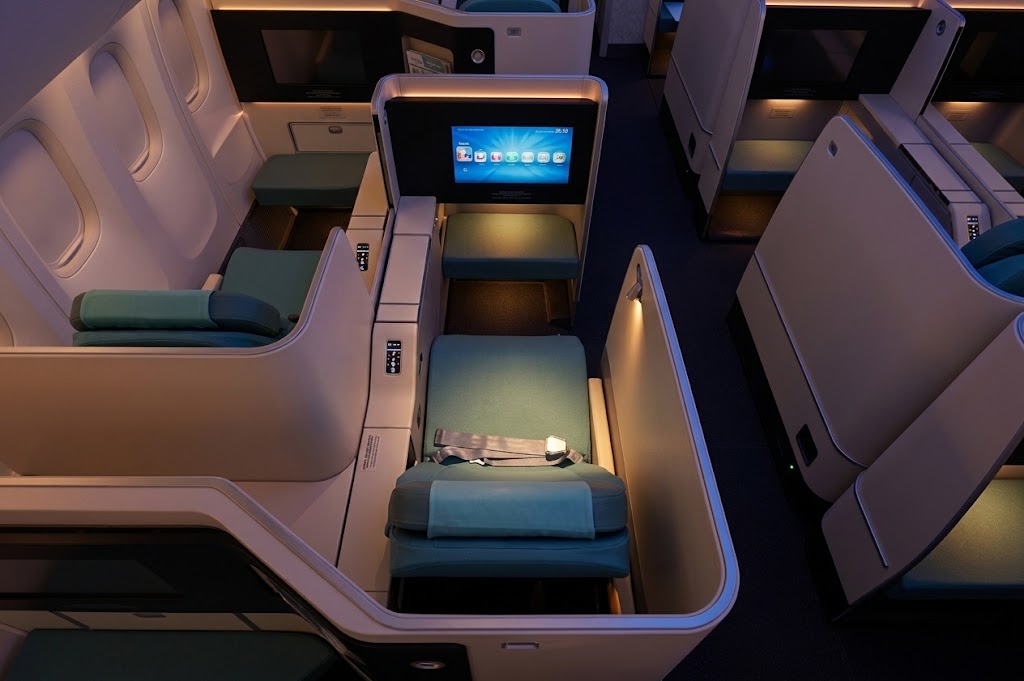
Six Kosmo Suites 2.0, arranged 1-1 with only two seats in the row — A and J, filling the section of fuselage ahead of the wing where the 747's nose tapers to a point. There is no seat between you and the window on one side and no seat between you and the aisle on the other. Each suite has a sliding door and high partitions.
This is the cabin the 747 is famous for, and the choice within it turns on the shape of the aeroplane rather than the seat.
Best: 2A and 2J. Row 2 is the middle of the three. The fuselage has opened out from the extreme taper at row 1, so you get the full suite footprint, and you are clear of both the nose bulkhead ahead and the galley and lavatory bank immediately behind row 3.
The romantic pick: 1A and 1J. Row 1 is right in the point of the nose, ahead of everything, with the flight deck above and in front of you. It is the seat people write about. The trade-off is that the fuselage is at its narrowest here, so the suite is the most enclosed of the six, and the cabin wall curves in noticeably beside you.
Weakest: 3A and 3J. Row 3 backs onto the galley and the pair of First Class lavatories, and it is the row every other passenger walks past. In a six-seat cabin this is a relative complaint rather than a real one, but if the seat map gives you a choice, take row 1 or 2.
Prestige Class: two cabins, and they are not the same
Korean splits its 48 Prestige Suites across both decks, and the two cabins have different layouts, different seat letters and a very different feel. Korean publishes 21.6 inches of seat width and 74 inches between rows for the product.
Upper deck: rows 16–21, 22 seats — the one to book
The upper deck is a 2-2 cabin, seats A and B on the port side, H and J on the starboard side, staggered so that each seat has direct aisle access. Rows 16 and 17 sit forward of the upper-deck exits; rows 18, 19 and 20 sit behind them. It is a narrow tube of a cabin with a galley and two lavatories at the front and another galley at the back, and it holds twenty-two people for an entire Pacific crossing.
If you have flown a 747 upper deck you already know why this is the right answer. It is quiet, it is private, nobody transits through it to get anywhere, and the sidewall storage bins beside the window seats on the upper deck are the best carry-on stowage on any commercial aircraft.
Best: 16A and 16J. The first row of the upper deck, window side, forward of the exits, closest to the front stairs and furthest from the aft galley.
Also excellent: 18A and 18J. The first row behind the upper-deck exits, which means an open space in front of you rather than a seatback.
The gamble: 21H and 21J. Row 21 is not a row. It is a pair of seats on the starboard side only — the port side of the aircraft at that point is the staircase down to the main deck. The two of them sit alone at the very back of the upper deck with the aft galley directly behind. If you are travelling as a couple and want to be left completely alone this is arguably a feature; if you want to sleep through a galley working an eleven-hour flight, it is not.
Main deck: rows 7–11, 26 seats
The main-deck Prestige cabin is 2-2-2 — seats A and B to port, D and E in the centre, H and J to starboard, staggered for aisle access. Rows 7, 8, 9 and 10 are full six-abreast rows. It sits between the First Class galley and the upper-deck staircase, in the widest part of the fuselage.
Best: 8A/8J and 9A/9J. Window pairs in the middle of the cabin, away from the galley at the front and away from the lavatory and staircase at the back.
For couples: 8D/8E or 9D/9E. The centre pair on a staggered 2-2-2 gives two people a shared space with nobody climbing past.
Avoid: 11D and 11E. Row 11 is the strangest seat pair on the aeroplane. It consists of two centre seats and nothing else — no A, no B, no H, no J. The pair sits alone at the back of the main-deck Prestige cabin, and directly behind them is a lavatory, a galley and the vestibule at the foot of the upper-deck staircase. You are an island in the middle of the aisle with the busiest piece of floor on the main deck immediately behind your headrest. They are the two Prestige seats to leave for somebody else.
Economy: rows 28–65, and it is not a regular cabin
Economy is nominally 3-4-3 — A, B, C to port, D, E, F, G in the centre, H, J, K to starboard — at a published 33 to 34 inch pitch, which is unusually generous and one of the genuine reasons to seek this aircraft out. Korean fits Thales TopSeries on demand throughout.
But the 747's shape means very few of those thirty-eight rows are actually ten seats wide. Between the upper-deck staircase, three sets of doors, two galley banks and a fuselage that tapers hard at the tail, the cabin is broken into blocks of wildly different width. Here is the whole of it:
| Rows | Seats in the row | Why |
|---|---|---|
| 28, 29, 30 | A, B, C only — 3 across | Staircase and galley fill the centre and starboard side |
| 31–37 | Full 3-4-3 | — |
| 38–45 | Full 3-4-3 | Row 38 is a bulkhead row behind the mid-cabin lavatories and door vestibule, with bassinet positions |
| 46, 47 | A, B, C and H, J, K — 6 across | Centre block is a galley |
| 48 | A, B, C only — 3 across | Lavatory on the starboard side, galley in the centre |
| 49 | B, C and H, J only — 4 across | Door vestibule on both sides |
| 50 | A, B, C and H, J, K — 6 across | Centre block still galley |
| 51–59 | Full 3-4-3 | Row 51 is a bulkhead row with bassinet positions in the centre |
| 60–63 | 2-4-2 — no A, no K | Fuselage tapering into the tail |
| 64, 65 | D, E, F, G only — 4 across, centre block | Tail cone; no side blocks at all |
The best economy seats on the aircraft: 28A, 29A and 30A
Economy begins at row 28, and for its first three rows it is three seats wide. The centre and starboard sides of the aeroplane at that point are taken up by the foot of the upper-deck staircase, a coat closet and a galley block. What is left is a nine-seat cabin on the port side — rows 28, 29 and 30, seats A, B and C — walled in on one side by the fuselage and on the other by the staircase structure.
Nine seats, a hard wall where the rest of the cabin should be, nobody transiting past you, and a bassinet position at the bulkhead. On a 314-seat economy cabin this is the closest thing to a private compartment that exists, and because the booking map shows it as an odd stub most people scroll straight past it. 28A is the seat to ask for on this aeroplane.
Two caveats worth knowing. It is a bulkhead row, so there is no seat in front to stow a bag under during taxi, and the bassinet positions mean an infant may be placed at the front of the block. And a galley sits ahead of the bulkhead, so there is service activity in front of you rather than beside you.
Also worth having
Row 38 (A–K) and row 51 (A–K). Both are bulkhead rows at the front of a cabin block, sitting behind a lavatory-and-door vestibule with open floor ahead of them. Extra room in front, with the standard bulkhead trade-offs and bassinet positions in the centre.
Rows 60–63, seats C, H and the centre D–G. The 2-4-2 rows in the taper have a genuine quirk in their favour: with no A or K seat, the B and J seats become window seats with a wider sidewall shelf, and the aisle seats sit in a narrower, quieter part of the cabin. If the rest of economy is full, this block is better than its position suggests.
Seats to avoid in Economy
Rows 64 and 65 — the worst seats on the aeroplane. The last two rows of the 747-8 are the centre block only: 64D, 64E, 64F, 64G and 65D, 65E, 65F, 65G. There are no side blocks beside them because the fuselage has narrowed to the tail cone. Eight seats, four abreast, marooned in the middle of the aircraft with no window anywhere near them, the four rear lavatories immediately behind, and the aircraft's last row of recline against a bulkhead. If a seat map ever offered a textbook case of what to pay to avoid, this is it.
Row 49 — 49B, 49C, 49H and 49J. Row 49 has only four seats, sitting either side of a door vestibule. Door-side seats mean cold draughts on a long sector, a crew jumpseat area beside you, and boarding traffic across your feet. They are also isolated: there is no A, no K and no centre block in the row.
46C, 46H, 47C, 47H and 48C. These are the aisle seats alongside the centre galley block that fills rows 46 to 50 — you will spend the flight next to carts. Note that row 48 has no H seat at all: a lavatory occupies the starboard side of that row.
Row 37 and row 63 — the last rows of their blocks, immediately in front of a lavatory or galley bulkhead, where recline is usually the first thing to go.
Quick-pick by traveller
| If you are… | Take | Why |
|---|---|---|
| Flying First | 2A or 2J | Full suite footprint, clear of both the nose taper and the aft galley |
| Flying First for the story | 1A or 1J | The point of the 747's nose — the seat people fly the aircraft for |
| Flying Prestige | 16A or 16J, upper deck | Quiet 22-seat cabin, no through traffic, sidewall storage bins |
| A couple in Prestige | 8D/8E or 9D/9E | Centre pair on the main deck, nobody climbing past |
| In economy and want the best of it | 28A, 29A or 30A | Nine-seat port-side nook walled off by the staircase |
| Travelling solo in economy | Any D or G, rows 51–59 | Aisle access on both sides of the centre block, one neighbour |
| Flying with an infant | Row 38 or row 51 centre | Bulkhead rows with bassinet positions |
| Off the aircraft fastest | 28C | Front of economy, aisle, beside the mid-cabin door vestibule |
| Anything at all | Not rows 64 or 65 | Centre-only tail rows with no window and four lavatories behind |
How to make sure you get the 747
Korean Air has three 747-8s and they concentrate on a small number of routes. On recent flying the type operated roughly half of all Seoul–Los Angeles services, about an eighth of Seoul–Tokyo Narita, and a small share of Hong Kong–Seoul. Seoul–Los Angeles is where you have a real chance of getting one on purpose.
The tell at the booking stage is the seat map itself. Nothing else in Korean's fleet has a deck selector, and nothing else has an economy cabin that starts three seats wide. If you see rows 28 to 30 offering only A, B and C, you are on the 747.
Related guides
- Korean Air A380 seat guide — the other double-decker
- Korean Air 777-300ER seat guide — what else flies Seoul–Los Angeles
- Korean Air A321neo seat guide
- Lufthansa 747-8 seat guide — the only other 747-8 passenger operator
- Korean Air 787-10 seat guide
Frequently asked questions
Does Korean Air's 747-8 have WiFi?
There is no connectivity fit recorded for the type, and passenger accounts of the long Pacific sectors describe flying without it. Korean's newer aircraft, including the A321neo, carry Viasat Ka-band. Assume the 747-8 has none and download what you need before departure.
Which are the best economy seats on the Korean Air 747-8?
28A, 29A and 30A. Economy begins three seats wide, because the upper-deck staircase and a galley take up the centre and starboard sides. That leaves a nine-seat cabin on the port side with a wall where the rest of the aircraft should be.
What are rows 64 and 65?
The last two rows of the aircraft, and they are centre-block only — seats D, E, F and G, with no side blocks at all because the fuselage has narrowed into the tail. Eight seats with no window nearby and four lavatories immediately behind. Avoid them.
Is the upper deck better than the main deck in Prestige?
Yes, for most people. The upper deck is a 2-2 cabin of twenty-two seats with no through traffic and the sidewall storage bins beside the window seats. The main deck is 2-2-2 and sits between the First Class galley and the staircase. Both use the same Prestige Suites seat.
What are seats 11D and 11E?
A two-seat island. Row 11 is the last row of the main-deck Prestige cabin and it consists of the centre pair only, with a lavatory, a galley and the staircase vestibule immediately behind. Good for a couple who want to be left alone, poor for anyone who wants to sleep.
How many First Class seats are there?
Six — 1A, 1J, 2A, 2J, 3A and 3J. They are Kosmo Suites 2.0 with sliding doors, arranged 1-1 in the nose of the main deck ahead of the wing.
How do I get on the 747 rather than a 777?
Seoul–Los Angeles is the route to try — the 747-8 has been operating about half of those flights. Check the seat map before you pay: if economy rows 28 to 30 show only seats A, B and C, it is the 747.