Korean Air A321neo Seat Selection Guide (2026)
✈️ Quick Verdict
Aircraft: Airbus A321neo · 20 in the fleet · 8 Prestige + 174 Economy = 182 seats
Layout: Prestige 2-2 (rows 7–8, lettered A/B/D/E) · Economy 3-3 (rows 28–56)
Version lottery: No — all 20 aircraft carry the same 8J/174Y layout.
Best seats: 39A/39F in Economy · 8A/8E in Prestige
Seats to avoid: 56A–56F (last row against the lavatories) · 54–55 (lavatory queue) · 37A–37F if you want to recline
IFE: Safran RAVE on demand, 13.3″ economy screens · Power: AC and USB in Economy; wireless charging in Prestige · WiFi: Viasat Ka-band
There is no seat C and no seat F in Prestige
Korean Air's A321neo Prestige cabin is eight seats in a 2-2 layout across two rows. Almost every airline lettering a 2-2 business cabin uses A and C on one side, D and F on the other, leaving the middle letters unused so that the window seat is always A or F. Korean does not. On this aircraft the seats are 7A, 7B, 7D, 7E and 8A, 8B, 8D, 8E.
The practical consequence is that the window seats are A and E, and the aisle seats are B and D. If you book by habit and reach for "F" you will not find it; if you assume "B" is a middle seat you will pass over an aisle seat in a cabin that has no middle seats at all. It is a small thing that catches a lot of people out on a booking screen that gives you two rows and eight choices.
The second oddity on the same screen: the cabin plan runs rows 7 and 8, and then economy starts at row 28. Nothing is missing. Korean numbers its cabins in blocks and simply does not use rows 1–6 or 9–27 on this type.
Prestige: rows 7 and 8
This is the interesting part of the aeroplane. Korean's A321neo Prestige seat reclines a full 180 degrees into a flat bed — the first and still the only lie-flat seat the airline fits to a narrowbody. It comes with a 44 cm on-demand screen and wireless charging. On a two-hour Beijing or Tokyo run you will barely get the bed flat before descent, which is part of the appeal: it is a genuinely premium seat on sectors where nobody expects one.
Eight seats, two rows, and the choice between them is straightforward.
Best: 8A and 8E. Row 8 is the aft row of the two, sitting against the divider that separates Prestige from economy. That puts a solid partition behind you and, crucially, it puts distance between you and the forward galley and lavatory, which are the only ones in front of the divider and see constant traffic on a short sector. A and E are the window seats.
Also good: 8B and 8D. Same row, aisle instead of window. In a 2-2 cabin the aisle seat costs you the window but costs you nothing in access — nobody has to climb over you and you do not have to climb over anybody.
Weakest: 7A, 7B, 7D and 7E. Row 7 is the bulkhead row directly behind the forward galley and lavatory. You get a wall in front of you rather than a seatback, which some people prefer, but you also get the galley noise, the cabin-crew working area and every trip to the front lavatory happening a metre from your shoulder. In a cabin this small the difference between row 7 and row 8 is the whole of the seat selection decision.
Economy: rows 28–56
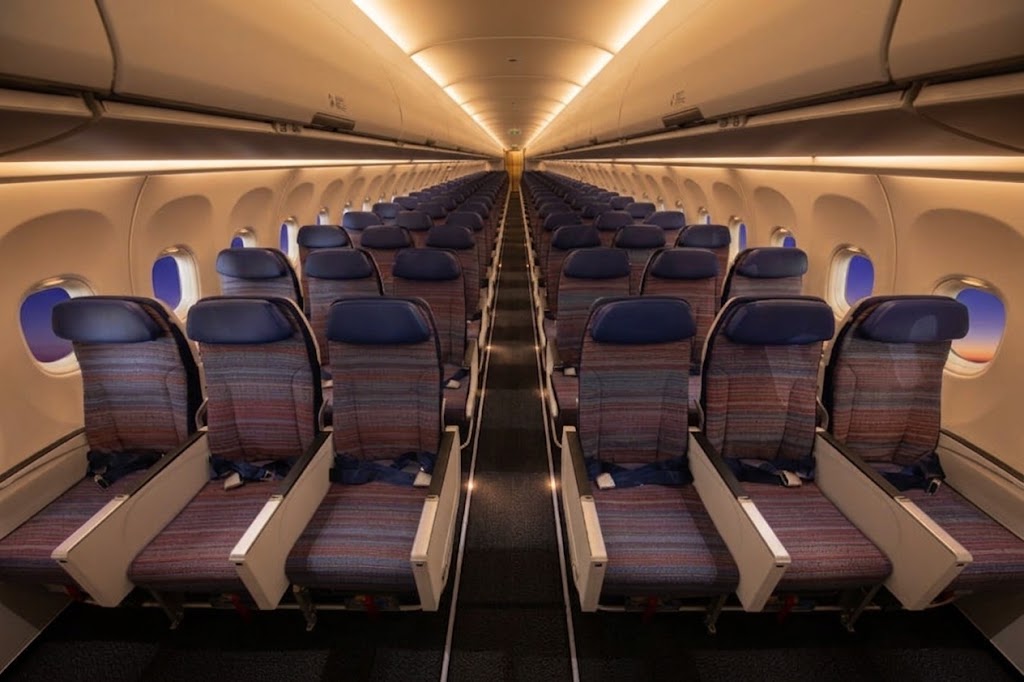
Economy is a straight 3-3 — A, B, C to port and D, E, F to starboard — running unbroken from row 28 to row 56. All twenty-nine rows carry six seats; there are no short rows, no gaps and no missing seats anywhere in the cabin. That is unusual on an A321neo and it is worth knowing, because it means the only thing distinguishing one economy seat from another here is where it sits relative to the exits and the lavatories.
The seat itself is good. Korean's launch specification for the A321neo economy cabin gives a 31 to 32 inch pitch, a 17.8 inch width, 13.3 inch seatback screens and both AC and USB power, with Airbus XL overhead lockers above. That is a better economy seat than a number of airlines put on widebodies.
Best seats in Economy
Row 39 (39A–39F) — the best economy seats on the aircraft. Rows 38 and 39 are both exit rows, on both sides, and both are drawn with the extra pitch that goes with an exit. On the seat map they look identical.
Row 39 is the better of the two because it is the aft row of the pair. The forward exit row in a double-exit arrangement normally has its recline restricted so that the escape path to the exit behind stays clear; the aft one reclines into an ordinary row. Korean does not publish per-seat recline for this type, so take this as the prudent reading rather than a guarantee — but when two exit rows offer the same legroom, the aft one is the safer buy.
Row 28 (28A–28F) — the front-of-economy pick. Row 28 is the first economy row, immediately behind the Prestige divider. Nothing reclines into you, you are first off after the eight Prestige passengers, and you are as far from the rear lavatories as it is possible to be on this aircraft. The trade is the usual bulkhead one: no seat in front to stow a bag under during taxi.
Rows 29–36 — the reliable middle. Forward of the wing, forward of the exits, a long way from the rear galley. If you want an uneventful seat, this is the block to pick from.
Seats to avoid in Economy
Row 56 (56A–56F) — the worst row on the aircraft. Row 56 is the last row and it backs directly onto the lavatory bank. Recline is restricted or absent, and the queue forms at your shoulder.
Rows 54 and 55 — and here is the structural problem. This aircraft has four lavatories, and three of them are behind row 56: two stacked on the port side, one of which is the accessible cubicle, and one on the starboard side next to the aft galley. The fourth is at the very front, ahead of the Prestige divider, and is effectively reserved for the eight Prestige passengers by geography.
That means all 174 economy passengers use the same three cubicles, all of them at the very back, with no mid-cabin lavatory anywhere across twenty-nine rows. On the two-hour Beijing and Tokyo runs this barely registers. On the five- to six-hour sectors this aircraft flies to Bangkok, Manila and Singapore, the aft four or five rows sit inside a standing queue for a large part of the flight. Rows 54, 55 and 56 are the ones to keep away from.
Row 37 (37A–37F) if you want to recline. Row 37 sits directly in front of exit row 38. Rows immediately ahead of an exit row commonly have their recline limited so the exit access stays clear. The legroom is normal; the recline is the thing to check.
Rows 40–42 if you want a view. These sit over the wing. Legroom is unaffected; the window is mostly aluminium.
Cabin features
| Feature | Prestige | Economy |
|---|---|---|
| Seats | 8 | 174 |
| Rows | 7–8 | 28–56 |
| Layout | 2-2, seats A/B/D/E | 3-3, seats A–F |
| Seat type | Lie-flat, 180° recline | Standard recliner |
| Pitch | Full flat bed | 31–32″ |
| Width | — | 17.8″ |
| Screen | 44 cm (~17.3″) | 13.3″ |
| Power | AC, USB, wireless charging | AC and USB, no wireless |
| Lavatories | 1 forward | 3, all behind row 56 |
| IFE | Safran RAVE on demand | Safran RAVE on demand |
| WiFi | Viasat Ka-band | Viasat Ka-band |
Quick-pick by traveller
| If you are… | Take | Why |
|---|---|---|
| Buying Prestige | 8A or 8E | Window, aft row, away from the forward galley and lavatory |
| Tall, in economy | 39A or 39F | Exit-row pitch, aft of the exit pair so recline is not compromised |
| Travelling solo | Any A or F, rows 30–36 | Forward cabin, far from the aft lavatory bank |
| A couple | A/B or E/F in rows 30–36 | Window pair with one aisle seat between you and the crowd |
| On a long sector (BKK, MNL) | Rows 28–40 | The lavatory queue on this aircraft only forms at the back |
| Flying with a child | Rows 29–33 | Forward cabin, not an exit row — children cannot sit in one |
| Off the aircraft fastest | 28C or 28D | First economy row, aisle, immediately behind Prestige |
| Paying the least | Rows 43–50, B or E | Middle seats behind the wing, but clear of the rear queue |
Where the A321neo sits in Korean Air's narrowbody fleet
Korean Air flies six narrowbody types, and the A321neo is both the largest sub-fleet and the only current-generation one:
| Type | Aircraft | Configuration |
|---|---|---|
| Airbus A321neo | 20 | 8J / 174Y |
| Boeing 737-900 | 9 | 8J / 180Y |
| Airbus A220-300 | 8 | 8J / 140Y |
| Boeing 737-900ER | 6 | 8J / 165Y |
| Boeing 737 MAX 8 | 6 | 8J / 150Y |
| Boeing 737-800 | 2 | 12J / 126Y |
If you are flying Seoul to Beijing, Tokyo, Hong Kong, Bangkok or Manila and you want the lie-flat seat, the A321neo is the only narrowbody in the fleet that has one — every other type in the table above carries a recliner in Prestige. Recent schedules put this aircraft on roughly a third of Beijing–Seoul flights and smaller shares of the Hong Kong, Bangkok, Manila and Tokyo Narita runs.
Related guides
- Korean Air 747-8 seat guide
- Korean Air A330-300 seat guide
- Korean Air 787-9 seat guide
- China Airlines A321neo seat guide
- Cathay Pacific A321neo seat guide
Frequently asked questions
Is Korean Air's A321neo business class lie-flat?
Yes. The Prestige seat reclines a full 180 degrees into a flat bed — the only lie-flat seat Korean Air fits to a narrowbody aircraft. There are eight of them, in rows 7 and 8.
Why is there no seat 7C or 7F?
Prestige is a 2-2 cabin and Korean letters it A, B, D, E rather than the more common A, C, D, F. The window seats are A and E; the aisle seats are B and D. There are no middle seats in the cabin at all.
Why does economy start at row 28?
Korean numbers its cabins in blocks. Prestige takes rows 7 and 8, economy takes 28 to 56, and the numbers in between are simply unused. No rows are missing from the aircraft.
Which are the exit rows?
Rows 38 and 39, both of them, on both sides. Row 39 is the better pick of the two: it is aft of the pair, so its recline is not constrained by an exit row sitting behind it.
How many lavatories are there in economy?
Three, and all three are behind row 56 — two on the port side, one of which is the accessible cubicle, and one on the starboard side beside the aft galley. There is no mid-cabin lavatory. The fourth lavatory on the aircraft is at the front, ahead of the Prestige divider.
Does economy have seatback screens and power?
Yes to both. Korean's specification for the A321neo economy cabin lists 13.3-inch seatback screens running Safran RAVE on demand, plus AC and USB power at every seat. Wireless charging is fitted in Prestige only.
Are all 20 aircraft the same inside?
Yes. Korean Air records a single configuration for the type — 8 Prestige and 174 Economy — so there is no version lottery to worry about on this aircraft.