Korean Air 737 Seat Selection Guide (2026)
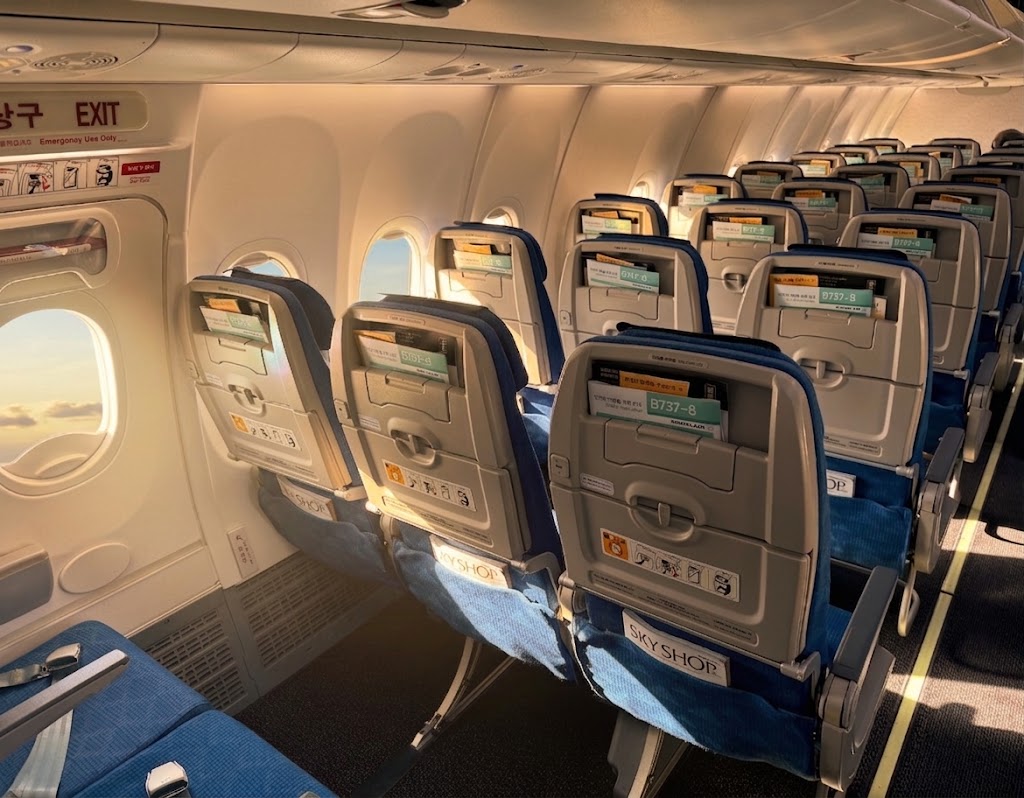
✈️ Quick Verdict
Aircraft: Boeing 737 — four configurations, about 23 aircraft between them
Config: 737-900 188 seats (9 aircraft) · 737-900ER 173 (6) · MAX 8 158 (6) · 737-800 138 (2). Business is 8 seats on three of the four and 12 on the 737-800
Layout: Prestige 2-2 (A B | D E), rows 7–8 or 7–9 · Economy 3-3, numbered from row 28 on every variant
Version lottery: Yes — four ways, and economy swings from 126 seats to 180
The one-look test: read the last row number. 50 → 737-800. 57 → 737-900. 55 → 737-900ER. 52 → MAX 8
The trap: row 28 is the front economy row on all four. On the 737-800 it carries extra legroom. On the 737-900, the 737-900ER and the MAX 8 it is tagged as having less legroom than a typical bulkhead — 17 to 19 inches to the wall
Best in Economy: row 35 on the 737-800 · row 40 on the 737-900 · row 39 on the 737-900ER · row 37 on the MAX 8. Four aircraft, four different row numbers, same seat
Best in Prestige: 7A, 7B, 7D, 7E on all four — the bulkhead row leads the cabin
IFE and Wi-Fi: seatback screens on the 737-800 and the 737-900ER · streaming only on the MAX 8 · neither screens nor Wi-Fi documented on the 737-900, which is the largest sub-fleet
Row 28 is the same row number on four aircraft and it is not the same seat
Korean Air numbers its narrowbody cabins in blocks: Prestige occupies rows 7 to 8 or 7 to 9, and economy opens at row 28 on every 737 in the fleet. Rows 10 to 27 do not exist. That means row 28 is the front economy row, behind the bulkhead, on all four aircraft — the row every seat map makes look like the one to have.
On the 737-800, it is. All six seats carry extra legroom.
On the other three it is the opposite. Row 28 has less legroom than a typical bulkhead on the 737-900 (47cm, about 19 inches to the wall), on the 737-900ER (46cm, about 18 inches) and on the MAX 8 (42 to 44cm, about 17 inches). The newest aircraft in the fleet has the worst version of it.
There is no fare difference, no product name, and nothing on a booking screen to separate these. It is the same airline, the same row number, the same position in the cabin, and the value flips depending on which of four airframes is scheduled. On the 737-900 and the 737-900ER, 28C and 28D do at least get a partial bulkhead with some foot room to one side; the other four seats get nothing.
The best economy row is a different number on every aircraft
All four cabins run the same pattern at the overwing exits: two exits, the row ahead of the second one loses its recline on the outboard seats, and the row behind it collects the legroom cleanly. Only the row numbers move.
| Aircraft | Exit-row recline penalty | Extra legroom | Book this row |
|---|---|---|---|
| 737-800 | Rows 33 and 34 (A, B, E, F) | Rows 34 and 35, about 38in | Row 35 — all six rate best |
| 737-900 | Rows 38 and 39 (A, B, E, F) | Rows 39 and 40 | Row 40 — all six rate best |
| 737-900ER | Rows 37 and 38 (A, B, E, F) | Rows 38 and 39 | Row 39 — all six rate best |
| MAX 8 | Rows 35 and 36 (A, B, E, F) | Row 36; row 37 at about 37in | Row 37 — all six rate best |
The row immediately ahead of each of those — 34, 39, 38 and 36 — has the same legroom and a seat back that will not move. It is the seat that looks identical on a booking map and is measurably worse, and it changes number four times across one airline’s 737 fleet.
The entertainment lottery is worse than the legroom one
| Aircraft | Seats | Aircraft count | Entertainment | Wi-Fi |
|---|---|---|---|---|
| 737-800 | 138 (12J/126Y) | 2 | Panasonic eX2 seatback screens | Fitted |
| 737-900 | 188 (8J/180Y) | 9 | None documented | None |
| 737-900ER | 173 (8J/165Y) | 6 | Panasonic eX2 seatback screens | Panasonic or Viasat satellite |
| MAX 8 | 158 (8J/150Y) | 6 | Streaming only — no seatback screens | Panasonic Ku-band |
The 737-900 is the largest of the four sub-fleets at nine aircraft, and it is the one with no Wi-Fi on record and no entertainment system documented for the cabin. An absent record is not the same as a confirmed absence — the Wi-Fi is explicitly listed as none, and the entertainment field is simply empty — but on a fleet where two variants have seatback screens and a third has streaming, the 737-900 is the one to plan around bringing your own.
The MAX 8 is explicit in the other direction: personal seatback displays are not fitted at all, and content streams to your own device instead. So the newest jet in the fleet has the tightest bulkhead and no screens, and the best Wi-Fi.
The 737-900ER ends in half a row
The 737-900ER has a quirk none of the others share: the last row is 55D, 55E and 55F only. The A/B/C side of the cabin stops at row 54. The rear lavatories sit on opposite sides of the aisle at staggered positions, which is why 54A, 54B and 54C are lavatory-adjacent while 54D, 54E and 54F merely sit in the traffic — and then the pattern reverses at row 55.
If you are assigned anything in rows 54 or 55 on a 737-900ER, all six seats in the A/B/C column of row 54 and all three of row 55 are against a lavatory, and 55D, 55E and 55F do not recline.
The seats with no window
| Aircraft | No window at all | Windows out of line |
|---|---|---|
| 737-800 | 30A | 48A, 48F |
| 737-900 | 36A, 36F, 49A and 49F — 49A/49F against a plugged window section. 35A has a window, but set so far back there is no usable view | 31A, 31F, 45A, 45F |
| 737-900ER | 34A, plus 48A and 48F against a plugged window section | 29A, 29F, 37A, 37F, 42A, 42F, 44A, 44F |
| MAX 8 | 32A | 31A, 31F, 42A, 42F, 44A, 44F |
Every variant loses one window seat on the left side somewhere in the low thirties — 30A, 32A, 34A or 35A — and the row number is different on each. There is no single seat to avoid across the fleet; there is a band, roughly rows 29 to 35 in the A column, where you should check the specific aircraft.
Prestige is the same on all four
Korean Air’s narrowbody Prestige cabin is a 2-2 recliner in rows 7 and 8 — and rows 7 to 9 on the 737-800, which is the only variant with twelve seats rather than eight. Row 7 is the bulkhead row on all four and rates best across all four seats on all four aircraft — it leads the cabin, with extra room ahead of it.
On the 737-900 the partial bulkhead at 7B and 7D covers 90 to 95 per cent of the space ahead, so the extra foot room there is nominal. It is still the best row in the cabin.
The back of the aircraft
| Aircraft | Last row | Rows to avoid |
|---|---|---|
| 737-800 | 50 | Row 50 — no recline, lavatories behind |
| 737-900 | 57 | Rows 56 and 57 — twelve seats against the lavatories; 57 does not recline |
| 737-900ER | 55 (D, E, F only) | 54A/B/C and 55D/E/F — lavatories on alternating sides |
| MAX 8 | 52 | Rows 51 and 52 — twelve seats against the lavatories; 52 does not recline |
Quick-pick summary
| Travelling as | Book | Why |
|---|---|---|
| Legroom first | Row 35 / 40 / 39 / 37 | The clean exit row on the -800, -900, -900ER and MAX 8 respectively |
| Front of economy | Row 28 — but only on the 737-800 | It is the only variant where row 28 has extra rather than reduced legroom |
| Business | 7A, 7B, 7D or 7E | Bulkhead row, best rated on all four aircraft |
| Wants a screen | The 737-800 or 737-900ER | Panasonic eX2 seatback entertainment; the MAX 8 streams and the -900 has neither on record |
| Wants Wi-Fi | Any variant except the 737-900 | The nine 737-900s have no Wi-Fi recorded |
| Window, and you mean it | Check the A column, rows 29–35 | Each variant loses a different window seat in that band |
| Avoid | The last two rows on any variant | Lavatories behind, and the last row does not recline on any of the four |
How to tell which version you are on
- Read the last row number on the seat map. 50 is the 737-800, 52 the MAX 8, 55 the 737-900ER, 57 the 737-900. This is the fastest and most reliable check, and it works at booking.
- Look at the shape of the last row. Only the 737-900ER ends with three seats on one side (55D, 55E, 55F) and nothing opposite.
- Count Prestige rows. Three rows (7, 8, 9) and twelve seats means the 737-800. Two rows and eight seats means one of the other three.
- Check whether row 36 and 37 exist. The 737-800 skips them — row 35 runs straight to row 38. The other three number continuously.
Comparable guides
Korean Air A321neo Seat Map & Best Seats (2026) — the newer narrowbody replacing much of this fleet
Korean Air 777-300ER Seat Map & Best Seats (2026) — three configurations, and business swings from 40 seats to 56
Korean Air 787-9 Seat Map & Best Seats (2026)
KLM 737-800 Seat Map & Best Seats (2026)
Frequently asked questions
Why does Korean Air number economy from row 28?
It is the airline’s own scheme. Prestige occupies rows 7 to 8 or 7 to 9, rows 10 to 27 are not fitted, and economy opens at row 28 on every 737 in the fleet. The numbering carries no information about cabin size — the 138-seat 737-800 and the 188-seat 737-900 both start economy at 28.
Is row 28 a good seat on the Korean Air 737?
Only on the 737-800, where all six seats carry extra legroom. On the 737-900, the 737-900ER and the MAX 8 the same row is recorded as having less legroom than a typical bulkhead — between 17 and 19 inches to the wall — and the MAX 8 is the tightest of the three.
What is the best economy seat on a Korean Air 737?
The row immediately behind the second overwing exit, which is row 35 on the 737-800, row 40 on the 737-900, row 39 on the 737-900ER and row 37 on the MAX 8. All six seats rate best in each case: full legroom and full recline.
Which Korean Air 737 has seatback screens?
The 737-800 and the 737-900ER, both with Panasonic eX2. The MAX 8 explicitly does not have them and streams to your own device instead. The 737-900 has no entertainment system documented at all, and no Wi-Fi.
How can I tell which Korean Air 737 I am booked on?
Read the last row number on the seat map: 50 for the 737-800, 52 for the MAX 8, 55 for the 737-900ER and 57 for the 737-900. The 737-900ER is also the only one whose last row has seats on one side of the aisle only.
How many 737s does Korean Air operate?
About 23 across the four configurations: nine 737-900s, six 737-900ERs, six MAX 8s and two 737-800s. The 737-900 is the largest sub-fleet and the one with the most economy seats, at 180.
Related Guides
- Korean Air A321neo Seat Selection Guide (2026)
- Korean Air 787-9 Seat Selection Guide (2026)
- Korean Air 777-300ER Seat Selection Guide (2025)
- Korean Air A330-300 Seat Selection Guide (2026)
- KLM Boeing 737-800 Seat Selection Guide (2026)
- Korean Air A220-300 Seat Selection Guide (2026)
- Korean Air Boeing 737-900 & 737-900ER Seat Selection Guide (2026)
- Korean Air Boeing 737-800 Seat Selection Guide (2026)
- Korean Air 737 MAX 8 Seat Selection Guide (2026)