Korean Air 737 MAX 8 Seat Selection Guide (2026)
✈️ Quick Verdict
Aircraft: Boeing 737 MAX 8 — 158 seats, 8 Prestige + 150 Economy, six aircraft
Layout: Prestige 2-2, A B | D E, rows 7–8 · Economy 3-3, A B C | D E F, rows 28–52
Version lottery: No for the MAX 8 itself — but Korean flies four different 737 cabins, and they share row numbers without sharing seats
The one-look test: read the last row number. 52 → MAX 8. 50 → 737-800. 57 → 737-900. 55 → 737-900ER
The trap: row 28 — the front economy row, and at 42–44cm (17in) to the wall it is the tightest of Korean's four 737 bulkheads. On the 737-800 the same row number is an extra-legroom row
Best in Economy: row 37 — about 37″ against a 31″ cabin standard, and it reclines. Row 36 has the space but not the recline
Best in Prestige: 7A, 7B, 7D, 7E — the bulkhead row leads the cabin
Seats to avoid: 32A — no window at all · rows 51 and 52 — rear lavatories, and row 52 does not recline
IFE: streaming to your own device — no seatback screens · Wi-Fi: Panasonic Ku-band, 10–40 Mbps
Row 28 is the same row number on four aircraft, and the MAX 8 has the worst one
Korean Air numbers economy from row 28 on every 737 it flies — the 737-800, the 737-900, the 737-900ER and the MAX 8. Four different cabins, one front-row number. The seat behind that number is not the same seat.
On the 737-800, row 28 is an extra-legroom row. On the 737-900 there is about 47cm to the wall; on the 737-900ER, about 46cm. On the MAX 8 it is 42 to 44cm — roughly 17 inches, and the record flags every seat in the row as having less legroom than a typical bulkhead.
So the newest 737 in the fleet has the tightest front row in the fleet, at the row number a returning Korean Air passenger is most likely to book from memory. All six seats also lose underseat storage and carry the tray table in the armrest, which narrows the seat itself.
28C and 28D claw back a little from partial bulkheads — 28C has about 80% coverage with a gap on its right, 28D about 80% with a small gap on its left that the record describes as little practical benefit. Neither changes the verdict.
Row 37 is the seat to book
The MAX 8 has two overwing exits, one after row 35 and one after row 36. That produces the usual three-row sequence, and as usual the middle one is the decoy.
| Row | Pitch | Reclines? | Verdict |
|---|---|---|---|
| 35 | Standard | Restricted | Avoid — the exit costs the recline and returns nothing |
| 36 | Extra legroom | Restricted | Good for a daytime sector |
| 37 | ~37″ (6″ over standard) | Yes | The best economy row on the aircraft |
Row 37 is the clean one — six inches more than the cabin standard, a full recline, and a normal seatback tray rather than one folded into the armrest. All six seats are worth having.
Row 36 is the seat most people book, because a booking map marks it as the exit row with extra legroom and says nothing about recline. It is a perfectly good daytime seat. On a red-eye it is not the one you want.
Prestige: eight seats, and the aisle question
Korean brands the front cabin Prestige Suites — eight seats across rows 7 and 8 in a 2-2 layout, lettered A and B on the left, D and E on the right.
Row 7 leads the cabin, with extra room ahead at the bulkhead on all four seats. It is the row to take. Row 8 sits behind it with the economy divider immediately aft.
Worth being clear about what 2-2 means: half the cabin has direct aisle access. The B and D seats are on the aisle; the A and E window passengers step past a neighbour to get out. On the short and medium-haul sectors this aircraft flies that matters less than it would on a long-haul, but if you are in A or E and you want to move around, you are climbing over someone.
32A has no window
One seat on the aircraft is a window position against a blank wall: 32A. There is no glass beside it at all.
Six more have a window set behind the seat, so the view is there if you lean back: 31A, 31F, 42A, 42F, 44A and 44F. If the window is why you are choosing, take a row in the low 30s or high 30s on either side and skip those.
The back of the aircraft
Rows 51 and 52 are the twelve seats to avoid. Both sit hard against the rear lavatories with the door traffic that implies. Row 52 does not recline at all — the rear wall is directly behind it — and 52B, 52C, 52D and 52E take galley noise and light on top. Row 50 catches the queue at 50A, 50B, 50E and 50F without the recline problem.
Two lavatories serve 150 economy seats here, which is on the thin side and is why the rear queue is worth planning around. Rows 38 to 49 are the clear stretch — past the exit rows, ahead of the lavatories.
Entertainment: bring your own screen
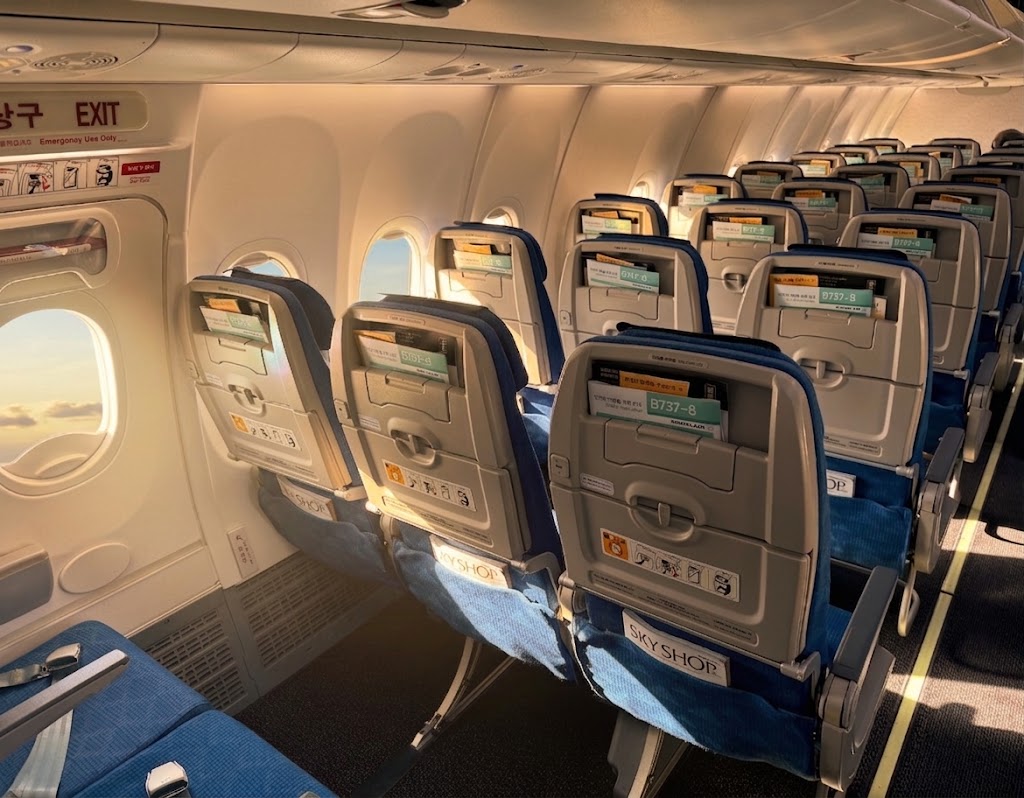
The MAX 8's cabin record is explicit: personal seatback displays are not provided. Content streams to your own device instead. That is a real difference from Korean's 737-800 and 737-900ER, both of which have seatback screens, and it is the strongest practical argument for checking which 737 you are on before a longer sector.
Wi-Fi is fitted — Panasonic's Ku-band service, in the 10 to 40 Mbps range, which is enough to stream.
Quick-Pick Summary
| Travelling as | Take | Why |
|---|---|---|
| Legroom priority | Row 37 | ~37in, six over standard, and it reclines |
| Red-eye | Row 37, never 35 or 36 | Row 36 has the legroom but its window and middle seats do not fully recline, and row 35 has the restriction without the legroom |
| Window seat | 37A or 37F | Best row, clean glass — never 32A, which has none |
| Couple | 37A + 37B | Best row, window pair, one stranger on the aisle |
| Quiet | Rows 38–49 | Past the exits, ahead of the rear lavatory block |
| Fast exit | 28C or 28D | First economy row — but expect the tightest bulkhead in the fleet |
| Prestige | 7B or 7D | Bulkhead row and an aisle seat — A and E climb over |
Frequently Asked Questions
How do I know I am on the MAX 8 and not another Korean Air 737?
Read the last row number on the seat map. 52 is the MAX 8. The 737-800 stops at 50, the 737-900 at 57 and the 737-900ER at 55. All four number economy from row 28, so the front of the map will not tell you apart.
Which is the best seat on Korean Air's 737 MAX 8?
Row 37. About 37 inches of pitch against a 31-inch cabin standard, and a full recline. Row 36 is the first of the two exit rows and has the legroom, but its A, B, E and F seats do not fully recline; row 35, one row ahead of the pair, takes the same restriction with no extra legroom at all.
Why is row 28 bad if it is at the front?
Because the wall is only 42 to 44cm — about 17 inches — away, which is tighter than a normal bulkhead and less usable room than a standard seat. It is also the tightest of the four Korean 737 cabins at the same row number; on the 737-800, row 28 is an extra-legroom row.
Does the MAX 8 have seatback screens?
No. The cabin record states explicitly that personal seatback displays are not provided; content streams to your own device. The 737-800 and 737-900ER do have seatback screens.
Are the Prestige Suites lie-flat?
They are Korean's short and medium-haul Prestige product in a 2-2 layout across rows 7 and 8 — eight seats, with the bulkhead row 7 the one to book. Only the B and D seats have direct aisle access; A and E step past a neighbour.
Which seat has no window?
32A. A further six — 31A, 31F, 42A, 42F, 44A and 44F — have a window set behind the seat and need a lean to see out.