Air China A330-200 Seat Selection Guide (2026)
✈️ Quick Verdict
Aircraft: Airbus A330-200 — three layouts at 237, 265 and 283 seats
Layout: Business 2-2-2 A C | D H | J L on all three · Economy 2-4-2 A C | D E F H | J L. There is no B, no G and no K
Version lottery: Yes. Business runs five rows, three rows or two rows depending on the airframe — 30, 18 or 12 seats
The one-look test: count the Business rows. 11–15 is the 237-seat jet, 11–13 the 265-seat one, 11–12 the 283-seat one. Or read the last economy row: 57, 62 or 65
Best seats — Business: 11D and 11H on any of the three — the centre pair, each with its own aisle, rated green
Best seats — economy: the tail row — 56A/56C/56J/56L (237), 61A/61C/61J/61L (265), 64A/64C/64J/64L (283)
Seats to avoid: the two rows ahead of the exit — 41–42 (237), 46–47 (265), 49–50 (283). Sixteen red seats on each aircraft
IFE: Thales i5000 on the 237 and 265-seat jets, Thales i4000 on the 283-seat one · Wi-Fi: recorded as fitted
The letters first, because they will catch you out
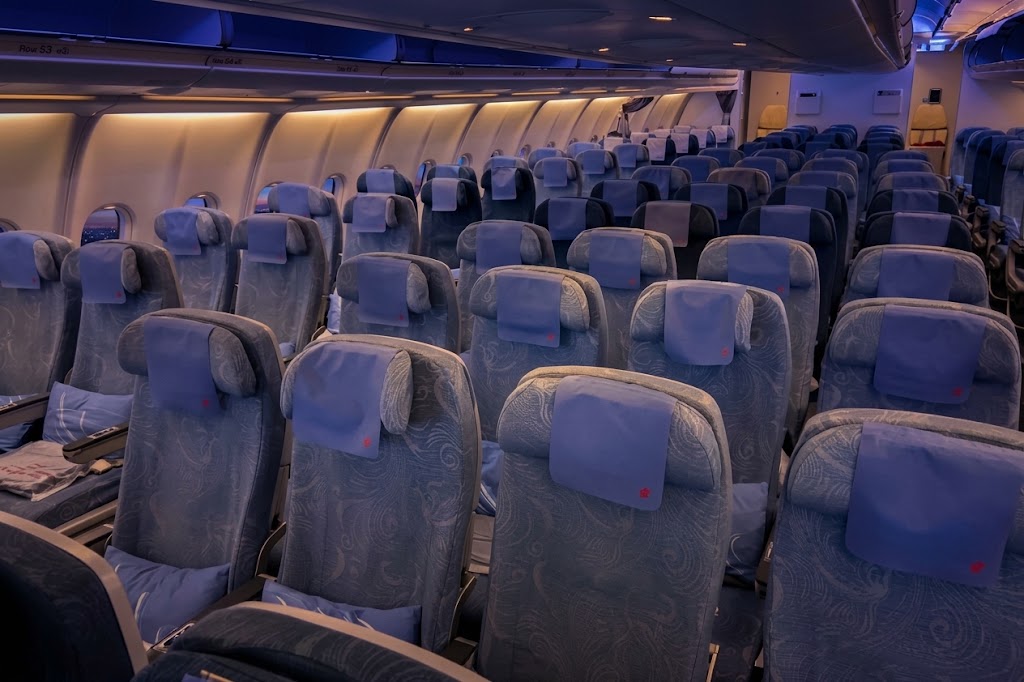
Air China’s A330-200 economy cabin is 2-4-2 and lettered A C | D E F H | J L. There is no B, no G and no K anywhere on the aircraft. If you are used to a European or American widebody and you ask for 40B or 40K, you are asking for seats that do not exist.
The practical consequence is a good one: the window pair is A and C, and there is no middle seat in it. Two people booking A and C get a window and an aisle with nobody between them, on either side of the aircraft, in any row. The middles are D, E, F and H in the centre block — and E and F are the two genuinely stuck seats.
Business is 2-2-2, lettered A C | D H | J L. D and H are the centre pair and both are recorded with direct aisle access. A and L are window seats you reach past C and J.
The version lottery: how much Business, and where everything moves
| 265-seat jet | 237-seat jet | 283-seat jet | |
|---|---|---|---|
| Business | 18 seats, rows 11–13 | 30 seats, rows 11–15 | 12 seats, rows 11–12 |
| Economy | 247 seats, rows 31–62 | 207 seats, rows 31–57 | 271 seats, rows 31–65 |
| Exit-row bulkhead | Row 48 | Row 43 | Row 51 |
| The two red rows | 46 and 47 | 41 and 42 | 49 and 50 |
| Best tail row | 61 | 56 | 64 |
| Forward bulkhead, row 31 | Extra legroom on all seven, but 31A and 31C sit beside a lavatory | Extra legroom on the outboard seats, generous bulkhead legroom on 31D/31E/31H | Tighter than a normal bulkhead on 31A, 31C, 31J and 31L |
| Extra bad zone | None | None | Rows 33 and 34 — row 33 loses its recline, row 34 sits against a lavatory |
Fleet records rank the 265-seat layout as the largest of the three sub-fleets, the 237-seat one next and the 283-seat one smallest. We are not going to turn that into a percentage — the underlying figures are not a reliable aircraft count — but the ordering is worth knowing when you are guessing what you will draw.
The trap that repeats on all three: two red rows ahead of the exit
Every one of the three configurations has the same structure in the middle of the economy cabin, at different row numbers.
The exit-row bulkhead — 43, 48 or 51 — has the legroom, and the four seats with the most of it are the ones you should not book. 43D/43E/43F/43H, 48D/48E/48F/48H and 51D/51E/51F/51H are rated red on their respective aircraft: they get extra-generous bulkhead legroom and a lavatory immediately adjacent, which on a long sector is the door, the light and the queue for the whole flight.
The four outboard seats in the same row — A, C, J and L — are the amber ones. They get extra legroom rather than the bulkhead-generous kind, and lavatory traffic rather than the lavatory itself. A and L additionally take the exit door curving into their space, which leaves 43C and 43J, 48C and 48J, or 51C and 51J as the best seats in the exit row on each aircraft.
And the two rows immediately ahead of it — 41 and 42, 46 and 47, or 49 and 50 — are rated red across all sixteen seats. A lavatory is immediately behind them, and the second of the pair loses its recline entirely to the exit-row clearance requirement.
That is 24 problem seats in a four-row block in the middle of every Air China A330-200, and on a booking map it looks like the middle of the cabin.
Business: take the centre pair
The Business cabins differ in length but not in shape — all three are 2-2-2 lettered A C | D H | J L, and in all three the seats rated green are the same ones: the D and H centre pair, in every row.
That is because D and H each have an aisle on one side and only each other on the other, so neither passenger climbs over anyone. A and L are window seats reached past C and J.
| Jet | Business rows | The picks | The catch |
|---|---|---|---|
| 237-seat | 11–15 (30 seats) | 11D, 11H, 12D, 12H, 14D, 14H, 15D, 15H — all green | 13D and 13H are amber — the galley is behind them |
| 265-seat | 11–13 (18 seats) | 11D, 11H, 12D, 12H — green | 13D and 13H are amber — galley behind |
| 283-seat | 11–12 (12 seats) | 11D and 11H only — the two green seats in the cabin | Row 12 is amber across all six seats, and 11A and 11L are amber too |
On the 283-seat jet the Business cabin is only two rows and only two seats in it are rated green. If you are paying for Business on this aircraft, 11D or 11H is a materially better seat than anything else on offer.
Economy: the tail is the pick
The economy cabin narrows towards the back and the last full row on each aircraft drops its F seat, leaving a seven-seat row: A C | D E H | J L. On all three configurations, that row is where the green seats are.
56A, 56C, 56J and 56L on the 237-seat jet, 61A, 61C, 61J and 61L on the 265-seat jet, and 64A, 64C, 64J and 64L on the 283-seat jet are all rated green, and all of them are recorded with direct aisle access and nobody to climb over. On the 283-seat jet, 64D also has no seat beside it.
Behind each of those is a three-seat centre-only row — 57, 62 or 65, D E H alone — which is the actual last row.
For a plain window seat further forward, the green A/L pairs are at rows 47, 49, 50, 51, 53 and 55 on the 237-seat jet; 33, 52, 54, 56, 58 and 60 on the 265-seat jet; and 36, 59, 61 and 63 on the 283-seat jet.
The 283-seat jet has a second problem zone
It is worth calling out separately because it is the only one of the three with a bad patch at the front of economy. Because its Business cabin is only two rows, the galley and lavatory complex sits further forward, and the result is that rows 31, 32, 33 and 34 are all rated amber or worse: row 31 is a tighter-than-normal bulkhead, row 33 loses its recline to the galley behind Business, and row 34 sits against a lavatory with three seats rated red.
On the other two configurations the front of economy is fine and row 31 is a genuinely roomy bulkhead.
Quick-pick summary
| You are | Book | Why |
|---|---|---|
| In Business | 11D or 11H | The centre pair in the first row — green on all three configurations, aisle each side, no galley behind |
| In Business as a couple | Any D/H pair except row 13 | Row 13 backs onto the galley on the 237 and 265-seat jets |
| A couple in economy | Any A and C pair | Window and aisle with no middle seat between you, at no extra cost |
| Alone in economy, want space | 56A/56L, 61A/61L or 64A/64L | The green tail-row seats, recorded with direct aisle access |
| Paying for legroom | The exit row — but the C or J seat only | The centre seats have the most legroom and a lavatory immediately adjacent, and A and L take the door in their space. C and J get the legroom with only the queuing traffic |
| Anyone | Avoid 41–42, 46–47 or 49–50 | Sixteen red seats immediately ahead of the exit row on every configuration |
FAQ
How do I tell which A330-200 I am on?
Count the Business rows on the seat map. Rows 11 to 15 is the 237-seat jet; 11 to 13 is the 265-seat one; 11 and 12 alone is the 283-seat one. If Business is not shown, read the last economy row instead: 57, 62 or 65.
Why are there no B, G or K seats?
The cabin is 2-4-2, so there are only eight positions across, and Air China letters them A C | D E F H | J L. Skipping B, G and K keeps A and L as the window seats and D, E, F and H as the centre block, which is a common convention on Chinese carriers. It does mean a seat map from another airline will not translate.
Which is the best of the three configurations?
The 237-seat jet, by a distance, if you are in Business — thirty seats over five rows, with eight of them the green centre-pair seats. In economy the differences are smaller, but the 283-seat jet is the one to avoid: it is the densest, it has the tightest forward bulkhead, and it is the only one with a second problem zone at rows 33 and 34.
Is the exit row worth booking?
Only the C and J seats. The centre four — 43D/43E/43F/43H, 48D/48E/48F/48H and 51D/51E/51F/51H — have the most legroom in the cabin and a lavatory immediately adjacent, and all four are rated red on each aircraft. A and L take the exit door curving into their space. C and J get the extra legroom with only queuing traffic against them, which makes them the two seats in the row worth having.
Does the A330-200 have Wi-Fi?
Wi-Fi is fitted on all three configurations, but the technology and the speed tier are not published, so treat availability as likely and performance as unknown. Seatback entertainment is Thales i5000 on the 237 and 265-seat jets and the older i4000 on the 283-seat one.