Air China A330-300 Seat Selection Guide (2026)
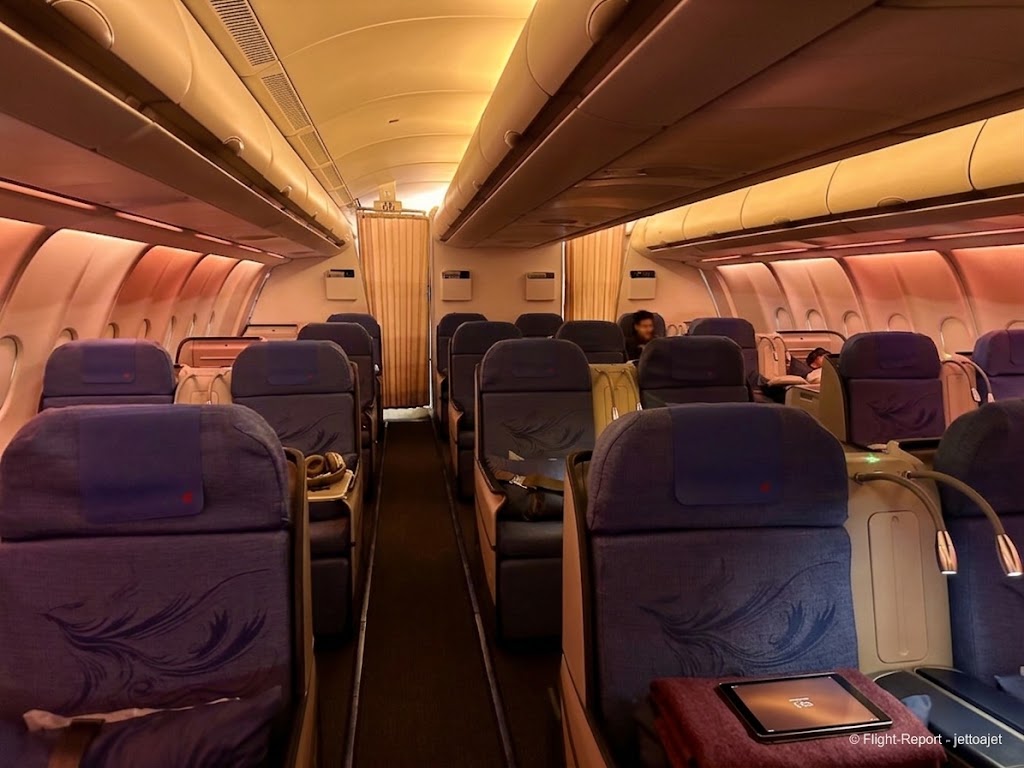
✈️ Quick Verdict
Aircraft: Airbus A330-300, 28 in the fleet, two configurations.
Config: 21 aircraft at 30 business / 16 premium economy / 255 economy (301 seats). 7 aircraft at 36 / 20 / 255 (311 seats).
Layout: Business 2-2-2 lie-flat. Premium economy 2-4-2. Economy 2-4-2.
Version lottery: Yes — and it changes the row numbers in every cabin.
Best seats: Business 11D, 11H, 13D, 13H (301-seat jet) or 11D, 11H, 15A, 15L (311-seat jet). Premium economy 32D–32H or 33D–33H. Economy 34A/34C/34J/34L on the 311-seat jet.
Seats to avoid: 15A/15L and 16A/16L (business, no window). The whole of premium economy row 31. 34A/34L and 35A/35L in economy — window seats with a blank wall.
IFE: Thales seatback screens, on-demand. Power: at seat in all cabins. WiFi: fitted; the provider is not confirmed for either variant.
The trap: in business, the window seats are the ones you climb out of
Air China's A330-300 business cabin is 2-2-2 — six seats across, in three pairs. Every booking engine will show you a window seat and quietly suggest it is the premium choice. On this aircraft it is not.
The two centre seats, D and H, are not a couple. They sit apart, each with an aisle to itself, and nobody has to step over either of them. The window seats A and L are the opposite: each is trapped behind an aisle seat. On a fourteen-hour sector that is the difference between getting up when you want to and waiting for a stranger to wake up.
Twenty of the 30 business seats on the smaller jet have direct aisle access — and A and L are not among them. The same ratio holds on the 36-seat jet: 24 of 36, with A and L again excluded. If aisle access matters more to you than the view, book D or H and stop looking at the window.
The version lottery: 301 seats or 311
Air China operates 28 A330-300s and no two cabins are numbered the same way. Twenty-one aircraft carry 301 seats — 30 business, 16 premium economy, 255 economy. The remaining seven carry 311 — 36 business, 20 premium economy, and the same 255 economy seats squeezed one row further back.
Economy is the same size on both. What moves is everything else: the business cabin gains a row, premium economy gains a row, and every economy row number shifts up by one. A seat request copied from the wrong version lands you a row out.
How to tell which version you are on
Look for a row 16 in business. If business ends at row 15, you are on the 301-seat jet. If there is a row 16, it is the 311-seat one.
Look at where economy starts. Row 33 means 301 seats. Row 34 means 311.
Look at the last row. The 301-seat jet ends at row 65, the 311-seat jet at row 66. Both last rows are three seats wide.
Business class
Both variants use a 2-2-2 lie-flat seat — Safran Aura Lite on the 301-seat jet. Pitch is in the region of 58–60 inches with a seat about 21 inches wide. The cabin runs rows 11 to 15 on the 301-seat aircraft and rows 11 to 16 on the 311-seat one, in both cases behind the forward galley and lavatories.
On the 301-seat jet (rows 11–15)
- Best overall — 13D and 13H. Centre seats with their own aisle, mid-cabin, and two rows clear of the galley behind row 15.
- Best window — 13A and 13L. The only window pods in the cabin with a properly aligned window and no galley behind them. You still climb over your neighbour.
- Also good — 11D and 11H. Front row, own aisle, first served.
- Avoid — 15A and 15L. There is no window here at all: a blank stretch of fuselage where the window should be. You are paying business fare for an inside seat.
- Think twice — 15D and 15H. Direct aisle access, but the galley is immediately behind: noise and bright light through every meal service.
On the 311-seat jet (rows 11–16)
- Best window — 15A and 15L. Aligned windows, and the last business row that has a window at all.
- Best aisle — 11D and 11H. Row 11 leads the cabin at the bulkhead, so there is extra room ahead as well as the private aisle.
- Families take note — 11A and 11L. These are bassinet positions. Passengers travelling with infants have priority and you may be asked to move. The 301-seat jet has no bassinet positions in business at all.
- Avoid — 16A and 16L. Windowless, exactly like 15A/15L on the other variant, and the galley is behind them.
Premium economy
This is the cabin where the A330-300 disappoints on both variants. Premium economy is 2-4-2 at roughly 37 inches of pitch — a real upgrade on economy's 32 — but it is parked directly behind the forward lavatories, and the front row takes the full cost of that.
301-seat jet: rows 31–32, sixteen seats
Row 31 is a bulkhead row, and a bad one. The wall sits about 25 inches ahead — closer than a typical bulkhead, so the famous bulkhead legroom is smaller than you expect. There is no underseat storage, the tray and screen live in the armrest so the seat is narrower than the spec sheet, and 31A, 31C, 31D, 31H, 31J and 31L are immediately adjacent to a lavatory. Row 32's window pairs catch the same queue.
Book 32D, 32E, 32F or 32H. Those four are the only premium economy seats on this variant with nothing flagged against them. Sixteen seats in the cabin, four of them clean.
311-seat jet: rows 31–33, twenty seats
Row 31 here is only four seats wide — D, E, F and H — because the doors take the space where A, C, J and L would go. All four sit against both a lavatory and a galley. Row 32 is lavatory-adjacent across its width. Row 33's window pairs, 33A/33C/33J/33L, measure about 36 inches, noticeably tighter than the rest of the cabin, and still catch lavatory traffic.
Book 33D, 33E, 33F or 33H. Same answer, one row further back: the centre four of the last premium row are the only clean seats.
Economy
Economy is 2-4-2 at 32 inches, 17.2 inches wide, 255 seats on both variants. The two-seat window pairs are the reason to fly an A330 in the back: no middle seat, and you are one person from the aisle.
The single best economy row is only on the 311-seat jet
Row 34 leads the economy cabin at roughly 36 to 37 inches of pitch — about five inches more than the rest of the cabin — and, unusually, it keeps normal underseat storage and a normal in-seat tray. There is no bulkhead penalty to pay for the legroom. 34A, 34C, 34J and 34L are the best economy seats on any Air China A330-300. The 301-seat jet has no equivalent: its first economy row, row 33, is an ordinary row.
Windowless window seats
Every A330-300 has a spot where the cabin's row spacing and the fuselage's window spacing fall out of step. On this aircraft it lands two rows into economy:
- 301-seat jet: 34A and 34L — wall only, no window.
- 311-seat jet: 35A and 35L — wall only, no window.
Both are sold as ordinary window seats. Neither has anything to look out of.
The mid-cabin lavatory block
A bank of lavatories and a galley sits mid-cabin, and it takes two rows with it on each side.
- 301-seat jet: avoid rows 46 and 47 entirely. Row 48 is the exit row behind them.
- 311-seat jet: avoid rows 47 and 48. Row 49 is the exit row.
The exit row is only half good
The exit row — row 48 on the 301-seat jet, row 49 on the 311-seat jet — has open space ahead and no seatback in front, which is genuine extra legroom. But it splits down the middle:
- The window pairs (A, C, J, L) are the ones to book. Extra legroom, nothing else against them.
- The centre four (D, E, F, H) have a lavatory immediately ahead. Same legroom, plus the queue standing over you for the whole flight.
On both variants the exit row seats put the tray table and screen in the armrest, which costs you an inch or so of seat width, and there is no underseat storage in the centre four.
The quiet stretch
Behind the exit row and ahead of the tail, both variants have a run of clean window seats with properly aligned windows:
- 301-seat jet: 50A/50L, 52A/52L, 54A/54L, 58A/58L.
- 311-seat jet: 51A/51L, 53A/53L, 55A/55L, 59A/59L.
The seats between them are fine; those are simply the rows where the window lines up squarely with the seat rather than sitting behind your shoulder.
The tail
The fuselage tapers over the last few rows and seats start disappearing. On the 301-seat jet rows 61 to 64 lose the F seat and row 65 is three seats wide. On the 311-seat jet the same happens from row 62, and row 66 is three wide. That taper has an upside: on the 311-seat jet 65A and 65L end up with nobody beside them and the spare floor space to themselves, 65C and 65J get an aisle to themselves, and 36J, 38J, 39J and 40J have the same solo position further forward. The downside is that the last two rows on either variant back onto the rear lavatories.
Cabin features compared
| 301-seat jet (21 aircraft) | 311-seat jet (7 aircraft) | |
|---|---|---|
| Business | 30 seats, rows 11–15, 2-2-2 Aura Lite | 36 seats, rows 11–16, 2-2-2 |
| Direct aisle access | 20 of 30 — not A or L | 24 of 36 — not A or L |
| Windowless business seats | 15A, 15L | 16A, 16L |
| Premium economy | 16 seats, rows 31–32 | 20 seats, rows 31–33 |
| Clean premium seats | 32D, 32E, 32F, 32H | 33D, 33E, 33F, 33H |
| Economy | 255 seats, rows 33–65 | 255 seats, rows 34–66 |
| Extra-legroom economy row | None — row 33 is ordinary | Row 34, ~36–37in, storage intact |
| Exit row | 48 — A/C/J/L clean, D–H face a lavatory | 49 — A/C/J/L clean, D–H face a lavatory |
| Windowless economy seats | 34A, 34L | 35A, 35L |
| IFE | Thales i5000 | Thales i4000 (older) |
Quick picks by traveller
| You are | 301-seat jet | 311-seat jet |
|---|---|---|
| Solo in business | 13D or 13H | 11D or 11H |
| Couple in business | 13A + 13C | 15A + 15C |
| Premium economy | 32D–32H centre four | 33D–33H centre four |
| Couple in economy | 50A + 50C, or 54A + 54C | 34A + 34C |
| Legroom on a budget | 48A, 48C, 48J, 48L (exit row) | 34A/34C/34J/34L, then 49A/49C/49J/49L |
| Family of four | Centre four of any row 50–58 | Centre four of any row 51–59 |
| Travelling with an infant | No bassinet positions recorded — ask at check-in | 31F, 32A, 32L, 49E, 49H — every bassinet mount here sits against a lavatory |
| Want space beside you | Row 65 (three seats wide) | 65A, 65L, 36J, 38J, 40J |
FAQ
Is Air China's A330-300 business class lie-flat?
Yes, on both variants. It is a 2-2-2 lie-flat seat — Safran Aura Lite on the 301-seat aircraft. The catch is not the bed, it is the access: only the centre seats D and H have an aisle of their own. Window passengers step over a neighbour.
Which Air China A330-300 will I actually get?
Most likely the 301-seat one — 21 of the 28 aircraft carry that layout, against 7 with 311 seats. But Air China does not distinguish them at booking, so check the seat map after ticketing and look for a row 16 in business.
Is premium economy worth it on this aircraft?
For the pitch, yes — roughly 37 inches against 32 in economy. For the position, be careful. The cabin sits right behind the forward lavatories, and only four seats on either variant escape a lavatory or bulkhead flag: 32D–32H on the 301-seat jet, 33D–33H on the 311-seat jet. If those are gone, row 34 in economy on the 311-seat jet gives you almost the same legroom for the economy fare.
Which economy seats have no window?
34A and 34L on the 301-seat jet; 35A and 35L on the 311-seat jet. All four are sold as window seats and all four face a blank wall. In business, 15A/15L (301-seat) and 16A/16L (311-seat) are the same story.
Where is the exit row and is it worth paying for?
Row 48 on the 301-seat jet, row 49 on the 311-seat jet. It is worth it at the windows — A, C, J and L — where you get open floor and no seatback ahead. It is not worth it in the centre four, where a lavatory sits immediately in front of you for the whole flight.
Is there WiFi?
Both variants are recorded as WiFi-equipped, but the system and pricing are not confirmed for either. Treat it as available but do not plan a working flight around it.
Related guides
Related Guides
- Air China 787-9 Seat Selection Guide (2026)
- Air China A350-900 Seat Selection Guide (2026)
- Air China 777-300ER Seat Selection Guide (2026)
- China Eastern A330-300 Seat Selection Guide (2026)
- China Southern A330-300 Seat Selection Guide (2026)
- Hainan Airlines A330-300 Seat Selection Guide (2026)
- Air China A330-200 Seat Selection Guide (2026)