United Airlines Boeing 737-900ER Seat Selection Guide (2026)
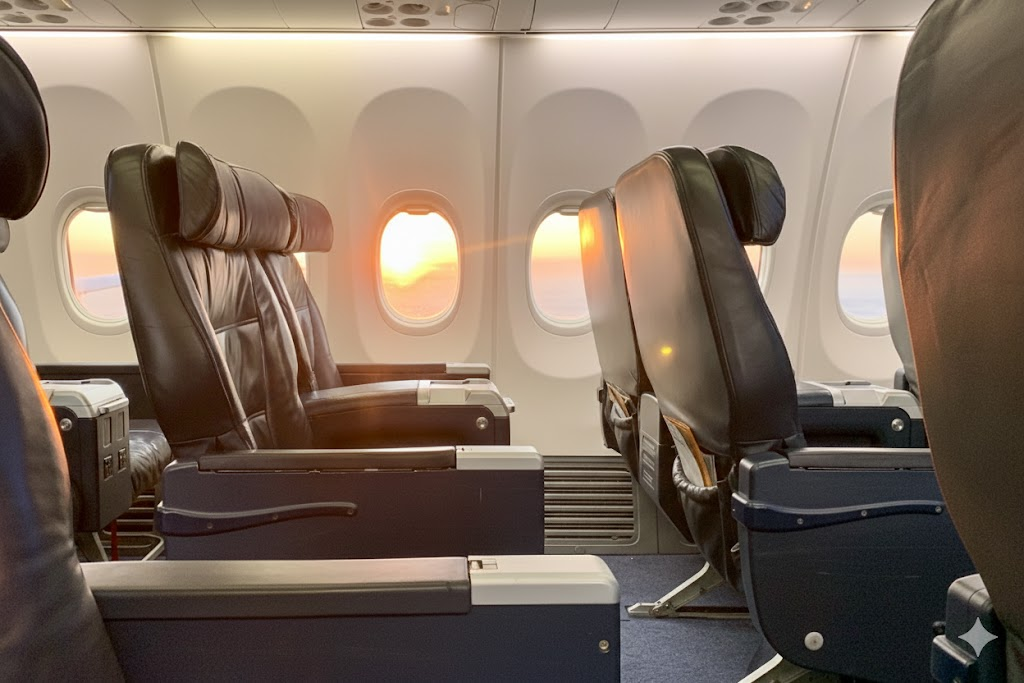
United's 737-900ER is the stretched workhorse of the domestic fleet — 136 aircraft averaging 12.7 years old, operating high-demand routes between major hubs. It carries 179 passengers in three classes: 20 First, 42–45 Economy Plus, and 114–117 Economy. With an additional 12 non-ER 737-900s (averaging 24 years old and headed for retirement), this is one of the most common aircraft types you'll encounter on United.
The 737-900ER is currently mid-transformation. A growing number have received the United Next Signature Interior with seatback HD screens, Bluetooth audio, larger Space Bins, and new First Class seats. The rest still fly with dated DIRECTV screens or streaming-only interiors. Starlink WiFi — already live on regional jets and 737-800s — is awaiting FAA certification for the 737-900ER and expected to begin installation during 2026.
The version lottery is real. Three 737-900ER sub-variants differ in Economy Plus seat count (39, 42, or 45 seats), shifting where Economy begins. Interior condition ranges from pre-merger Continental-era cabins to fully retrofitted Signature aircraft. And watch out for the 12 non-ER 737-900s — same IATA code (739), same 20-seat First Class, but a completely different layout with 167 seats and no plans for interior upgrades before retirement.
Key detail: Row 5 in First Class is the single biggest trap on this aircraft. Seats 5A/5B do not recline (lavatory wall directly behind), while 5E/5F have approximately half the recline of other First rows. This is the last row of First on all 737-900 variants and catches many passengers off guard, especially upgrades.
Quick Verdict
| Cabin | Rows | Seats | Pitch | Width | Recline |
|---|---|---|---|---|---|
| First Class | 1–5 | 20 | 36.7" | 20" | 5" (except row 5) |
| Economy Plus | 7–14 (varies) | 42–45 | 33–34" (38.8" at rows 20–21) | 17" | 3" |
| Economy | Varies–39 | 114–117 | 30.3" | 17" | 2" |
The Three 737-900ER Versions
All three carry 179 passengers with identical First Class. The difference is the Economy Plus / Economy split.
Version 1 — 39 Economy Plus (aircraft 3801–3810)
Configuration: 20F + 39 E+ + 120 Economy = 179 seats
Fleet size: ~10 aircraft (oldest 737-900ERs)
Key difference: Fewest E+ seats, most Economy rows. Economy starts earlier. These are the earliest-delivered 737-900ERs and most likely to still have pre-retrofit interiors.
Version 2 — 42 Economy Plus (aircraft 3811–3894)
Configuration: 20F + 42 E+ + 117 Economy = 179 seats
Fleet size: ~84 aircraft (bulk of fleet)
Key difference: The standard configuration. This is what you'll most likely fly. Economy Plus typically runs rows 7–14, with Economy from row 15 (or 16) through row 39.
Version 3 — 45 Economy Plus (aircraft 3895–3899)
Configuration: 20F + 45 E+ + 114 Economy = 179 seats
Fleet size: ~5 aircraft (newest delivery batch)
Key difference: These came with Boeing Space Bins from the factory — larger overhead bins with a 1:1 bag-to-passenger ratio. Three additional E+ seats compared to Version 2.
The non-ER 737-900 (12 aircraft — being retired)
Configuration: 20F + 51 E+ + 96 Economy = 167 seats
Interior: Original Continental-era cabins. DirecTV only, no seatback touchscreens. These will NOT receive the Signature Interior retrofit or Starlink. They lack the extra aft exit doors that the ER has, hence the lower capacity.
How to tell which version you have
Check your seat map on united.com after booking. Count the Economy Plus rows. The E+ section appears in a different colour. If you see only 167 total seats, you're on the non-ER (expect an older interior). For the ER variants, the E+ seat count in the booking summary tells you which version you've drawn.
Best Seats
First Class
Best: 2A/2F, 3A/3F, 4A/4F — Window seats in rows 2–4 are the sweet spot. Standard 36.7" pitch with full 5" recline. Good balance of legroom, recline, and distance from the forward galley. 2A and 3A on the left side are preferred by frequent flyers for the better window alignment.
Acceptable: Row 1 (any seat) — Bulkhead row has small footwell cutouts providing some legroom, but the cutouts are modest compared to the 737-800. Close proximity to the forward galley means noise and light from crew activity. Fixed armrests with tray tables make the seat slightly narrower. No underseat storage during takeoff and landing.
Acceptable: 2C/2D, 3C/3D, 4C/4D — Centre aisle seats with full amenities. Functional for short flights, though window seats are always preferable for privacy and resting.
Economy Plus
Best: 21A/21F — The second exit row has 38.8" pitch — more legroom than First Class. These window seats offer genuine extra space. The trade-off: a shorter armrest attached to the exit door, and no underseat storage during taxi/takeoff/landing. Fixed armrests with bi-fold tray tables make the seat slightly narrower.
Excellent: 21B/21C and 21D/21E — Exit row centre and aisle seats with the same 38.8" pitch. The middle seats here are among the last to be assigned, so they often stay empty — giving you effective extra width as well as legroom. Full recline.
Very good: 7D/7E/7F — Bulkhead row with excellent legroom thanks to a partial-height partition that lets you stretch your feet underneath. The right-side seats (D/E/F) are preferable to A/B/C because they're further from the forward lavatory.
Good: Rows 8–9 (all seats) — Standard Economy Plus with 33–34" pitch, full recline, full underseat storage. Solid, reliable choices without any quirks.
Good: Row 20 (all seats) — Exit row with 38.8" pitch, but seats do NOT recline. Excellent for daytime flights where legroom matters more than recline.
Economy
Best: Row 22A/22F, 23A/23F — First rows of Economy after the exit area. Standard 30.3" pitch with full recline and underseat storage — nothing special, but no quirks either.
Acceptable: Rows 22–28 (forward Economy) — The closer to the front, the better for deplaning speed and distance from the rear lavatory zone.
Seats to Avoid
First Class
Row 5 (the trap row): This is the most commonly reported disappointment on the 737-900ER. Seats 5A and 5B do NOT recline — the lavatory wall sits directly behind them. Seats 5E and 5F have roughly half the recline of other First rows. Passengers queuing for the mid-cabin lavatory also stand right behind row 5. On redeyes or transcontinental flights, this row is a serious downgrade from rows 2–4.
Economy Plus
11A: NO WINDOW. This is the most infamous missing-window seat on the 737 family. Air conditioning ducts behind the fuselage panel prevent window installation. The seat is still sold as a "window" seat at Economy Plus prices.
12A and 12F: NO WINDOWS. Same issue as 11A — structural ducts block window placement. 12A has one partial window (forward present, rear absent), so it's slightly better but still poor for window lovers.
9A: Misaligned window. The window doesn't centre on the seat — you'll need to lean forward or backward to see out.
Row 15 (all seats): Does NOT recline. The exit row is directly behind, so these seatbacks must remain upright.
Row 7A/7B/7C: Bulkhead with fixed armrests, no underseat storage, and proximity to the forward lavatory. Less desirable than 7D/E/F.
Economy
Row 39 (all seats): Last row, limited recline, lav proximity. Adjacent to the rear lavatories with constant foot traffic, door noise, and potential odours. Last off the plane.
Rows 37–38: Reduced seat width due to the fuselage tapering toward the tail. Row 38 also suffers from proximity to the lavatories and galley noise.
Interior Lottery: Pre-Retrofit vs Signature
Your 737-900ER experience varies dramatically depending on which interior you get.
Pre-Retrofit (still a significant portion of the fleet)
- IFE: Old DIRECTV LiveTV screens (small, low-resolution, non-touch) or streaming-only via the United app
- Power: AC outlets (110V) shared between seats — typically 2 outlets for every 3 seats in Economy. No USB ports
- WiFi: ViaSat KA-band (paid, or free for T-Mobile customers on mobile)
- Overhead bins: Standard Boeing Pivot bins — carry-on rollaboards must go in wheels-first
- Seats: Original Collins Aerospace Pinnacle seats, showing their age
Signature Interior (growing number of aircraft)
- IFE: New HD seatback screens at every seat — 13" in First, 10" in Economy — with Bluetooth audio
- Power: USB-A and USB-C at every seat (including Economy), plus AC outlets in First and Economy Plus
- Seats: New First Class seat with articulating cradle design, privacy dividers, and wireless charging
- Bins: Boeing Space Bins with 1:1 passenger-to-carry-on capacity
- Lighting: LED mood lighting throughout
- Overall: Dramatically improved experience — same seat count and pitch, but feels like a different aircraft
Starlink WiFi (Awaiting FAA Certification)
As of February 2026, Starlink has been certified and installed on United's regional fleet (300+ aircraft) and 737-800s. The 737-900ER is next in line. Once certified, expect 250–400 Mbps download speeds, free for all MileagePlus members. Pre-Starlink 737-900ERs have ViaSat KA-band (paid).
Best Seats by Traveller Type
| Traveller | First Class | Economy Plus | Economy |
|---|---|---|---|
| Solo business | 2A or 3A | 8D | 22A |
| Couple | 2A/2C or 3A/3C | 8A/8B or 9A/9B | 22A/22B |
| Window lover | 2A or 3A | 8A or 9A | 22A or 23A |
| Legroom priority | 2A (full recline) | 21B/21C (38.8" pitch) | 22A |
| Family | — | 8–9 (any) | 22–25 |
| Budget | — | — | 22–24 (avoid 37–39) |
Lavatory Warning
The 737-900ER has three lavatories: one forward (between First Class and Economy Plus, behind row 5), and two at the rear (behind row 39). That's approximately 159 Economy/E+ passengers sharing three lavatories, with most Economy passengers relying on just the two rear ones. On flights over 3 hours, expect queuing in the rear galley area around rows 37–39. The mid-cabin lavatory (behind row 5 / ahead of row 7) also creates congestion for both First Class and Economy Plus passengers.
Key Facts
| IATA code | 739 |
| Fleet size | 136 737-900ER + 12 737-900 (non-ER) |
| Average age | 12.7 years (ER); 24.1 years (non-ER) |
| Engines | Two CFM56-7B26 (26,300 lbs thrust each) |
| Total seats (ER) | 179 |
| Total seats (non-ER) | 167 |
| First Class | 20 seats (rows 1–5), 2-2 |
| Economy Plus | 42–45 seats (ER); 51 seats (non-ER), 3-3 |
| Economy | 114–120 seats (ER); 96 seats (non-ER), 3-3 |
| Seat width (Economy/E+) | 17" |
| Seat width (First) | 20" |
| Missing windows | 11A (none), 12A (partial), 12F (none) |
| No-recline rows | 5A/5B (none), 5E/5F (limited), 15 (none), 20 (none) |
| WiFi | ViaSat KA-band → Starlink (awaiting FAA cert, expected 2026) |
| IFE | DIRECTV/streaming (pre-retrofit); 10"/13" HD seatback screens with Bluetooth (Signature) |
| Lavatories | 3 (1 forward, 2 rear) |
| Last updated | February 2026 |
How to Check Your Aircraft Interior
- At booking: Go to united.com → select your flight → check "Details" for aircraft type. A 179-seat total indicates ER; 167 seats indicates non-ER
- Seat map clue: Count Economy Plus rows. 42 E+ = Version 2 (most common). 45 E+ = Version 3. 39 E+ = Version 1 (oldest). 51 E+ with 167 total seats = non-ER
- Interior check: If the seat map shows DIRECTV screens or physical remotes, you have a pre-retrofit interior. New HD touchscreens with Bluetooth = Signature Interior
- Starlink status: Check united.com flight status for the Starlink WiFi banner — not yet available on 737-900ERs as of February 2026
- Tail number: Aircraft 3801–3810 are the oldest ERs; 3895–3899 came with Space Bins from factory
Compared to Other United Narrowbodies
| Aircraft | Seats | E+ Seats | Interior | Key Advantage |
|---|---|---|---|---|
| 737-900ER | 179 | 42–45 | Mixed (lottery) | Highest capacity 737 |
| 737 MAX 9 | 179 | 48 | All Signature | Same seats, guaranteed new interior |
| 737-800 | 166 | 48–54 | Mixed (lottery) | First to get Starlink |
| A321neo | 196 | — | All Signature | Wider cabin, newest type |
| 737 MAX 8 | 166 | 54 | All Signature | Guaranteed new cabin |
If you have a choice between a 737-900ER and a MAX 9 on the same route, take the MAX 9 — it's the newer, better cabin experience with identical capacity.
Comparable Guides on SeatCompare.ai
- United Airlines 737 MAX 8 Seat Selection Guide (2026) — the direct smaller sibling with guaranteed Signature Interior
- United Airlines Boeing 737-800 Seat Selection Guide (2026) — shorter fuselage, first mainline type with Starlink WiFi
- Delta Boeing 737-900ER Seat Selection Guide (2026) — Delta's version with three different sub-variants and no power on some
← See all aircraft seat guides
FAQ
What's the difference between the 737-900 and 737-900ER?
The ER (Extended Range) has extra aft emergency exit doors, a flat rear pressure bulkhead, and strengthened wings — allowing 179 seats vs 167 on the non-ER. The non-ER 737-900s (only 12 aircraft) are being retired and have the oldest interiors in the fleet.
Does Economy have power outlets?
On pre-retrofit aircraft: AC outlets exist but they're shared — 2 outlets for every 3 Economy seats. On Signature-retrofitted aircraft: USB-A and USB-C at every seat, including Economy.
Is Economy Plus worth it?
Yes — especially exit rows 20–21 with 38.8" pitch (more legroom than First Class). Standard E+ rows at 33–34" are also a meaningful upgrade over Economy's 30.3".
Why can't I recline in row 5 First Class?
The lavatory wall sits directly behind 5A/5B, blocking any recline. 5E/5F have a close bulkhead behind them allowing only partial recline. This catches many upgrade passengers by surprise.
Why don't seats 11A, 12A, and 12F have windows?
Air conditioning ducts run through the fuselage wall at this location on all 737NG variants. Boeing places the ducts between the belly-mounted AC packs and the ceiling distribution system. This affects every 737NG operator worldwide, not just United.
Will I get seatback screens?
It depends on whether your aircraft has received the United Next Signature Interior retrofit. A majority of 737-900ERs have been retrofitted as of early 2026, but some still fly with old DirecTV screens or streaming-only. Check the seat map for clues.
When will Starlink WiFi be available on the 737-900ER?
United is seeking FAA certification for Starlink installation on the 737-900ER during 2026. Once certified, rollout should proceed quickly. Pre-Starlink 737-900ERs have ViaSat KA-band WiFi (paid, or free for T-Mobile customers).