SWISS A220-300 Seat Selection Guide (2026)
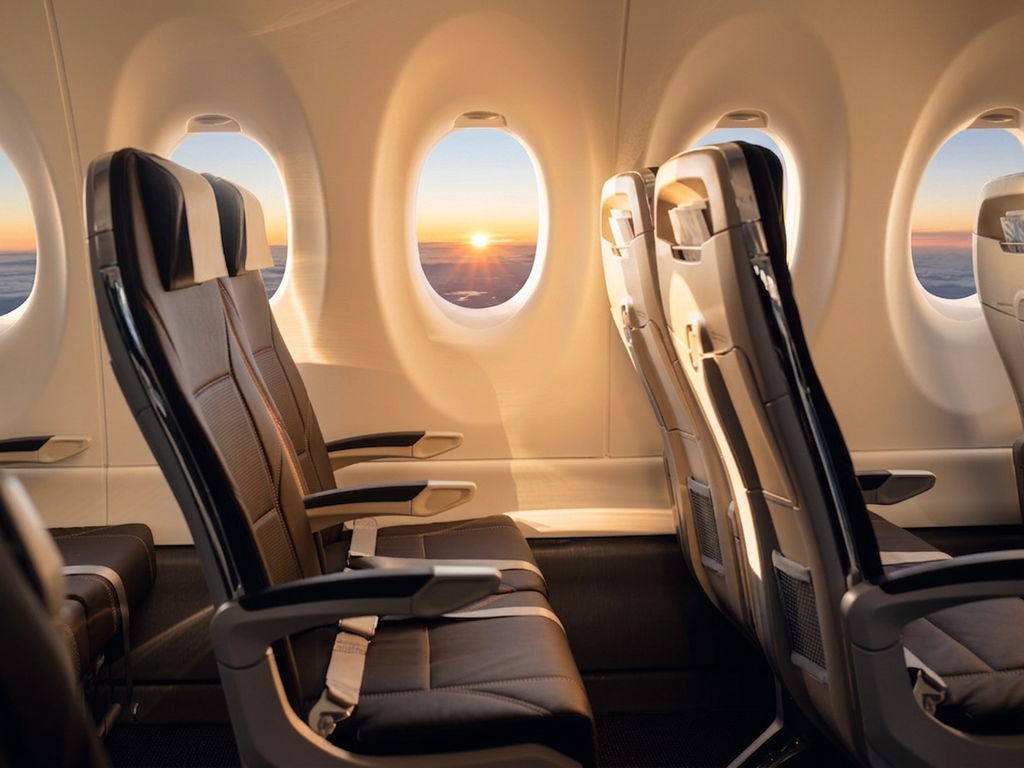
The SWISS A220-300 has no seat B and no row 13. It is a 2-3 aircraft — A and C on the port side, D, E and F on the starboard side — so every port-side row is a two-seat pair with nobody wedged in the middle. Twenty seats near the front are rated green with nothing traded away. Five at the back sit against the lavatory door.
Flying the same airframe with a different operator? See the Qantas A220-300 guide — the same aircraft at 137 seats, with a 10-seat recliner business cabin and row 13 kept in.
✈️ Quick Verdict
Aircraft: Airbus A220-300, fleet of 23
Configuration: 145 seats — 30 Business, 115 Economy (nominal: the Business curtain moves with demand)
Layout: 2-3 throughout, rows 1 to 30 — A C / D E F, there is no seat B, and row 13 does not exist
Exit row: row 12 — the overwing exit sits between rows 11 and 12
Version lottery: Yes — SWISS also flies the shorter A220-100 (125 seats, 14 aircraft)
Best seats: rows 7, 8, 9 and 10 — all five seats green in every one of them (rows 9–10 are the safest; a heavy Business load can pull the curtain back over rows 7–8)
Best legroom: row 12 at 39" — 12C, 12D and 12E are the unflagged ones, but row 12 is the exit row and carries the usual exit-row conditions
Seats to avoid: 29A, 29C, 30A, 30C, 30D — the five red seats, all at the lavatory
IFE: None — no screen data recorded and the IFE description is empty
Power / USB: Not stated — the cabin data records empty values for both
WiFi: Viasat, rated "Better", fleet-wide
Recline: 2" — no recline at rows 11 and 30
The Version Lottery — A220-100 or A220-300
SWISS flies two A220 variants, and each has its own cabin layout. Your booking may say "Airbus A220"; the seat map at selection tells you which one you actually have.
| A220-300 | A220-100 | |
|---|---|---|
| Fleet | 23 | 14 |
| Total seats | 145 | 125 |
| Business / Economy | 30 / 115 | 30 / 95 |
| Rows | 1 to 30 (no row 13) | 1 to 26 (no row 13) |
| Layout | 2-3, A C / D E F | 2-3, A C / D E F |
| Standard pitch | 28" to 32" | 30" |
| Extra-legroom row | Row 12 — 39" | Row 10 — 38" declared |
| No-recline rows | 11 and 30 | 9 and 26 |
| Space per seat | 5.7 sq ft | 5.9 sq ft |
| Red-rated seats | 5 (29A, 29C, 30A, 30C, 30D) | 0 |
| Seat | 145 ZIM EC-00 slimline | 125 ZIM EC-00 slimline |
The shorter aircraft is the more forgiving one — but only from row 14 back. The A220-100 carries a flat 30" pitch across the cabin and has no red-rated seats at all: its avoid-rated count is zero. The A220-300 stretches the same fuselage cross-section over 20 more economy seats, and it pays for them at the back — rows 14 onwards drop to 28"/29" and five seats end up rated avoid. Ahead of the exit it runs the other way. The A220-300's rows 7 to 11 are declared 32", commented at ~33", which beats the A220-100's flat 30" everywhere except its one extra-legroom row. Book the front of the -300 and you are better off; book the back and you are worse off.
The A220-300's extra-legroom row is deeper on the declared numbers — 39" against the A220-100's 38" — and its own coordinate spacing checks out: the row 11 to 12 gap of 125 px scales to 39.2" against that declared 39". Do not read that as a settled win. The same method applied to the A220-100 puts its row 10 nearer 40" than 38". Treat the two extra-legroom rows as comparable rather than ranked.
Two things to flag on the A220-100 comparison, because the underlying data does not reconcile them:
- Row 10 pitch on the A220-100 is disputed. The declared pitch is 38". The coordinate gap is 129 px against a 96 px standard, which scales to about 40.3". The same method reproduces the A220-300's declared 39" to within 0.2", so this is not a measurement artefact. Both figures stand.
- The A220-100 has fewer rated seats, not just fewer bad ones. It carries 31 rated seats (0 red, 20 yellow, 11 green) against the A220-300's 48 (5 red, 16 yellow, 27 green). An unrated seat is not a good seat — it is a seat with nothing recorded against it.
The A/C Pair Is the Whole Story
The A220 is a 2-3 aircraft: A and C on the port side, D, E and F on the starboard side. Five seats per row, not six. SWISS skips the letter B entirely, so the port pair runs A then C.
That means every single port-side row is a two-seat pair with no middle seat. A is the window, C is the aisle, and there is nobody wedged between them.
The starboard side is a conventional triple — D aisle, E middle, F window — and E is the only middle seat on the aircraft. If you are travelling as a pair, the A/C combination is the seat pairing to select, and it costs nothing to do so.
Row 13 does not exist. The cabin runs 1 to 12, then 14 to 30. Every row that exists has all five letters — there are no partial rows on this aircraft.
Business Class — Rows 1 to 6 as Mapped, but the Curtain Moves
Thirty seats across rows 1 to 6 as the cabin is currently mapped — and that is a snapshot, not a fixed boundary. This is the European short-haul convention: an economy seat sold with a blocked neighbour and a curtain that moves. On a light Business load the curtain sits forward of row 6; on a heavy one it sits aft of it, and rows that this guide calls economy are sold as Business instead. Treat "rows 1 to 6" and the 30/115 split as the mapped default, and read the boundary off the seat map at booking rather than off this page.
The cabin description states it directly:
The Business Class section is located at the front of the cabin. Here, on the port side a blocked (unoccupied) seat alternates between A and C and on the starboard side the middle seat is blocked. As is standard in European aviation, the Business section is sized dynamically where the dividing curtain moves forward/aft in accordance with demand.
A caveat you should know about before you rely on that. The blocking is described in prose only. No seat in the underlying seat data is actually marked blocked or unbookable — not one of the thirty. The blocking pattern cannot be read off the seat data, so treat the alternating A/C and blocked-E arrangement as SWISS's stated policy rather than as something verified seat by seat.
There is a second wrinkle. The seat description reads "In Business Class the E seats are not sold. On the port (AB) side, alternating seats are also blocked" — but this aircraft has no seat B. The description is using generic ABC/DEF column labels here; the port pair is A and C.
Aisle access records 0 throne seats out of 30. Nobody in this cabin has guaranteed direct aisle access from the data.
Row 1
Only one seat in the business cabin carries a rating, and it is in row 1:
- 1E — be aware. Two flags: "Tray table in armrest — narrower effective seat width" and "Near galley (behind) — expect noise and bright light during meal prep."
- 1A, 1C and 1F are unrated but all carry the tray-in-armrest comment. Same narrower effective width, no galley flag.
- 1D is unrated and adds "Partial bulkhead (45% coverage) — extra legroom on left side" to the tray-in-armrest note. It is the one row 1 seat with a legroom upside recorded.
Row 1 is also the only row where the armrests do not move: they are adjustable on "all seats with the exception of those at row 1."
Rows 2 to 6 carry no ratings and no comments at all. That is not an endorsement, it is silence. On window position, 5A and 5F each get two aligned windows; 2A, 2F, 3A, 3F, 4A, 4F, 6A and 6F get one each, all rated "average."
Economy — Rows 7 to 30
Rows 7 to 30, 115 seats, 2-3, 18" wide, 5.7 sq ft per seat, ZIM EC-00 slimline. Gasper vents throughout. No screens. Recline is 2" and there is none at all at rows 11 and 30.
Rows 7 to 10 — the best block on the aircraft
Twenty seats, all five in each row, all rated green. 7A, 7C, 7D, 7E, 7F; 8A, 8C, 8D, 8E, 8F; 9A, 9C, 9D, 9E, 9F; 10A, 10C, 10D, 10E, 10F. Every one carries the same single comment and no penalty of any kind: "Seat pitch ~85cm (33in) — 9cm more than typical for this cabin."
These are the front rows of economy, immediately behind the moving business curtain, and they are the only place on this aircraft where you get above-standard pitch with nothing traded away. If you want one recommendation from this guide, it is any seat in rows 7 to 10 — and 9A or 10A if you want the window with no middle seat beside you.
One caveat follows directly from that moving curtain: on a heavy Business load rows 7 and 8 can end up inside the Business cabin and vanish from economy seat selection altogether. Rows 9 and 10 are the safer pick — same pitch, same green rating, further from the boundary.
Two different numbers are published for this pitch. The seat comment says ~85cm (33in). The pitch data says "Rows 2 to 11: 32"". Both come from the same source, which does not reconcile them. Either way it is above the cabin's rear-section standard.
Row 11 — the good pitch, but no recline
Row 11 sits ahead of the exit. Four of its five seats are flagged.
| Seat | Rating | Why |
|---|---|---|
| 11A | Be aware | Extra pitch, but "Seat may not fully recline — exit row behind requires clear path" |
| 11C | Be aware | Same |
| 11D | Good | The one clean seat in row 11 — extra pitch, no recline flag |
| 11E | Be aware | Extra pitch plus restricted recline |
| 11F | Be aware | Extra pitch plus restricted recline |
The recline data confirms it independently: "No recline at rows 11 and 30." 11D is the pick — same pitch benefit as its neighbours, no offsetting flag. It is the starboard triple's aisle seat.
Row 12 — 39", the most legroom on the aircraft, and the exit row
Row 12 is the overwing exit row. The exit itself sits between rows 11 and 12 — which is exactly why row 11 cannot recline into it, and why row 12 gets the 39". The legroom comes with the standard exit-row conditions: you must be willing and able to help operate the door, nothing may be stowed at your feet for take-off and landing, and infants, children and unaccompanied minors are not seated there. If any of that rules you out, 11D is the fallback — the same forward-cabin pitch, no recline penalty, no exit-row duty — and after that any seat in rows 9 or 10.
| Seat | Rating | Why |
|---|---|---|
| 12A | Be aware | Extra legroom, but "Window set behind the seat — restricted view, lean back to see out". Zero aligned windows |
| 12C | Good | Extra legroom, no penalty |
| 12D | Good | Extra legroom, no penalty |
| 12E | Good | Extra legroom, no penalty |
| 12F | Be aware | Extra legroom plus misaligned window, zero aligned windows |
12C, 12D and 12E are the three extra-legroom seats left unflagged — clean of ratings penalties, though the exit-row conditions above apply to all five. 12A and 12F still get the legroom; they just get a window you have to lean back to use, which is a fair trade if legroom is what you are after. Note that 12E is a middle seat rated green — on a 39" row that is unusually defensible.
Rows 14 to 27 — pitch drops, and the windows go in and out
From row 14 the cabin tightens, to 28" on the A/C side and 29" on the D/E/F side.
A contradiction worth knowing. The pitch data limits that 28"/29" band to "Seats 14 to 20". The coordinate spacing is identical — 90 px on the A column, 91 px on the F column — for every row from 14 all the way through 30. Geometrically the tighter pitch runs to the back of the aircraft, not just to row 20. Plan for 28"/29" from row 14 onward.
Almost nothing in this stretch is rated, and the ratings that do exist are all about windows, all on the starboard side.
| Great window | Poor window |
|---|---|
| 21F, 24F, 27F | 20F, 23F, 26F |
21F, 24F and 27F are rated green with a "great" window and no comments at all — they are the three best pure window seats in the rear cabin. 20F, 23F and 26F are the seats immediately ahead of each of them and carry "Window set behind the seat — restricted view, lean back to see out."
No A-side seat between rows 14 and 27 carries a rating at all. Window status is recorded on them without attaching a colour: 14A, 15A, 16A, 18A, 19A, 21A, 22A, 24A and 27A get one "average" window each, and 17A, 20A, 23A and 26A get two. The same applies on the unrated F side — 14F, 15F, 16F, 18F, 19F and 22F at one window, 17F and 25F at two.
Rows 28 to 30 — the lavatory end
This is where the A220-300's five red seats live. Four of the five are on the port A/C pair; the fifth, 30D, is the starboard triple's aisle seat.
| Seat | Rating | Why |
|---|---|---|
| 28A | Be aware | "Near lavatory (behind) — some queuing traffic and noise" |
| 28C | Be aware | Same |
| 29A | Avoid | "Immediately adjacent to lavatory (behind) — expect noise, odors, and queuing traffic" |
| 29C | Avoid | Same |
| 29D | Be aware | Lavatory traffic behind |
| 29F | Be aware | Misaligned window |
| 30A | Avoid | Immediately adjacent to the lavatory |
| 30C | Avoid | Immediately adjacent to the lavatory |
| 30D | Avoid | Immediately adjacent to the lavatory, plus galley noise behind |
| 30E | Be aware | "Near galley (behind) — expect noise and bright light during meal prep" |
| 30F | Be aware | Galley noise behind — though it does get a "great" aligned window |
29A, 29C, 30A, 30C and 30D are the five seats to never book. Row 30 also has no recline at all, so the last row gives you a lavatory door, a galley, 28"/29" of pitch and a fixed seat back.
30E and 30F are only flagged for galley noise, not the lavatory door — if you are stuck in row 30, those two are the least-bad of the five.
28D, 28E and 28F carry no rating at all; 28F does hold two average windows.
Cabin Features
The seat data carries one cabin object for this aircraft, typed "Economy seats", covering all 145 seats. The 30/115 Business/Economy split exists in the seat counts and in the per-seat cabin field, but not as a separate cabin record — so the physical specification below is shared by both cabins, which is exactly what a Euro-business layout means.
| Whole cabin (rows 1–30) | |
|---|---|
| Seats | 145 (30 Business rows 1–6, 115 Economy rows 7–30 — nominal split; the curtain moves) |
| Rows | 1 to 12, 14 to 30 — no row 13 |
| Layout | 2-3 (A C / D E F) — no seat B |
| Exit row | Row 12 — overwing exit between rows 11 and 12 |
| Pitch (declared) | 28" to 32". Rows 2–11 at 32"; row 12 at 39"; rows 14–20 at 28" A/C side, 29" D/E/F side |
| Pitch (derived) | 28"/29" spacing runs to row 30, not row 20 |
| Width | 18" |
| Recline | 2" — none at rows 11 and 30 |
| Space per seat | 5.7 sq ft |
| Seat | ZIM EC-00 slimline |
| Adjustable armrest | Yes, except row 1 |
| Adjustable headrest | Not stated |
| Gasper vent | Yes |
| Power / USB | Not stated — both fields are empty strings |
| IFE | None recorded — no screen data, empty IFE description |
| WiFi | Viasat, rated "Better", 100% of fleet. Note: "Starlink installations starting H2 2026" |
| Privacy doors | No |
| Bluetooth / wireless charging | No / No |
| Direct aisle access | 0 of 145 seats |
Quick-Pick Summary
| If you are | Book |
|---|---|
| After the best all-round seat | Any seat in rows 7, 8, 9 or 10 — 20 green seats, above-standard pitch, no flags. Prefer 9 or 10: a heavy Business load can pull the curtain back over rows 7–8 |
| A couple who hate middle seats | 9A and 9C, or any A/C pair in rows 7–10 — a two-seat row with nobody between you |
| Tall, and legroom beats everything | 12C, 12D or 12E — 39", all three green. Row 12 is the exit row: able-bodied only, nothing at your feet for take-off. Fallback 11D, then rows 9–10 |
| Tall but want the window too | 12A or 12F — same 39" and the same exit-row conditions, but the window sits behind you. If the exit row is out, 9A or 9F |
| Want extra pitch and an aisle | 11D — the only unflagged seat in row 11 |
| Want the best window at the back | 21F, 24F or 27F — green, "great" aligned windows, no comments |
| A family of three | Row 7, 8, 9 or 10 D-E-F — the only clean green triples on the aircraft |
| Be aware, not avoid | Rows 11 (A/C/E/F), 12A and 12F, 20F, 23F, 26F, 28A, 28C, 29D, 29F, 30E, 30F, and 1E |
| Never book | 29A, 29C, 30A, 30C, 30D — the five red seats, all at the lavatory door |
How to Tell Which Version You're On
Both SWISS A220s are 2-3 with no seat B and both skip row 13, so the layout gives you nothing. Three tells actually work:
- Count the rows in the seat map at booking. The A220-300 runs to row 30. The A220-100 stops at row 26. This is the cleanest single check.
- Find the extra-legroom row. On the A220-300 it is row 12. On the A220-100 it is row 10. If the roomy row is row 10, you are on the short one.
- Count total seats. 145 means A220-300. 125 means A220-100.
A fourth tell, if the map shows it: the A220-300's last row is row 30, with a lavatory immediately behind 30A, 30C and 30D. The A220-100's last row is row 26, and none of its seats are rated avoid.
Frequently Asked Questions
Why is there no seat B on the SWISS A220-300?
The A220 cabin is 2-3, not 3-3. SWISS letters the port pair A and C and the starboard triple D, E and F, so the letter B is simply never used. Every row has five seats.
What are the best seats on the SWISS A220-300?
Rows 7, 8, 9 and 10 — all five seats in each of those four rows are rated green, with the comment "Seat pitch ~85cm (33in) — 9cm more than typical for this cabin" and no offsetting drawback. That is 20 clean seats, more than the rest of the aircraft combined.
Which SWISS A220-300 seats should I avoid?
29A, 29C, 30A, 30C and 30D — the five seats rated avoid, all flagged "Immediately adjacent to lavatory (behind) — expect noise, odors, and queuing traffic." 30D adds galley noise on top. Row 30 also has no recline.
Where is the most legroom in economy?
Row 12, at a declared 39" against a 32" forward-cabin standard. 12C, 12D and 12E are rated green; 12A and 12F get the same legroom but a window set behind the seat. Row 12 is the overwing exit row — the exit sits between rows 11 and 12 — so all five seats carry the usual exit-row conditions and are not available to infants, children or anyone unwilling to help operate the door. If that rules you out, 11D is the next best, then any seat in rows 9 or 10.
Is SWISS A220 Business Class a real business seat?
No — it is the European convention. The cabin data describes the same 2-3 economy shell with the starboard middle seat blocked and an alternating blocked seat on the port side, behind a curtain that moves with demand. Note that no seat in the payload is actually flagged as blocked, so the pattern is stated policy rather than data-verified — and because the curtain moves, "rows 1 to 6" is the mapped default rather than a fixed cabin boundary.
Does the SWISS A220-300 have WiFi and power?
WiFi yes — Viasat, rated "Better", across the whole fleet, with the fleet notes recording "Swiss Connect EAN Viasat powered in-flight wifi is currently being rolled out" and "Starlink installations starting H2 2026". Power is not stated: the power and USB fields are both empty strings, so nothing can be claimed either way. There is no in-flight entertainment system recorded.
Comparable Guides
- Qantas A220-300 Seat Selection Guide (2026) — the same airframe at 137 seats, with a 10-seat recliner business cabin and row 13 kept in
- Air France A220-300 Seat Selection Guide (2026) — the other European A220-300, with not one seat rated avoid
- Air France Boeing 787-9 Seat Selection Guide (2026) — the long-haul three-cabin comparison
- easyJet Airbus A320 Seat Selection Guide (2026) — the 3-3 European narrowbody benchmark
- SWISS Airbus A330-300 Seat Selection Guide (2026) — SWISS long-haul, mid-retrofit