ANA 787-10 Seat Selection Guide (2026)
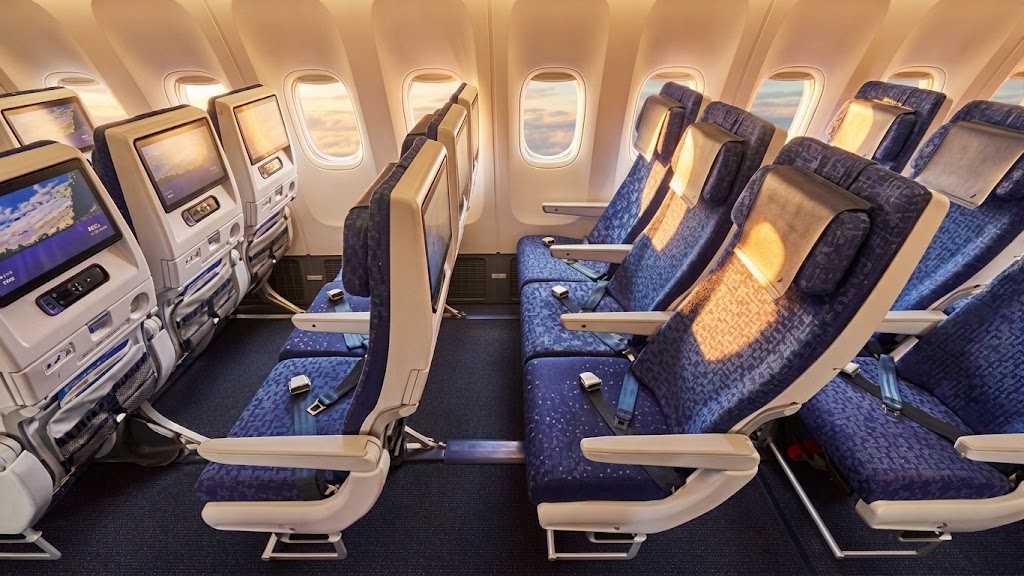
✈️ Quick Verdict
Aircraft: Boeing 787-10 — two configurations, 6 international and 9 domestic
International: 294 seats — 38 Business (THE Room, staggered 1-2-1), 21 Premium Economy (2-3-2), 235 Economy (3-3-3)
Domestic: 429 seats — 28 Premium Class (2-2-2 recliner), 401 Economy (3-3-3)
Version lottery: Yes, and it is the widest in ANA's fleet. 135 seats separate the two, and no seat number means the same thing on both.
Best seats, international: 20D, 20F and 20G — the centre bulkhead trio with 84cm (33in) of open floor ahead. In business, 4C, 4K, 10C and 10K.
Best seats, domestic: 50A, 50K, 51A and 51K — the rear taper to 2-3-2 leaves a strip of open floor beside each one.
Seats to avoid: 5A and 5H in business — suites against a windowless stretch of wall. Row 15 in international premium economy, which has the bulkhead legroom and a lavatory door in front of it. Row 32 on the domestic jet, rated lowest end to end, with no window at all at 32A and 32K.
IFE: Safran RAVE, on demand, on both versions.
Wi-Fi: Panasonic eXConnect Ku-band, fleet-wide on both.
Two aircraft wearing the same type code
Most version lotteries turn on a retrofit or a leased airframe with someone else's cabin in it. This one is deliberate. ANA built the 787-10 into two entirely separate products: a three-class international jet for long-haul, and a two-class domestic jet designed to move very large numbers of people between Japanese cities at peak times.
The gap is 135 seats. Economy alone runs 235 seats internationally against 401 domestically — 28 rows of economy against 47, in the same fuselage. Booking one when you expected the other is not a matter of losing an inch of pitch; it is a different flight.
| International (294) | Domestic (429) | |
|---|---|---|
| Aircraft | 6 | 9 |
| Front cabin | 38 Business, staggered 1-2-1, rows 1–10 | 28 Premium Class, 2-2-2 recliner, rows 1–5 |
| Direct aisle access up front | 100% — every seat | 64% |
| Premium economy | 21 seats, 2-3-2, rows 15–17 | None |
| Economy | 235 seats, rows 20–47 | 401 seats, rows 6–52 |
| Row 1 | Two seats: 1A and 1H | Four seats: 1A, 1C, 1H, 1K |
| Last row | 47 | 52 |
How to tell in three seconds. Look at row 1. Two seats — 1A and 1H, nothing between them — and you are on the international jet with THE Room. Four seats across and you are on the domestic one. If you would rather check the back: the international cabin ends at row 47, the domestic at row 52.
International: Business (THE Room)
Thirty-eight suites in a staggered 1-2-1 across rows 1 to 10. Every seat has direct aisle access, and all 38 are private, enclosed positions — there is no bad seat in this cabin in the structural sense. The stagger alternates: odd rows are lettered A, D, F and H; even rows are C, E, G and K. Row 1 has only 1A and 1H.
The trap in a cabin with no bad seats: 5A and 5H. Both are proper window suites in every respect except the window. The pod sits against a windowless stretch of fuselage wall, so you get the suite and the privacy and no view at all. On a daytime flight to Europe that is a real loss, and nothing on the booking map distinguishes 5A from 4C.
- Best windows: 4C, 4K, 10C and 10K — the four suites with a properly aligned window at the pod.
- Best for two people together: the centre pair in any row — 3D and 3F on an odd row, 4E and 4G on an even one. The stagger means the letters change row to row, so book by position rather than by letter. Both seats keep direct aisle access and neither is separated from the other by an aisle.
- Best solo: 1A or 1H — the two suites in row 1, at the very front, with nothing beside them and the smallest cabin footprint to walk past.
- Leave: 5A and 5H for the missing window. 10E and 10G have a lavatory immediately behind, though it is curtain-separated and a cabin this size generates little queuing.
International: Premium Economy
Twenty-one seats in three rows of 2-3-2 — A and C, then D, F and G, then H and K. It is a small cabin and the row you want is not the one that looks best.
Row 15 is the trap. It is the bulkhead row, so it carries extra legroom and no seat in front — and the lavatories sit immediately ahead of it. 15A, 15C, 15D, 15G, 15H and 15K all rate at the bottom of the cabin for exactly that reason: on a ten-hour sector you are looking at a lavatory door and listening to the queue that forms in front of it. Only 15F escapes the worst of it, sitting far enough inboard to be merely near the traffic rather than against it.
- Best: row 17. The rearmost premium economy row, clear of the lavatories, with no flags against any of its seven seats. 17A and 17K for a window, 17D or 17G for an aisle.
- Second: 16C, 16F and 16H — row 16 without the misaligned windows or the lavatory proximity.
- Leave: the whole of row 15 unless legroom outweighs everything else for you, and 16A and 16K, where the window sits behind the seat.
International: Economy
235 seats in 3-3-3 — A, B, C on the left, D, F, G in the centre, H, J, K on the right — running from row 20 to row 47. Just under half the cabin has direct aisle access, which is the best a 3-3-3 can do.
The seats worth going out of your way for
- 20D, 20F and 20G — the most legroom in economy by a distance. Row 20 is a three-seat centre block on its own, with 84cm (33in) of open floor to the bulkhead ahead — which makes 20F a middle seat you would actually choose. The trade is real, and all three carry a caution for it: nothing goes under the seat in front because there is no seat in front, and both the tray table and the screen live in the armrest, so the seat sits narrower than the rows behind.
- 32B and 32J — the exit row at door 3, with extra legroom and no seatback in front, and without the door intrusion that affects 32A and 32K or the galley noise that affects 32C and 32H.
- 34D, 34F and 34G — the second centre bulkhead, with 73cm (29in) to the wall. Same armrest-tray trade as row 20, and a shorter run of open floor.
- 21A, 21B, 21J and 21K — bulkhead legroom on the outer blocks. 21C and 21H do slightly better still, with a partial bulkhead leaving open floor on the aisle side.
- 35A, 35K, 40A, 40K, 45A and 45K — the six best-aligned window seats in the cabin.
- Row 33 — a plain six-seat row behind the exit with nothing flagged against it. Unremarkable, which after rows 30 to 32 is the point.
The seats to leave
- Rows 30 and 31 — the mid-cabin lavatory bank. 30C, 30D, 30F, 30G, 30H, 31B, 31C, 31H and 31J are immediately adjacent to a lavatory door.
- Rows 46 and 47 — the rear lavatories, and the lowest-rated block in economy. 47B and 47J are solo seats with nobody beside them and the spare underseat space, which is the one consolation back here.
- 32A and 32K — exit-row legroom, but the door itself curves into the footwell, starting 45–50cm ahead, so your legs go out at a diagonal.
- 23A, 23K, 28A, 28K, 34A, 34K — windows set behind the seat. 42A and 42K have the window ahead of the seat instead.
- 29D, 29F, 29G — the centre block backing onto the mid-cabin lavatories.
Domestic: Premium Class
Twenty-eight recliners in 2-2-2 across rows 1 to 5, with row 1 carrying only the window pairs — 1A, 1C, 1H and 1K, no centre. ANA publishes the domestic Premium Class seat at roughly 127cm of pitch and 56cm of width.
- Best: row 1 — the bulkhead, open floor ahead, and only four seats in it. 1A and 1K are the picks.
- Best windows: 4A and 4K, the two seats in this cabin with a properly aligned window.
- Best solo: any of 2D, 2G, 3D, 3G, 4D, 4G, 5D or 5G. The centre pairs each have their own aisle, so nobody climbs over anybody.
- Note: the window pairs A/C and H/K do not both have aisle access — 64% of this cabin does, against 100% on the international jet's business cabin.
Domestic: Economy, all 401 of them
Forty-seven rows of 3-3-3 from row 6 to row 52, with four rows cut short by doors and galleys and two more tapering at the tail. This is one of the highest-capacity single-deck economy cabins flying anywhere, and where you sit in it matters more than usual.
The seats worth going out of your way for
- 50A, 50K, 51A and 51K — the standout. The rear cabin tapers from 3-3-3 to 2-3-2 for its last two full rows, and the window seats end up with an open strip of floor beside them and the neighbouring underseat space to themselves. Four seats out of 401 with elbow room.
- 51A and 51K specifically also carry a properly aligned window, which 50A and 50K do not quite manage.
- 50C, 50H, 51C and 51H — the same two rows on the aisle, each with direct access and nobody to climb over.
- 15D, 15F and 15G — the centre bulkhead trio with 75cm (29in) to the wall. The outer seats of row 15 are a different story, below.
- 33K — the exit row at door 3 with extra legroom and no seatback ahead, and the only seat in that row not hard against a lavatory door or the door surround.
- Row 6 — the forward bulkhead, extra legroom across all nine seats. 6C and 6H do best, with a partial bulkhead leaving open floor on the aisle side.
- 8A, 8K, 38A, 38K, 42A, 42K, 46A and 46K — the best-aligned windows down the length of the cabin.
The seats to leave
Row 32 is the worst row on either version. All nine seats rate at the bottom of the cabin. Seven of them are immediately adjacent to a lavatory door. And 32A and 32K — the two window seats — have no window at all: wall only. There is nothing to recommend about any seat in this row.
- 15A, 15B, 15C, 15H, 15J and 15K — bulkhead legroom with a lavatory door immediately in front. The same trap ANA sets in international premium economy, repeated here at scale.
- 33A — the exit door L3 curves into the footwell from 50cm ahead, so the legs go out at a diagonal. 33B, 33C, 33H and 33J have a lavatory ahead instead.
- Row 52 — the last row, three centre seats only, with the rear galley and lavatories behind.
- 13D, 13F, 13G, 14D, 14F and 14G — the short centre rows backing onto a galley.
- 7A, 7K, 11A, 11K, 18A, 18K, 22A, 22K, 26A, 26K, 30A, 30K, 36A, 36K, 45A, 45K, 49A and 49K — a long list of window seats where the window sits behind the seat. On a cabin this size the misalignment repeats every four rows or so; if the view matters, use the list of good windows above rather than picking a window at random.
- 16A to 16K and 34C, 34H — near-lavatory traffic without being right against a door.
Quick-pick summary
| If you are… | International (294) | Domestic (429) |
|---|---|---|
| Tall, in economy | 20D, 20F or 20G | 33K, or 15D/15F/15G |
| Solo, want space | 47B or 47J | 50A, 50K, 51A or 51K |
| A couple, premium cabin | A D/E or F/G centre pair | 2D + 2G, or 1A + 1C |
| After the view | 35A, 40A, 45A; 4C or 10C in business | 38A, 42A, 46A, 51A; 4A in Premium Class |
| Sleeping | Rows 35–45, window, away from both lav banks | Rows 37–44, window |
| Off the aircraft fastest | 21C or 21H | 6C or 6H |
| Travelling with a child | Rows 24–28, centre block | Rows 19–29, centre block |
| Booking on price alone | Rows 35–45; skip 30, 31, 46, 47 | Rows 17–31 and 35–49; skip 32 and 52 |
Comparable guides
- ANA 787-9 — the shorter 787 with the same split between domestic and international cabins
- ANA THE Room FX — the next-generation business seat, and how it differs from the suites on this aircraft
- ANA 787-8 — the smallest of the three 787s in the fleet
- ANA 777-300ER — the other long-haul THE Room aircraft
- ANA 737-800 — the narrowbody on the same domestic routes as the 429-seat 787-10
Frequently asked questions
Does the ANA 787-10 have THE Room?
The international version does — 38 suites in a staggered 1-2-1 across rows 1 to 10, every one with direct aisle access. The domestic version has no business class at all: its front cabin is 28 Premium Class recliners in a 2-2-2, which is a domestic product and not comparable. If the booking shows a front cabin of five rows rather than ten, you are not getting a suite.
Which ANA 787-10 business seats have no window?
5A and 5H. Both are window-side suites whose pod sits against a windowless stretch of fuselage wall. Everything else about them is normal, which is exactly why they catch people out. The best-windowed suites are 4C, 4K, 10C and 10K.
Is the bulkhead row in ANA premium economy worth taking?
Usually not. Row 15 has the legroom and no seat in front, but the lavatories sit immediately ahead, and six of its seven seats rate at the bottom of the cabin because of it. On a long sector, row 17 — clean, unflagged, three rows back — is the better seat even though it looks less generous on the map.
What is the worst seat on the ANA 787-10?
32A or 32K on the domestic version. They are window seats with no window — wall only — in a row where all nine seats are rated at the lowest grade and seven of them sit against a lavatory door. On the international version, the equivalent block is rows 46 and 47 at the rear lavatories.
Why does the domestic 787-10 carry 429 seats?
It is built for the busiest Japanese domestic trunk routes, where the constraint is slots rather than range. Removing the business and premium economy cabins and replacing them with a five-row Premium Class recliner section frees the rest of the fuselage for 401 economy seats across 47 rows — against 28 rows on the international jet. The seat is not a long-haul seat and it is not sold as one.
Are there any seats with nobody beside them in economy?
Yes, on both. On the domestic jet, 50A, 50K, 51A and 51K sit in the rear taper where the cabin narrows to 2-3-2, leaving an open strip of floor and the neighbouring underseat space. On the international jet, 47B and 47J have the same arrangement in the last row — though there the rear lavatories are immediately behind you.