ANA 767-300ER Seat Selection Guide (2026)
✈️ Quick Verdict
Aircraft: Boeing 767-300ER — two cabins, international and domestic
Config: 202 seats (35 Business + 167 Economy, 6 aircraft) or 270 seats (10 Premium Class + 260 Economy, 9 aircraft)
Version lottery: Yes, and it is the widest on the type. Economy goes from 167 seats to 260; the front cabin goes from 35 seats to 10
The one-look test: economy starts at row 15 on the international jet and row 5 on the domestic one. The last row is 39 against 43
Best seats — front cabin: the D column. 1D to 7D internationally, 1D and 2D domestically — solo seats with an aisle on each side and nobody to climb over
Best seats — economy: 26A/26K and 33A/33K internationally · 21A and 21K domestically, the only two seats in the roomy mid-cabin row that dodge the lavatory door
Seats to avoid — international: rows 16 and 17. All seventeen seats carry a lavatory note and every seat in row 17 loses its recline
Seats to avoid — domestic: 17A and 17K — no window at all, wall only · and rows 40 to 43 at the rear lavatories
IFE: Panasonic eX2 on demand internationally · streamed to your own device domestically · Wi-Fi: OnAir satellite, 10–40 Mbps, on both
One type code, ninety-three seats of difference
ANA operates the Boeing 767-300ER in two configurations, and the gap between them is unusually large even by the standards of a carrier that runs separate domestic and international fleets. The international jet is recorded at 202 seats — 35 in Business, 167 in Economy, across six aircraft. The domestic jet is recorded at 270 seats — 10 in Premium Class, 260 in Economy, across nine aircraft.
Economy grows by ninety-three seats. The front cabin shrinks by twenty-five. Same fuselage, same doors, same type code on your ticket.
In practice the route tells you which one you are on: the 202-seat cabin flies ANA’s shorter international sectors and the 270-seat cabin flies within Japan. But route is not a guarantee, and the seat map is, so the reliable check is where economy begins. Economy starts at row 15 on the international jet and at row 5 on the domestic one, because the international Business cabin occupies seven rows and the domestic Premium Class cabin occupies two. The other giveaway is the last row: 39 against 43.
Business and Premium Class: take the D column
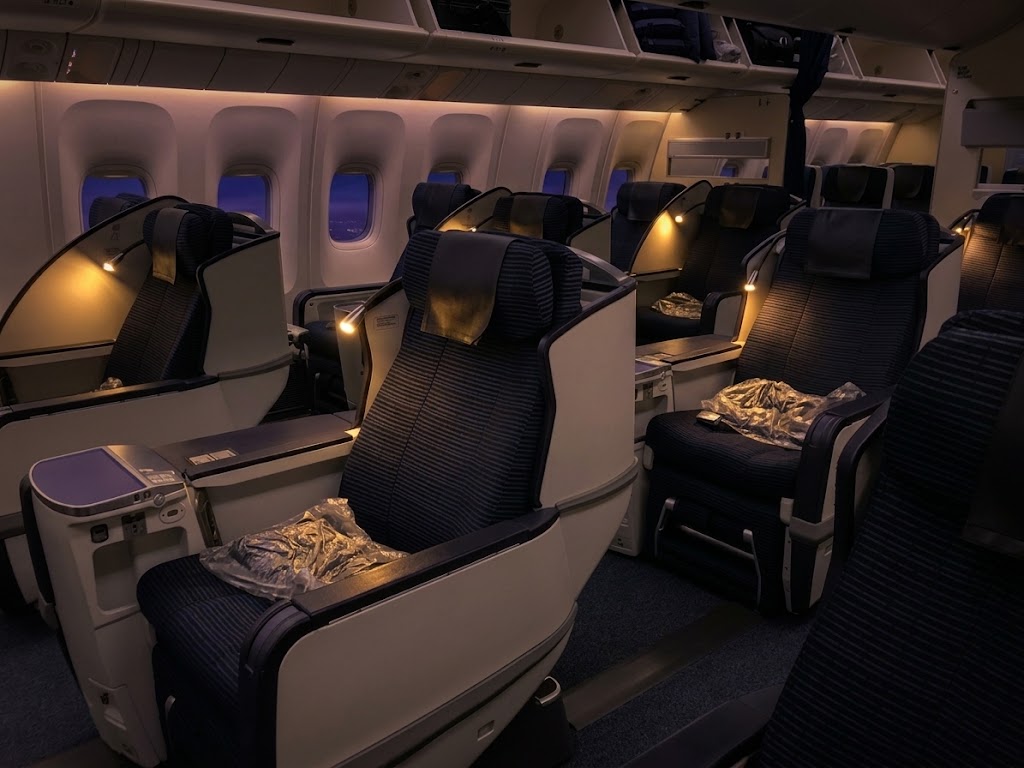
Both cabins use the same 2-1-2 shell — A C | D | H K. The international jet fills seven rows of it, the domestic jet two.
The D column is the reason to care. Every D seat is a solo seat with an aisle on both sides, no neighbour, and nobody to climb over. 1D through 7D on the international cabin and 1D and 2D on the domestic one are the strongest seats on either aircraft, and on the international jet they account for seven of the thirteen seats in the cabin that rate best outright. Direct aisle access across the whole Business cabin runs to 60 per cent, and the seats that miss out are the A and K windows: they sit outboard of C and H, so a window seat here costs you a climb past a neighbour every time you get up.
On the international cabin 3A and 3K are the pick of the windows — two windows each and nothing else attached. Row 1 is the one to skip: all five seats sit against the forward galley, and 5A has its window set behind the seat.
On the domestic cabin 1C and 1D rate best; 1C gets a genuine partial bulkhead with foot room to one side. Skip 1H and 1K, which take the galley noise.
One thing this cabin is not: a bed. No seat on the 767-300ER is recorded as lie-flat in either configuration. This is a cradle recliner — a comfortable regional Business seat with generous pitch, and not the staggered flat product ANA fits to its 787s and 777s. If you are booking a long overnight and the aircraft comes up as a 767, that is worth knowing before you pay a Business fare for it.
International economy: rows 16 and 17 are the trap
The 167-seat economy cabin runs from row 15 to row 39 in a 2-3-2 layout — A C | D F G | H K.
Row 15 is the forward bulkhead and it does what bulkheads do: extra legroom on all seven seats, no underseat storage, and the tray and screen live in the armrest, so the seat is narrower than the seat map makes it look. 15D and 15G are walled off at 90 to 95 per cent coverage, which is recorded as having little practical benefit — you get the bulkhead without the foot room.
Directly behind it is the problem. Every one of the seventeen seats in rows 16 and 17 carries a lavatory adjacency or a queuing note, and all seven seats in row 17 also lose their recline to the wall behind them. Two consecutive rows, seventeen compromised seats, sitting immediately behind the row most people are trying to book. 16A and 16K also have their windows set behind the seat.
Row 18 is the four-seat row on the far side of the mid-cabin monuments — A C | H K only, no centre block. It carries extra legroom and no underseat storage, and the lavatory traffic arrives from in front rather than behind. It is a real legroom row and a fair trade, provided you know what you are sitting next to.
Further back, 26A, 26K, 33A and 33K are the clean window picks. Windows sit out of line at 16A, 16K, 23A, 23K, 30A, 30K, 37A and 37K — on those you lean back to see out. At the very rear, rows 37 and 38 sit in lavatory traffic and row 39 is 39A and 39C alone and does not recline.
Domestic economy: the roomiest row is also a lavatory row
The 260-seat cabin runs row 5 to row 43, same 2-3-2 layout, and it holds the two most expensive mistakes available on the type.
17A and 17K have no window at all. Wall only. They are the only two seats on the aircraft with that fault, they carry no other warning, and on a booking screen they look like ordinary window seats. If you have paid for a window on this aircraft, those are the two seat numbers to check first.
The second one is row 21. It is the mid-cabin bulkhead, it has extra legroom on all seven seats, and it is one of the worst-rated rows on the aircraft — because 21C, 21D, 21F, 21G and 21H sit immediately against a lavatory ahead. Five of the seven roomiest economy seats on the aeroplane are pressed up against a lavatory door. 21A and 21K are the exceptions: they take the same legroom with queuing traffic nearby rather than the door itself, which makes them the two seats worth having in the row and among the best in the cabin.
Row 5 is the forward economy bulkhead and it is tighter than a bulkhead usually is. The wall sits 43cm (17in) ahead of 5H and 5K, 49cm (19in) ahead of 5A and 5C, and 50cm (20in) ahead of the centre block. That is a bulkhead row where the front row of the cabin gives you less room than an ordinary seat, not more.
Rows 19 and 20 are partial — row 19 loses H and K, row 20 is 20A and 20C alone. 19A and 19C may not fully recline because the exit path has to stay clear, and 20A and 20C lose recline to the wall. The rear block, rows 40 to 43, sits against the lavatories and the galley; row 43 is 43D, 43F and 43G alone and does not recline.
The clean picks in the middle of the cabin are 7A/7K, 9A/9K, 15A/15K, 29A/29K and 36A/36K. Windows sit out of line at 6A, 6K, 13A, 13K, 14A, 14K, 16A, 16K, 26A, 26K, 33A, 33K and 40K.
Cabin features side by side
| International (202) | Domestic (270) | |
|---|---|---|
| Aircraft recorded | 6 | 9 |
| Front cabin | Business, 35 seats, rows 1–7 | Premium Class, 10 seats, rows 1–2 |
| Front cabin layout | 2-1-2 cradle recliner, not lie-flat | 2-1-2 cradle recliner, not lie-flat |
| Direct aisle access up front | 60% — C, D and H only | 60% — C, D and H only |
| Economy | 167 seats, rows 15–39 | 260 seats, rows 5–43 |
| Economy layout | 2-3-2 — A C | D F G | H K | 2-3-2 — A C | D F G | H K |
| Legroom row | Rows 15 and 18 | Rows 5 and 21 |
| Seats with no window | None | 17A, 17K |
| Worst block | Rows 16–17 (17 seats) | Rows 40–43 and 21C–21H |
| IFE | Panasonic eX2, on demand | Streamed to your own device |
| Wi-Fi | OnAir satellite, 10–40 Mbps | OnAir satellite, 10–40 Mbps |
Quick picks by traveller
| You are | International (202) | Domestic (270) |
|---|---|---|
| Travelling alone up front | Any D seat, rows 1–7 | 1D or 2D |
| Window seat up front | 3A or 3K | 1A or 2A — expect to climb past a neighbour |
| Legroom on a budget | 18A, 18C, 18H, 18K | 21A or 21K |
| A couple, no middle seat | Any A/C or H/K pair | Any A/C or H/K pair |
| Family of three | Centre block D F G, rows 19–36 | Centre block D F G, rows 22–39 |
| Quiet window, nothing attached | 26A, 26K, 33A, 33K | 29A, 29K, 36A, 36K |
| Avoid at all costs | Rows 16 and 17 | 17A, 17K and row 43 |
How to tell which one you are booked on
1. Look at where economy starts. Row 15 means the international 202-seat cabin. Row 5 means the domestic 270-seat cabin. This is the fastest check and it never lies.
2. Look at the last row. 39 is international. 43 is domestic.
3. Count the rows up front. Seven rows of Business is the international jet. Two rows is the domestic one.
4. Check row 18. On the international cabin it is four seats — A, C, H and K, with a gap where the centre block would be. Nothing like that appears on the domestic cabin, where row 18 is a full seven seats.
Frequently asked questions
Is ANA’s 767 Business class lie-flat?
No. Neither the 202-seat international cabin nor the 270-seat domestic one records a single lie-flat seat. Both use a 2-1-2 cradle recliner. ANA’s flat-bed Business products are on the 787 and 777 fleets, and if a flat bed matters for your sector it is worth checking the aircraft type before you book.
Which seat is best if I am travelling alone?
Any seat in the D column of the front cabin. It is a single seat with an aisle on both sides, so nobody sits beside you and nobody has to climb over you. There are seven of them on the international jet (1D to 7D) and two on the domestic one (1D and 2D).
Are 17A and 17K really windowless?
On the 270-seat domestic cabin, yes — both are recorded as having no window at that seat position, wall only. They are the only two seats on the aircraft with that fault. On the 202-seat international cabin, row 17 is a different matter entirely: those seats have windows but lose their recline and sit in lavatory traffic.
Is row 21 worth booking on the domestic 767?
21A and 21K, yes — the extra legroom without the lavatory door. 21C, 21D, 21F, 21G and 21H, no: they have the same legroom and sit immediately against a lavatory ahead, which is why they rate among the worst seats in the cabin despite being the roomiest.
Does the 767 have Wi-Fi?
Both configurations are equipped with OnAir satellite Wi-Fi at 10 to 40 Mbps. In-flight entertainment differs: the international cabin has Panasonic eX2 with audio and video on demand, while the domestic cabin streams to your own device.
How many 767-300ERs does ANA operate?
Six aircraft are recorded in the 202-seat international layout and nine in the 270-seat domestic one. ANA’s published fleet prose describes a larger 767 fleet overall, so treat those as the counts for these two specific cabins rather than a total.