United Airlines Boeing 767-300ER Seat Selection Guide (2026)
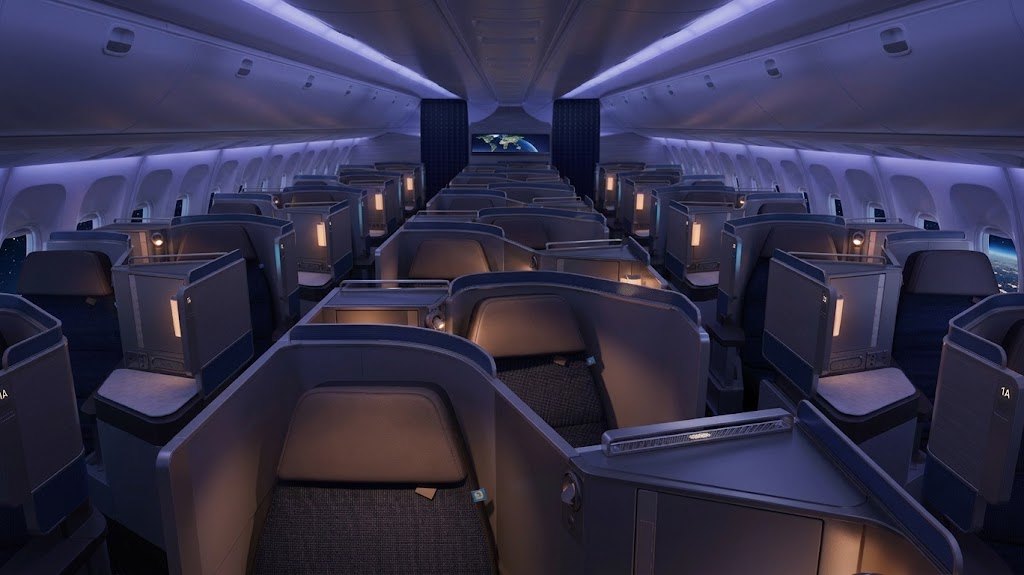
✈️ Quick Verdict
United flies 37 Boeing 767-300ERs in two very different configurations: High-J (24 aircraft, 46 Polaris, 167 seats) and Standard (13 aircraft, 30 Polaris, 203 seats). Polaris is 1-1-1 staggered — every Business seat is a single with direct aisle access. Economy is 2-3-2, so the window pairs are genuinely private.
Best seats: High-J — 3A / 3L, 5A / 5L, 9A / 9L (Polaris) · 20A / 20L (Premium Plus) · 33A/B, 35A/B, 37A/B (Economy Plus). Standard — 5A / 5L, 3A / 3L (Polaris) · 22A / 22L (Premium Plus) · 31A/B and 31K/L (exit row).
Avoid: 1A / 1L both variants · 15F, 16D, 18A / 18L and all of row 44 on High-J · 21A / 21L and 30A / 30L (no window) plus row 50 on Standard.
| Aircraft | Boeing 767-300ER |
| Fleet size | 37 (24 High-J, 13 Standard) |
| Version lottery | Yes — major. 46 Polaris seats vs 30, and two completely different Economy cabins |
| Business layout | 1-1-1 staggered (Safran Optima) — every seat is a single with direct aisle access |
| Premium Plus layout | 2-2-2 — no middle seats anywhere |
| Economy layout | 2-3-2 — seven abreast, genuine two-seat window pairs |
| Entertainment | Panasonic seatback — 16" Polaris, 13" Premium Plus, 9" Economy |
| Power | 110V AC and USB-A at every seat. No USB-C, no wireless charging, no Bluetooth audio |
| WiFi | Panasonic Ku-band satellite — fine for browsing and light streaming, not the new Starlink |
The version lottery: 46 Polaris seats or 30
This is the single most important thing to know before you pick a seat on a United 767-300ER. The two configurations are not minor variations — they are different aircraft in every way that matters to a passenger.
| Cabin | High-J | Standard |
|---|---|---|
| Aircraft in fleet | 24 | 13 |
| Polaris | 46 seats, rows 1–18 | 30 seats, rows 1–10 |
| Premium Plus | 22 seats, rows 20–23 | 24 seats, rows 20–23 |
| Economy Plus | 43 seats | 32 seats |
| Standard Economy | 56 seats | 117 seats |
| Total | 167 | 203 |
| Share of cabin that is premium | ~67% | ~42% |
High-J is the premium-heavy version, and it is now the majority of the fleet. Roughly two-thirds of the cabin is Polaris, Premium Plus or Economy Plus, and standard Economy is squeezed down to 56 seats. United uses it where premium demand carries the route — it now covers all Newark–Heathrow flying, plus Chicago–Zurich and a growing set of premium leisure markets.
Standard keeps a 30-seat Polaris cabin and puts the space back into Economy, which balloons to 149 seats across rows 30–51. You are more likely to see it on secondary transatlantic routes and leisure destinations.
⚠️ How to tell which one you are on
1. Look at where Polaris ends on the seat map. High-J runs Polaris to row 18. Standard stops at row 10. This is unambiguous.
2. Look at the last row of the aircraft. High-J ends at row 44. Standard ends at row 51.
3. Count the Polaris rows. High-J skips rows 13 and 14, so the numbering jumps from 12 to 15 — the Standard version never gets that far. Do not rely on route alone: United swaps configurations, and the same flight number can be either aircraft on different days.
United Polaris (1-1-1 staggered)
Both versions use the same seat: a Safran Optima staggered single, 20.6 inches wide, reclining a full 180° into a 6-foot-6 flat bed. That is slightly narrower than United's 777 and 787 Polaris seats, and there are no privacy doors on the 767. Bulkhead seats in row 1 have wider footwells than the rest of the cabin. Every seat is a single — there are no adjacent pairs anywhere in the cabin, and every passenger has direct aisle access.
The stagger — and the mistake most people make
The 1-1-1 layout alternates. On odd-numbered rows, the A and L seats sit hard against the fuselage: these are the true window seats. On even-numbered rows, A and L are pushed toward the aisle with a storage console between you and the window.
This pattern is the same on both sides of the aircraft. Odd rows are the window rows on the left and the right. If you have read elsewhere that the two sides alternate oppositely, that is wrong. The centre seat also swaps letter as you go back: it is F on odd rows and D on even rows.
| Seat | Odd rows (1, 3, 5, 7, 9, 11, 15) | Even rows (2, 4, 6, 8, 10, 12, 16, 18) |
|---|---|---|
| A seat | True window, against the fuselage | Aisle-side, console at the window |
| Centre seat | F | D |
| L seat | True window, against the fuselage | Aisle-side, console at the window |
✅ Best Polaris seats — High-J
- 3A / 3L — the best window alignment in the cabin, and far enough back to escape the forward galley.
- 5A / 5L and 9A / 9L — true window positions with two windows each, in the quietest stretch of the cabin.
- 4D, 6D, 10D, 5F, 9F, 11F — if you would rather sleep than look outside, the centre singles are shielded by consoles on both sides and see no foot traffic at all.
- 11A / 11L and 15A / 15L — true window, quiet, one window each.
🚫 Polaris seats to avoid — High-J
- 1A / 1L — bulkhead, but directly beside the forward lavatory. Noise, odour and queuing passengers, plus no underseat storage.
- 15F and 16D — these centre singles sit immediately in front of the aft Polaris lavatories, which occupy the centre spine where rows 17 and 18's centre seats would be. 16D is the worst seat in the cabin.
- 18A / 18L — last Polaris row, lavatory immediately inboard, Premium Plus divider behind.
- 7A / 7L — no window at all. These seats align with a blank section of fuselage wall. Everything else about them is fine, which makes them a genuine trap.
- 8A / 8L and 12A / 12L — poor window alignment on top of the aisle-side stagger.
Polaris on the Standard version
Best: 5A / 5L (two windows each and the quietest part of a shorter cabin), then 3A / 3L and 9A / 9L. Any even-row D or odd-row F between rows 2 and 10 is quiet and shielded.
Avoid: 1A / 1L (forward lavatory immediately beside, no underseat storage, bassinet position in the row), 2A / 2L (lavatory queue traffic) and 8A / 8L (poor window alignment). There is no aft Polaris lavatory on this variant, so rows 9–10 are quieter than the equivalent seats on High-J.
United Premium Plus (2-2-2)
Premium Plus on the 767 is 2-2-2, a real advantage over the 2-4-2 Premium Plus on United's 777s and 787s: there are no middle seats anywhere. The seats are Collins Aerospace MiQ recliners at 38-inch pitch, 18.7 inches wide, with 6 inches of recline plus an adjustable leg rest and foot rest. Screens are 13-inch. In the centre pair, neither passenger has to climb over the other.
High-J — 22 seats, rows 20–23
Row 20 has no centre pair. D and F begin at row 21, so row 20 is just A/B and K/L.
- Best: 20A and 20L — bulkhead windows with extra legroom.
- Good: 22D, 22F, 23D, 23F — centre pairs with direct aisle access on both sides, clear of the bulkhead trade-offs.
- Trade-offs: 20B, 20K — extra legroom, but forward lavatory traffic and a bassinet beside you.
- Trade-offs: 21D, 21F — extra legroom, but no underseat storage, tray table and screen in the armrest (which narrows the seat), a bassinet position and lavatory traffic ahead.
Standard — 24 seats, rows 20–23
- Avoid: 21A and 21L — no window at all. These positions face blank fuselage wall.
- Avoid: 20A and 20L — the window sits behind the seat. You have to lean back to see out, and you give up underseat storage.
- Best: 22A, 22L, 23A, 23L — proper window alignment, quiet mid-cabin, none of the bulkhead compromises.
- Good: 21D, 21F, 22D, 22F, 23D, 23F — centre pairs with direct aisle access.
- 20D and 20F are the bulkhead centre pair with extra legroom, but 20D is a bassinet position.
Economy Plus and Economy (2-3-2)
The 767's narrower fuselage means Economy is 2-3-2 — seven abreast instead of the 3-3-3 or 3-4-3 you get on a 777 or 787. The window pairs (A/B and K/L) are only two seats wide, so a couple gets a private pod with no stranger beside them, and there is no middle-of-four: the only middle seat is E. Seats are Collins Aerospace Pinnacle, 18.5 inches wide at 31-inch pitch with a 9-inch screen. Economy Plus buys extra pitch, not a different seat.
High-J — rows 30–44, 99 seats
Economy Plus (43 seats) is oddly distributed here. It covers 30D/E/F, plus the A/B and K/L pairs only in rows 31–40. The centre D/E/F block in rows 31–41 is standard Economy despite sitting between two extra-legroom pairs. If you are paying for Economy Plus, you are choosing a window pair or nothing.
- Best: 33A/B, 35A/B, 37A/B and their K/L mirrors — Economy Plus pitch, window pair, best window alignment in the cabin.
- Good: 31A/B and 31K/L — bulkhead Economy Plus, but no underseat storage, tray in the armrest, and bassinets at 31A and 31L.
- Watch: 38A and 38L — Economy Plus pitch, but poor window alignment.
- Legroom pick: 43A/43B and 44A — 43-inch pitch with extendable leg rests. Usually blocked as crew rest on long-haul, so treat them as a lucky break rather than a plan.
- Avoid: the whole of row 44, plus 43K and 43L — lavatories immediately behind. 44E is the worst seat on the aircraft.
- Note: row 42 has no A/B seats (left-hand door), and row 30 is centre-block only.
Standard — rows 30–51, 149 seats
Economy Plus (32 seats) covers all of rows 30, 31 and 32 full-width, plus the centre D/E/F block in rows 33–35 and the K/L pair in row 33.
- Best: 31A/B and 31K/L — exit row, full Economy Plus, extra legroom, proper recline. The standout Economy seats on this variant.
- Best windows: 37A, 39L, 42A, 44L, 47A, 47L — excellent alignment in the standard cabin.
- Avoid: 30A and 30L — no window at all, blank fuselage wall. Row 30 also has restricted recline because the exit doors sit immediately behind it.
- Watch: 30B and 30K — extra legroom, same recline restriction. 33L, 36A, 38L, 41A, 46A, 46L have poor or misaligned windows.
- Legroom pick: 49A/49B and 50A/50B — 43-inch pitch, usually crew rest on long-haul.
- Avoid: the whole of row 50, plus 51K and 51L — lavatories immediately behind. Row 49 catches the queue. Row 51 has K/L only.
Cabin features at a glance
| Feature | Polaris | Premium Plus | Economy |
|---|---|---|---|
| Layout | 1-1-1 staggered | 2-2-2 | 2-3-2 |
| Width | 20.6" | 18.7" | 18.5" |
| Pitch / recline | 180° flat, 6'6" bed | 38" pitch, 6" recline | 31" pitch, 4" recline |
| Screen | 16" | 13" | 9" |
| Direct aisle access | 100% of seats | Window and centre pairs | No |
| Personal air vent | High-J only | Yes | Yes |
| Privacy doors / Bluetooth / wireless charging | No | No | No |
Quick-pick summary
| Travelling as | High-J pick | Standard pick |
|---|---|---|
| Solo, want a view | 3A or 3L (Polaris) | 5A or 5L (Polaris) |
| Solo, want to sleep | 5F, 9F or 6D (Polaris centre) | 5F, 6D or 9F (Polaris centre) |
| Couple, premium | 22D + 22F (Premium Plus centre pair) | 22D + 22F (Premium Plus centre pair) |
| Couple, economy | 35A + 35B (Economy Plus window pair) | 31A + 31B (exit row window pair) |
| Maximum legroom, economy | 43A / 43B if unblocked, else 31A/B | 31A/B (exit row) |