Air New Zealand's New 787-9: 219 Seats, No Skynest, and Which Flights Get It (2026)
✈️ Quick Verdict
What is happening: ZK-NZT landed in Auckland on 29 October 2026, Air New Zealand’s first new Boeing 787-9 in seven years, in a 219-seat four-class layout — 8 Business Premier Luxe, 34 Business Premier, 52 Premium Economy and 125 Economy. A second aircraft, ZK-NZS, followed within days.
The honest version: this is not the refit the rest of the fleet has been through. It is a different aeroplane. A refitted 787-9 carries 272 seats; this one carries 219. Business goes from 26 seats to 42, premium economy from 33 to 52, and economy loses 88 seats.
The Skynest is not on it: the sleep pods were due to launch in December on the next newly delivered 787-9 flying Auckland–New York. That aircraft has arrived without them, two regulatory approvals are outstanding, and Air New Zealand has not set a new date.
Where to find it: Auckland–New York. The airline names that route, and the schedule filing that set up the aircraft’s deployment put the 219-seater on it three times a week from late October. Two aircraft out of sixteen means everywhere else is almost certainly an older one.
How to tell: count the business seats on the seat map. Forty-two in twelve rows is the new aircraft, 26 is a refitted one, 27 is the single jet still in its original cabin. Premium economy is the second tell — 52 seats against 33.
Air New Zealand has not taken delivery of a new Boeing 787 since 2019. The order that produced ZK-NZT was placed that year and was originally meant to start arriving in 2022. So when the aircraft touched down in Auckland on the evening of 29 October 2026, after a ferry flight from San Antonio the day before, it closed a seven-year gap.
Most of the coverage has led on the sleep pods that are not in it. That is the right story, and we will get to it. But the aircraft itself is the bigger change, and almost nothing written about it has said plainly how different it is from the fourteen 787-9s Air New Zealand already flies.
A different aeroplane, not a refit
Thirteen of the airline’s fourteen existing 787-9s have been through a cabin refit that added four Business Premier Luxe suites and replaced the old herringbone business seats. One aircraft has not. The new-build jets are neither of those things.
| Version | Business Premier | Premium Economy | Economy | Total | How many |
|---|---|---|---|---|---|
| Original | 27, herringbone | 33 | 215 | 275 | One |
| Refit, with Luxe | 26, of which 4 are Luxe | 33 | 213 | 272 | Thirteen |
| New-build: ZK-NZT, ZK-NZS | 42, of which 8 are Luxe | 52 | 125 | 219 | Two, more to come |
Read across that table and the new aircraft is a different proposition entirely. Ninety-four of its 219 seats are business or premium economy — 43 per cent of the aeroplane — against 59 of 272 on a refitted jet, which is 22 per cent. Twice the share of the cabin is premium.
Economy is where it comes from. The cabin drops from 213 seats to 125, and within that 125 there are nine Skycouch positions and 24 Economy Stretch seats, so the ordinary economy cabin is smaller again. The flip side is that roughly one economy seat in five on this aircraft is an extra-legroom seat, against a far thinner proportion on the older jets. Fewer passengers share the same number of lavatories and galleys, too. Economy on this aircraft is a better place to sit and a harder seat to get.
The Luxe cabin doubles, from four suites to eight, which matters more than it sounds. Four suites on thirteen aircraft is a product most passengers never see. Eight suites on a route the aircraft flies three times a week is a product you can plan a trip around — and our 787-9 seat guide covers the two older cabins in row-by-row detail if you draw one of those instead.
Both new aircraft are also built on the increased-maximum-take-off-weight 787-9 airframe, which the FAA cleared in March 2026. Boeing’s own figures put the increase at about 10,000 lb, or 4,540 kg, and say it buys either roughly three tonnes of extra payload or more than 300 nautical miles of extra range. Either, not both — the airline picks one per flight. On a 17-hour Auckland–New York sector, that is the margin between leaving cargo and bags behind and not. What it is not is the first such aircraft anywhere: United took an increased-weight 787-9 within about two months of the March certification. This is the first in Air New Zealand’s fleet.
The Skynest that is not there
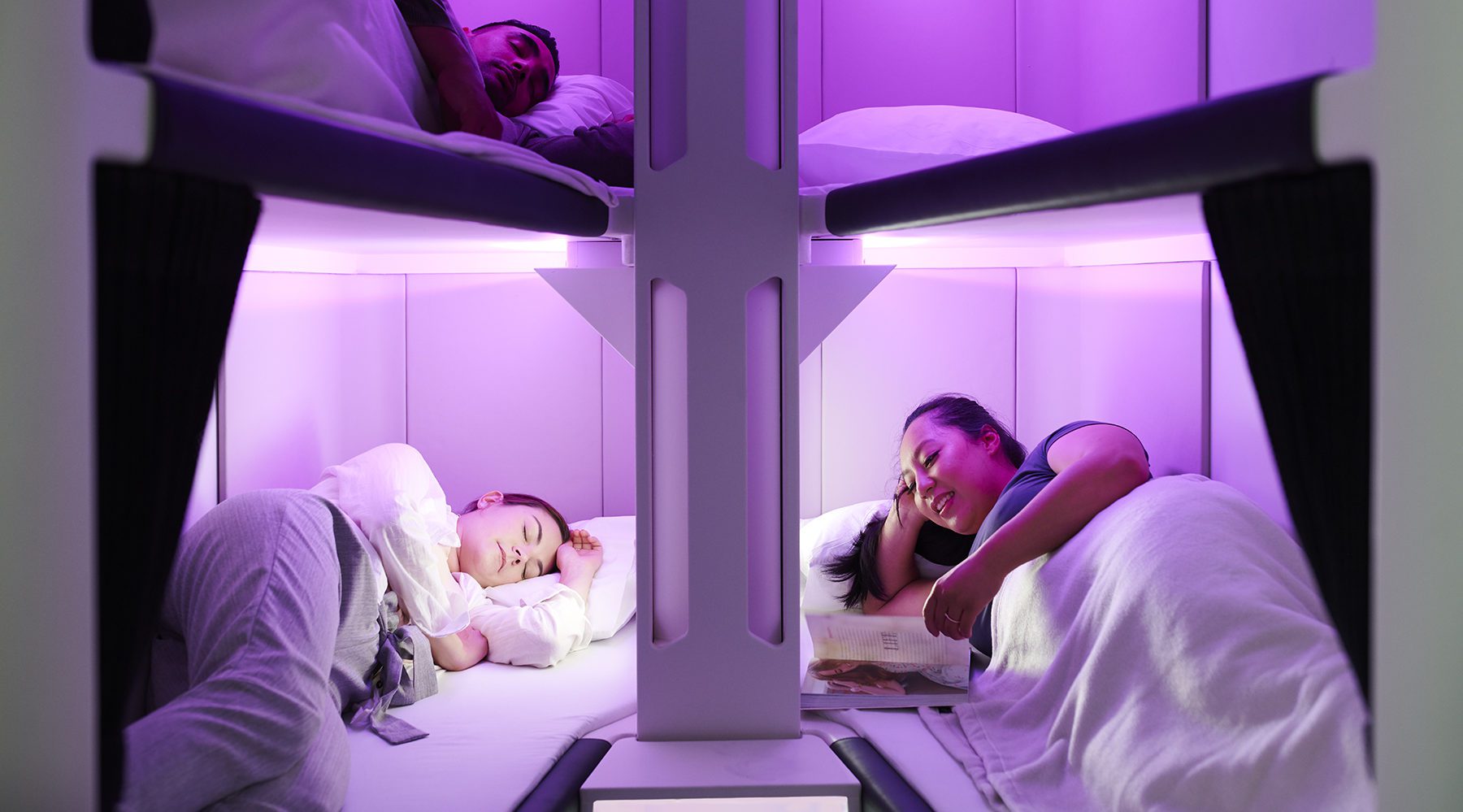
Skynest is six full-length lie-flat sleep pods in a three-level bunk arrangement, sitting between the premium economy and economy cabins and sold by the session to economy and premium economy passengers. Bookings opened in May. Our Skynest guide has the pod dimensions, the session mechanics and the pricing.
The launch plan was November, then December, on the next newly delivered 787-9 operating Auckland–New York. That aircraft is ZK-NZT. It is in Auckland and the pods are not in it.
Air New Zealand’s own position is that “regulatory certification is taking longer than anticipated.” Two approvals remain outstanding. The reported detail is that an overseas certifying authority does not have the resources to finish inside the original timeframe, while the New Zealand regulator’s side is moving faster. The airline will fly the new aircraft through the southern summer peak and install the pods after it. Jeremy O’Brien, Air New Zealand’s chief customer and digital officer, put it this way: “We’ll confirm the new launch date for the Skynest once the timeline is clear.”
There is no new date. Some coverage has read “after the peak” as meaning next year; the airline itself has not said that, and it has not said which of the incoming aircraft will carry the pods — only that some of the batch will.
For anyone holding a booking, the practical position is simple. If you booked a seat on Auckland–New York for the southern summer expecting to add a Skynest session, that option is not going to appear. The aircraft you fly may well be the brand-new one; the pods on board it will not be.
Which flights actually get it
Two aircraft is not many, and this is where the version lottery bites.
Air New Zealand names Auckland–New York, and the schedule filing that set up the aircraft’s deployment put the 219-seat 787-9 on that route three times a week from 25 October. Treat that as the airline’s intent rather than a published guarantee for any given date, because the same filing tells you why. Lodged in April, it had the aircraft flying nine other routes across the southern winter — Brisbane, Honolulu, Melbourne, Nadi, Papeete, Perth, Rarotonga, San Francisco and Sydney — on dates from late June onwards. The delivery slipped to the end of October, so none of that happened. The New York assignment is the part that survived, and it is the part the airline has repeated publicly.
Two things worth carrying into a booking elsewhere. Christchurch gained three 787-9 routes this season — Singapore from late October, Tokyo Narita from 28 November and Perth from 30 November — but “787-9” there means any of the sixteen, and on the balance of probability it is not one of the two new ones. And Auckland–Singapore splits between the 787-9 and the 777-300ER across its daily rotations, which is a separate draw with a separate answer: our 777-300ER guide covers that aircraft as it flies today, and its own new Business Premier cabin does not arrive until May 2027.
How to tell which 787-9 you are booked on
The seat map answers it before you pay, and the business-class count is the fastest check:
- 42 business seats across rows 1–12 — ZK-NZT or ZK-NZS, the new aircraft. The premium economy cabin runs to 52 seats and economy ends well short of where you would expect it to.
- 26 business seats, four Luxe suites in row 1 — one of the thirteen refitted aircraft. Premium economy is 33 seats.
- 27 business seats and no Luxe suites — the single aircraft still in its original cabin, with inward-facing herringbone seats.
- Premium economy is the second tell, and on a crowded seat map it is the easier one. Fifty-two seats is unmistakable against 33.
- Do not rely on the Luxe label. Air New Zealand says the new aircraft has eight Luxe suites, but seat maps may mark only the four in row 1 that way. And the letters will not separate the two Luxe-equipped cabins: both run 1-2-1 as A | B J | K, while the herringbone cabins use A, J and K. None has a C or H seat.
What Air New Zealand has not said
- When Skynest launches, or which of the incoming aircraft will carry it.
- Whether installing the pods later changes the 219-seat count or the economy row numbering. The pods sit between premium economy and economy, which is where the economy cabin currently begins.
- Which eight business seats are the Luxe suites. Seat maps may show only row 1 as Luxe, so confirm before paying for one.
- Which routes get the aircraft beyond Auckland–New York as more arrive, or the final split between 787-9s and 787-10s in the order, which is reported as ten aircraft but has not been fixed publicly at five and five.
- What happens to anyone who booked a Skynest session for the original launch window.
Frequently asked questions
Does Air New Zealand’s new 787-9 have Skynest?
No. ZK-NZT arrived on 29 October 2026 without the pods. Two regulatory approvals are outstanding, the pods will be installed after the southern summer peak, and no new launch date has been given.
How many seats does the new Air New Zealand 787-9 have?
219: 8 Business Premier Luxe, 34 Business Premier, 52 Premium Economy and 125 Economy, the last including nine Skycouch positions and 24 Economy Stretch seats. A refitted 787-9 has 272 seats.
Which route has the new 787-9?
Auckland–New York. Air New Zealand names it, and the schedule filing behind the aircraft’s deployment put it there three times a week from late October 2026.
How do I know if I have drawn the new aircraft?
Count the business seats on the seat map. Forty-two means a new-build aircraft, 26 means a refitted one, 27 means the single original jet. Alternatively count premium economy: 52 seats rather than 33.
Is the new aircraft better if I am in economy?
Yes, on balance, although there is less of it. Economy drops from 213 seats to 125, which means fewer people sharing the galleys and lavatories, and 24 of those 125 are Economy Stretch seats with around 35 inches of pitch. The catch is that a smaller cabin on a popular route is a harder seat to get at a low fare.
Why is this Air New Zealand’s first new 787 in seven years?
The order was placed in 2019 with deliveries originally due from 2022. It is the delay, not the order, that produced the seven-year gap.
Check your own flight
Sixteen Air New Zealand 787-9s now fly three different cabins, and on two of them nearly half the aeroplane is premium. Which one you get is decided by the aircraft, not the fare — so pull up the seat map for your own date and count the business seats. Our 787-9 guide has the row-by-row picks for the cabins you are most likely to draw, and the 777-300ER guide covers the other long-haul aircraft on the network.
Seat counts and schedule information reflect Air New Zealand’s statements and published filings as at 3 November 2026. Aircraft assignments change and this programme has already slipped more than once; confirm the seat map for your own flight and date before booking.