Air NZ's New 777 Business Premier: A Different Seat From the 787
Published July 16, 2026 · Cabin Report · ~6 min read
Air New Zealand has revealed plans to overhaul the cabins on its Boeing 777-300ER fleet, unveiling a new Business Premier suite alongside upgrades in economy. Announced on 14 July 2026, the project retires one of the most-criticised business seats still flying — the carrier's ageing herringbone — and replaces it with a modern, door-equipped reverse-herringbone product. The headline for frequent flyers is twofold: the 777 finally gets a competitive business class, and, oddly, it's a completely different seat from the one Air New Zealand is currently installing on its 787-9 Dreamliners.
What's actually changing
The upgrade covers Air New Zealand's seven Boeing 777-300ERs — the core long-haul workhorses that joined the fleet from late 2010, and excluding the ex-Cathay Pacific frames. Rather than reinvent the whole aircraft, the airline is targeting the two cabins that matter most to perception and revenue: business and economy. Total capacity holds steady at 342 seats, with only minor reshuffling to make room for the wider new business suites.
Chief Customer and Digital Officer Jeremy O'Brien framed it as both a passenger-experience play and a fleet-longevity one: the current Business Premier and Economy cabins have "served us exceptionally well" since 2010, but upgrading the interiors lets the airline "keep these aircraft flying for longer, while reducing the maintenance demands that come with an older cabin product."
The New 777-300ER Layout at a Glance
- Total seats: 342 (unchanged)
- Business Premier: 44 seats — Collins Aerospace Elevation, reverse herringbone with doors
- Premium Economy: 52 seats (down 2) — soft refresh only, no new seat
- Economy: 246 seats (up 2), including 16 Skycouch rows
- Fleet: 7 aircraft (excludes ex-Cathay Pacific frames)
- Timeline: first jet into retrofit March 2027, back in service ~May 2027
The new Business Premier: doors, at last
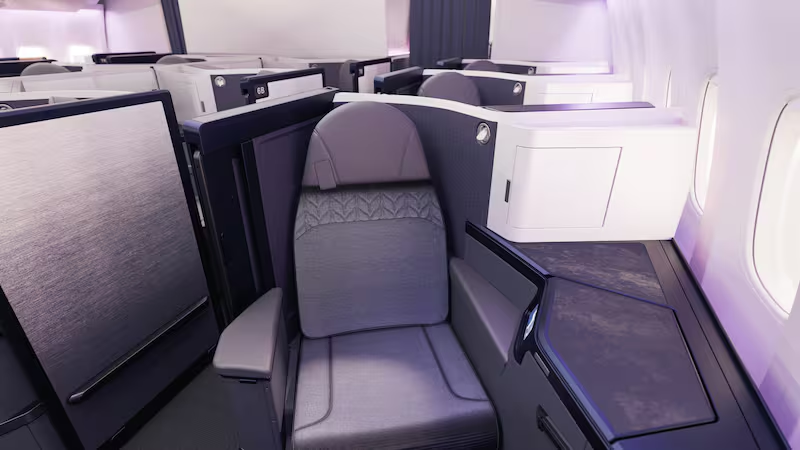
The centrepiece is a business cabin of 44 seats built on the Collins Aerospace Elevation platform, arranged in a reverse-herringbone layout. Every seat gets direct aisle access, a privacy door, and 43 inches of pitch converting to a full lie-flat bed. Centre pairs add sliding privacy dividers, making them workable for couples travelling together or solo travellers who want to shut the world out. Each suite carries an 18-inch seatback screen with Bluetooth audio pairing, plus USB-A and USB-C power.
There is one notable omission: no wireless charging, a feature the 787's new business seat does include. And unlike the Dreamliner, the 777 will not offer a Business Premier Luxe tier — the four-seat, door-and-larger-bed "near-first" product is a 787-only proposition for now. Even so, the addition of doors alone is a significant leap. The seat it replaces is a first-generation herringbone widely regarded as one of the least competitive purpose-built long-haul business seats still in service.
Economy and Premium Economy: modest but real
Economy grows by two seats to 246, including 16 rows of the airline's signature Skycouch — the row that converts into a padded flat lounging surface. The cabin retains an Economy Stretch sub-class offering 35 inches of pitch, a meaningful step up from the 31–32 inches in standard economy. Premium Economy, by contrast, isn't getting a new seat at all: it drops two seats to 52 and relies on the soft refresh (new seat covers and cabin curtains) it received over the past year. Anyone expecting a redesigned premium economy on the 777 should temper expectations.
The odd part: two fleets, two different business seats
Here's what makes this announcement genuinely interesting. Air New Zealand is simultaneously rolling out two entirely different new business products across its long-haul fleet. The 787-9 uses a custom seat on Safran's Visa platform — with a 24-inch screen and wireless charging, but no privacy door. The 777-300ER gets an off-the-shelf Collins Elevation seat — with a door and direct aisle access, but a smaller 18-inch screen and no wireless charging.
Usually a split like this is forced by cabin width, but that logic doesn't apply here: the 777 fuselage is actually wider than the 787's. The likelier explanations are certification risk (re-certifying the custom 787 seat on a different airframe is costly) and supply — an off-the-shelf product can be sourced faster while Collins and Safran juggle a global backlog of retrofit orders. The upshot for travellers is that "Air New Zealand business class" now means two distinct experiences depending on aircraft type, and the door-equipped 777 suite is arguably the more competitive of the pair.
✈️ SeatCompare tip: Until at least mid-2027, the aircraft type on your Air New Zealand long-haul booking determines which business product you get — and neither the current 777 nor 787 herringbone is being replaced overnight. Check whether your flight is operated by a 777-300ER or a 787-9, then confirm whether that specific frame has been retrofitted yet. The reverse-herringbone door suite won't appear on any 777 until around May 2027 at the earliest.
787 vs 777: the new business products compared
| Feature | 787-9 (Business Premier) | 777-300ER (Business Premier) |
|---|---|---|
| Seat platform | Safran Visa (custom) | Collins Elevation (off-the-shelf) |
| Layout | Forward-facing, 1-2-1 | Reverse herringbone, 1-2-1 |
| Privacy door | No (sliding screens only) | Yes |
| Screen | 24-inch 4K | 18-inch |
| Wireless charging | Yes | No (USB-A/USB-C only) |
| "Luxe" suite tier | Yes — 4 seats | No |
| Business seat count | 26 (incl. 4 Luxe) | 44 |
| In service | Since May 2025, rolling out | From ~May 2027 |
Timeline and the usual caveat
Air New Zealand plans to send the first 777-300ER for reconfiguration in March 2027, aiming to have it back in revenue service by May 2027, with the remaining six to follow. As with any cabin-retrofit programme, delays are common and arguably likely — supply-chain and certification slips have already pushed several rival airlines' seat launches to the right. Treat May 2027 as a target, not a guarantee.
For SeatCompare readers the practical takeaway is clear: Air New Zealand's long-haul fleet is heading toward a much stronger business-class line-up, but it's arriving in two flavours on two different aircraft, and it won't be everywhere for a while yet. Knowing your aircraft type — and whether your specific frame has been done — remains the single most useful thing you can check before you book.
Cabin specifications reflect Air New Zealand's 14 July 2026 reveal. Layouts, timelines and availability can change; always confirm the live seat map when booking.