Air Canada Dash 8-400 Seat Selection Guide (2026)
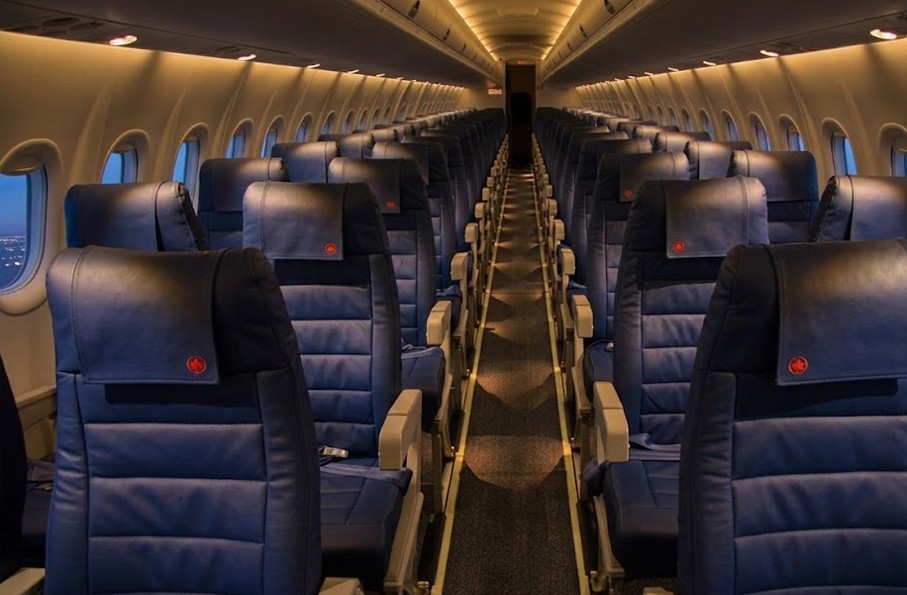
✈️ Quick Verdict
Aircraft: De Havilland Dash 8-400 (Q400) — 78 or 76 seats, all economy
Layout: 2-2 throughout, rows 1–20. Lettered A C | D F on the 78-seat aircraft and A B | D E on both 76-seat aircraft
Version lottery: Yes — three configurations. The seat letters identify the 78-seat jet; the position of the two-seat back row separates the other two
Best seats: Rows 12 and 13 at the window — the only seats rated best-grade for the view · even rows 4, 6, 8, 10 at the window — properly aligned glass
Seats to avoid: Odd rows 3, 5, 7, 9, 11 at the window — the glass sits behind you · the outboard right bulkhead seat (2F or 2E) — reduced view and no underseat storage
Extra legroom: Only the bulkhead pairs — row 1 on the left, row 2 on the right. No branded extra-legroom product is recorded on the type
IFE: None recorded · Wi-Fi: Starlink, recorded as a rollout in progress and not yet fitted to every aircraft
Three configurations, and the seat letters give it away
Air Canada Express flies the Dash 8-400 in three cabins. They are the same aeroplane with the same 2-2 seating and the same 20 rows — what changes is the seat count, the lettering, and where the short back row sits.
| 78 seats | 76 seats (right) | 76 seats (left) | |
|---|---|---|---|
| Seat letters | A C | D F | A B | D E | A B | D E |
| Aisle seats | C and D | B and D | B and D |
| Row 1 | 1A, 1C (left pair only) | 1A, 1B (left pair only) | 1A, 1B (left pair only) |
| Row 20 | Full four seats | 20D, 20E — right side | 20A, 20B — left side |
| Best window grade | 12A, 12F, 13A, 13F, 20A, 20F | 12A, 12E, 13A, 13E, 20E | 12A, 12E, 13A, 13E, 20A |
How to tell which one you are on
Look for a C or an F on your boarding pass. Only the 78-seat aircraft uses those letters. If your seat is 3C, 11F or anything else with a C or an F, you are on the 78-seat jet and the aisle seats are C and D.
If your seat has a B or an E, you are on one of the 76-seat aircraft, where the aisle seats are B and D. To separate those two, look at row 20 on the seat map: if it shows 20D and 20E, the back row is on the right; if it shows 20A and 20B, it is on the left. That single two-seat stub is the only difference between them.
None of this changes the comfort of the aircraft in any meaningful way — it changes which seat number to ask for. A passenger who books “12F” expecting the best window on the aircraft will find that seat does not exist on two of the three sub-fleets.
The trap: half the window seats look at the wrong place
From row 3 to row 11 the window alignment alternates strictly, on all three configurations:
| Rows | Window alignment | Verdict |
|---|---|---|
| 3, 5, 7, 9, 11 | Misaligned — the window sits behind the seat, so you lean back to see out | Avoid if the view matters |
| 4, 6, 8, 10 | Properly aligned | Good |
| 12, 13 | Best grade recorded on the aircraft | Best view on board |
| 14 to 19 | Aligned; 14, 17 and 19 have two windows per seat on most aircraft | Good |
This is unusually clean as patterns go — it is not a case of one or two odd seats but a strict alternation over nine rows. If you are booking a window seat on a Q400 for the scenery, and Air Canada’s Q400s fly some of the most scenic short routes in Canada, pick an even row.
Rows 12 and 13: the best view, and the loudest seats
12A, 12F/E, 13A and 13F/E are the only seats on the aircraft rated green with the best window grade. They are also inside the wing span — and on a turboprop the wing is where the propellers are. You get the clearest view on the aeroplane from the noisiest part of the cabin.
That is a genuine trade rather than a trap, but it is worth knowing before you choose. If noise matters more than the view, the front of the cabin — rows 4, 6, 8 and 10 at the window — is well forward of the propeller line.
The front: two bulkhead pairs, one row apart
The Dash 8-400’s cabin starts unevenly. The forward right-hand service door takes up the space where the right-hand row 1 would be, so row 1 is a two-seat left-hand pair and the right side of the cabin begins at row 2.
That gives two bulkhead pairs: 1A and 1C (or 1B) on the left, and 2D and 2F (or 2E) on the right. All four carry extra legroom, and all four lose their underseat storage and take the tray table in the armrest, which narrows the seat.
The outboard right bulkhead seat — 2F on the 78-seat jet, 2E on the 76-seat ones — is the one to avoid. It takes all the bulkhead compromises and adds a reduced window view from a plugged window nearby, with the remaining glass misaligned. It is the only seat on the aircraft carrying four separate notes.
If you want the bulkhead legroom, 1A is the best of the four: extra legroom, a properly aligned window, and none of the window problems.
The back row has no lavatory behind it
This is the Q400’s quiet advantage and it is worth stating plainly. The single lavatory on Air Canada’s Dash 8-400 is at the front of the aircraft, ahead of row 1. There is no galley and no lavatory behind the last row.
On almost every other aircraft the back rows are the ones to avoid, because they sit against the lavatory bank and often do not recline. Here, nothing at all is flagged against rows 14 to 20 — no lavatory adjacency, no galley noise, no recline warning. Row 20 at the window carries the best window grade on the aircraft.
If you like sitting at the back, this is one of the few types where that costs you nothing.
Quick picks by traveller
| You are | Book |
|---|---|
| After the best view | 12A or 13A — best window grade, accepting propeller noise |
| After a good view and a quieter seat | 4A, 6A, 8A or 10A — aligned windows, forward of the propellers |
| Tall | 1A — bulkhead legroom with a proper window. Accept no underseat storage |
| A couple | Any even-numbered row — the 2-2 layout means a pair to yourselves |
| Nervous about noise | Rows 4 to 8 — well forward of the propeller line |
| Happy at the back | Rows 17 to 20 — no lavatory or galley behind them at all |
| Avoiding the worst seat | Not 2F (78-seat) or 2E (76-seat) — four separate drawbacks |
Frequently asked questions
How many Dash 8-400 configurations does Air Canada fly?
Three. One with 78 seats, lettered A C | D F, and two with 76 seats, both lettered A B | D E. The two 76-seat cabins differ only in whether the two-seat row 20 sits on the left or the right of the aisle.
How do I tell which one I am booked on?
Check your seat letter. A C or an F means the 78-seat aircraft. A B or an E means one of the 76-seat aircraft — and then row 20 on the seat map tells you which: 20D/20E for the right-hand back row, 20A/20B for the left.
Which is the best seat on the Dash 8-400?
12A or 13A for the view — the only seats rated best-grade for the window. 1A for legroom. If you want a good window without the propeller noise, take an even-numbered row between 4 and 10.
Why do odd-numbered window seats have a problem?
The window pitch and the seat pitch do not match on this aircraft, so the two drift in and out of alignment. From row 3 to row 11 the effect is a strict alternation: odd rows have the window set behind the seat, even rows line up.
Is the back of the Q400 bad?
No, and that is unusual. The only lavatory is at the front, and there is no galley behind the last row, so nothing is flagged against rows 14 to 20. Row 20 at the window is one of the best-rated seats on the aircraft.
Is there Wi-Fi on Air Canada’s Dash 8-400?
Starlink is being fitted, and the rollout is in progress rather than complete across the fleet. There is no in-flight entertainment system of any kind, so bring your own downloads.
Where are the extra-legroom seats?
Only at the two bulkheads — row 1 on the left and row 2 on the right. There is no branded extra-legroom product anywhere on the type, and no exit row with extra pitch: the Dash 8-400 has no overwing exit row in the way a jet does.