Air Canada A320 Seat Selection Guide (2026)
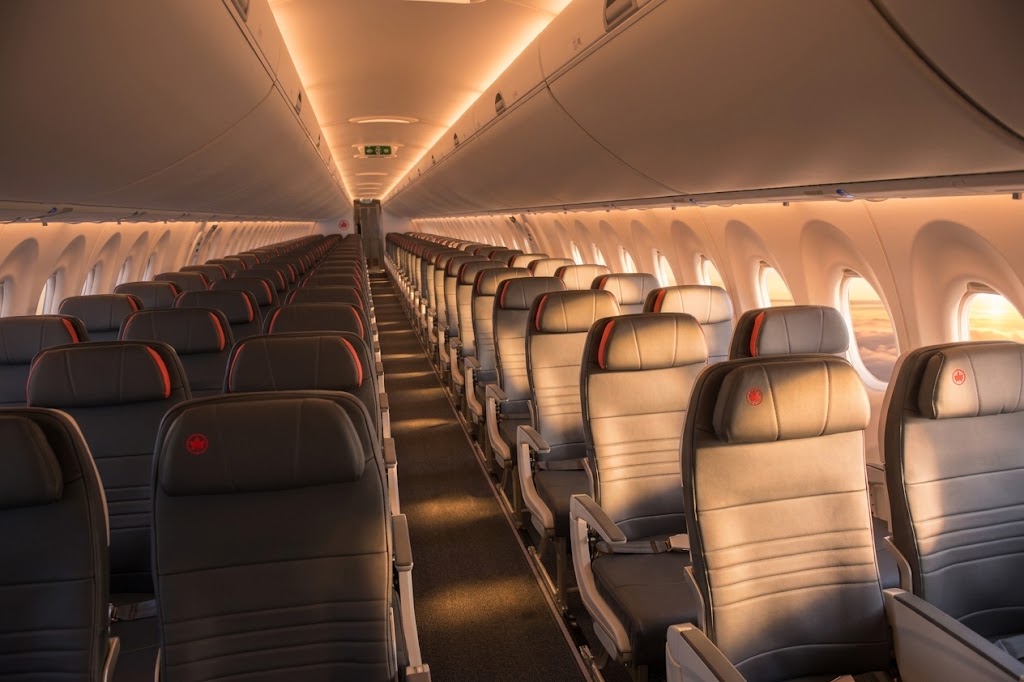
✈️ Quick Verdict
Aircraft: Airbus A320 — four configurations in scheduled service
Config: 146 (14J + 132Y, 9 aircraft) · 150 (12J + 138Y, 4) · 152 (8J + 144Y, 3) · 168 (12J + 156Y, count unpublished)
Version lottery: Yes, and it is a legroom lottery. Standard economy pitch runs from about 31in on the 146-seat jet to about 28in on the 168-seat one
The one-look test: the last row number. 33 = 146 seats · 34 = 150 · 35 = 152 · 37 = 168
Best free seat on the fleet: row 16 on the 146-seat jet. Same spacing as Preferred rows 13–15, and not sold as Preferred
Best seats overall: rows 17–18 (146) · rows 18–19 (150) · row 19 (152) · row 20 (168)
Seats to avoid: the last two rows on every configuration — hard against the rear lavatories, and the last row never reclines
No window at all: 37A and 37F on the 168-seat Dream Cabin jet. No other A320 configuration has a windowless seat
Four cabins, one flight number
Air Canada’s A320 fleet is not one aeroplane. It is four, and the differences are large enough to change how a five-hour transcon feels.
| Cabin | Seats | Business | Economy | Aircraft | Standard economy pitch |
|---|---|---|---|---|---|
| 2006 XM cabin | 146 | 14, rows 1–4 | 132, rows 12–33 | 9 | about 31in |
| ex-Alaska Airlines | 150 | 12, rows 1–3 | 138, rows 12–34 | 4 | about 31in |
| ex-China Southern | 152 | 8, rows 1–2 | 144, rows 12–35 | 3 | about 30in |
| Dream Cabin | 168 | 12, rows 1–3 | 156, rows 12–37 | not published | about 28in |
Three inches separates the roomiest standard economy seat on this fleet from the tightest, and nothing in a fare class or a flight number tells you which one is coming. Two of the four cabins arrived secondhand and kept the layouts their previous operators fitted — four airframes came from Alaska Airlines and three from China Southern — which is why the Business cabin ranges from fourteen seats down to eight.
The last row number is the reliable tell. If the seat map ends at row 33 you are on the 146-seat jet; 34 is the ex-Alaska cabin, 35 the ex-China Southern one, and 37 the Dream Cabin. That check takes two seconds on a booking screen and it separates all four.
Row 16 on the 146-seat jet is free Preferred
The 146-seat cabin sells 36 Preferred seats: rows 12 to 15, and rows 17 to 18. Rows 17 and 18 are the overwing exits and they earn it — about 35 inches against a cabin standard nearer 31, and all twelve of their seats rate best.
Rows 13, 14 and 15 are a different story. They are Preferred, and they are drawn at the same spacing as row 16, which is not. Row 16 sits in the gap between the Preferred block and the exit rows, and on the layout it measures exactly what the three paid rows ahead of it measure.
So if you are on a 146-seat A320 and the Preferred fee for row 14 does not appeal, row 16 is the same seat for nothing. The only caveat is at the window: 15A and 15F have the window set behind the seat, and 16A and 16F do not, which makes row 16 the better window row as well.
Row 12 is the forward economy bulkhead and it is worth a moment. All six seats carry extra legroom, but 12B, 12C and 12E lose their underseat storage and take the tray in the armrest. 12A, 12D and 12F keep both — they are the three best bulkhead seats in the cabin, and all three rate best.
The other three cabins, row by row
150 seats — the ex-Alaska jets
Four airframes, registered C-FCQD, C-FCQX, C-FCYX and C-FCZF, still carrying the cabin Alaska Airlines fitted. This is the best-value economy cabin in the fleet.
Rows 13, 14 and 15 are drawn at about 33 inches against a 31-inch standard, with no recline penalty of any kind — eighteen seats that rate best and are not an exit row. Rows 18 and 19, the overwing exits, run about 35 inches for another twelve. That is thirty roomy seats on a 138-seat economy cabin.
Row 12 is the bulkhead: extra legroom on all six, but every one of them loses underseat storage and takes the tray in the armrest — less forgiving than the 146-seat jet, where three of the six keep both. Rows 33 and 34 back onto the rear lavatories and rate worst across all twelve seats; row 34 also does not recline. 16A and 16F have the window set behind the seat.
152 seats — the ex-China Southern jets
Three airframes including C-FCUG and C-FDGQ. The smallest Business cabin on the fleet — eight seats over two rows — and the largest economy cabin bar the Dream Cabin, at 144 seats.
Standard pitch here is about 30 inches, the second tightest of the four, which makes the front of the cabin matter more. Rows 13 to 17 are drawn at about 33 inches and rate best almost throughout.
Then the exit-row trap, and this cabin runs the classic version of it. Rows 18 and 19 are the overwing exits. 17A, 17B, 17E, 17F, 18A, 18B, 18E and 18F all lose recline because the exit path behind them has to stay clear. Row 19 takes about 34 inches with no recline penalty at all and is the strongest row on the aircraft — all six seats rate best.
Row 12 is a cramped bulkhead rather than a roomy one: the wall sits 42cm (17in) ahead of the centre block and 47cm ahead of A, B and C, and all six lose underseat storage. It is the one bulkhead row on this fleet worth actively avoiding. Rows 34 and 35 are the rear lavatory block; row 35 does not recline. Windows sit out of line at 16A, 16F, 22A, 22F, 29A and 29F.
168 seats — the Dream Cabin
The densest A320 Air Canada flies: twenty-six economy rows against twenty-two on the 146-seat jet, and a standard pitch of about 28 to 29 inches. No fleet count is published for this variant.
Rows 19 and 20 are the only rows with real legroom — about 34 inches at the overwing exits. As on the ex-China Southern cabin, the row in front pays: 18A, 18B, 18E, 18F, 19A, 19B, 19E and 19F may not fully recline. 19C, 19D and the whole of row 20 keep the legroom and the recline, which makes row 20 the row to book.
And the trap: 37A and 37F have no window at all. Wall only. The whole of row 37 also fails to recline and sits against the rear galley and lavatory. Those are the only two windowless seats anywhere on Air Canada’s A320 fleet, and they are on the aeroplane where you are least likely to be checking. Windows sit out of line at 14A, 14F, 21A, 21F, 26A, 26F, 31A, 31F, 36A and 36F.
Row 12 is the bulkhead, with 12B, 12C and 12E losing underseat storage and 12A, 12D and 12F keeping it.
Business class across the four cabins
All four use the same 2-2 layout — A C | D F — and all four give 50 per cent direct aisle access, which is what 2-2 gives you. The difference is how many rows there are: four on the 146-seat jet, three on the 150 and 168, and two on the 152.
The 146-seat cabin is the odd one: row 1 is 1D and 1F only, with no A or C, which is how fourteen seats fit into four rows. Those two seats lead the cabin with extra room ahead at the bulkhead, and they sit against the forward galley.
On the other three, row 1 is a full four seats, all with bulkhead legroom, and on each of them the seats beside the galley take the meal-service noise and light. If quiet matters more than legroom, row 2 or 3 is the better call; 3A and 3F rate best on both the 146-seat and 150-seat cabins.
Two other A320s wearing the same paint
Two more A320 cabins carry Air Canada branding and are not part of the four above.
Air Canada Rouge flies an A320 at exactly the same 168 seats and the same 12 + 156 split as the Dream Cabin, across five aircraft, with 24 designated Preferred seats. The seat count will not separate them. The tell is row 13: on the Rouge jet it is drawn at about 33 inches and rates best; on the mainline Dream Cabin it is standard pitch. Both have 37A and 37F walled off with no window.
Air Canada Jetz is a single A320 fitted with seventy business-class recliners and nothing else. It flies charters, not scheduled service, so you will not be assigned to it by accident — but if you ever see a 70-seat A320 on an Air Canada seat map, that is what it is.
Quick picks by traveller
| You are | 146 seats | 150 seats | 152 seats | 168 seats |
|---|---|---|---|---|
| After legroom, free | Row 16 | Rows 13–15 | Rows 13–17 | Nothing free — take row 20 |
| After legroom, paying | Rows 17–18 | Rows 18–19 | Row 19 | Row 20 |
| Bulkhead without the trade-offs | 12A, 12D, 12F | None — all six lose storage | Avoid row 12 entirely | 12A, 12D, 12F |
| A couple | A/B or E/F, rows 13–16 | A/B or E/F, rows 13–15 | A/B or E/F, rows 13–17 | A/B or E/F, row 20 |
| Window with a real view | 16A, 16F | 13A, 13F | 19A, 19F | 27A, 27F, 32A, 32F |
| In Business | 3A, 3F | 3A, 3F | 1A, 1C, 1F | 2A, 2F |
| Avoiding the worst | Rows 32–33 | Rows 33–34 | Rows 34–35 | Row 37 |
How to tell which A320 you are booked on
1. Find the last row on the seat map. 33, 34, 35 or 37 — that alone separates all four cabins.
2. Count the Business rows. Four rows means the 146-seat jet, and its row 1 has only two seats. Two rows means the ex-China Southern 152. Three rows is either the 150 or the 168, which the last row number then splits.
3. Look at where the exit rows sit. Rows 17 and 18 on the 146-seat jet, 18 and 19 on the 150, 18 and 19 on the 152, 19 and 20 on the 168.
4. If it says 168 seats, check row 13. Roomier than the rows around it means Rouge; ordinary means the mainline Dream Cabin.
Frequently asked questions
Which Air Canada A320 has the most legroom?
The 146-seat and 150-seat cabins share the roomiest standard economy at about 31 inches. For a single best seat, row 18 on the 146-seat jet or row 19 on the 150-seat jet, both at about 35 inches. The 168-seat Dream Cabin is the tightest at about 28 to 29 inches standard.
Is a Preferred seat worth paying for on the A320?
On the 146-seat jet, only if it is row 17 or 18 — the exit rows at about 35 inches. Preferred rows 13, 14 and 15 are drawn at the same spacing as row 16, which is not sold as Preferred, so you can have the same seat for nothing.
Which seats have no window?
37A and 37F on the 168-seat Dream Cabin jet, and 37A and 37F on the Rouge A320. Nothing on the 146, 150 or 152-seat cabins is walled off, though several window seats on each have the window set behind the seat.
Do the exit rows recline?
It depends which cabin. On the 146 and 150-seat jets neither exit row carries a recline restriction. On the 152 and 168-seat jets the first exit row and the row ahead of it both lose recline on A, B, E and F — so take the second exit row (19 and 20 respectively), which keeps both.
How many A320s does Air Canada operate?
Nine in the 146-seat cabin, four in the 150-seat, three in the 152-seat, and no published count for the 168-seat Dream Cabin. Add five more at Rouge and one Jetz charter aircraft. Published totals for the fleet as a whole do not break down cleanly by cabin, so this guide quotes the per-configuration counts rather than a headline number.
Related Guides
- Air Canada A321 Seat Selection Guide (2026)
- Air Canada A220-300 Seat Selection Guide (2026)
- Air Canada 737 MAX 8 Best Seats & Map (2026)
- Air Canada A321XLR Seat Map & Best Seats (2026)
- Air Canada E175 Seat Selection Guide (2026)
- Air Canada Rouge A321 Seat Selection Guide (2026)
- Air Canada CRJ-900 Seat Selection Guide (2026)
- Air Canada Rouge A319 Seat Selection Guide (2026)