Air Canada A321XLR Seat Map & Best Seats (2026)
✈️ Quick Verdict
Air Canada's Airbus A321XLR entered revenue service on 9 June 2026, with the first transatlantic sector — Montreal–Toulouse — on 15 June 2026. It is the airline's first lie-flat narrowbody and the launch platform for the new "Glowing Hearted" cabin standard.
One configuration fleet-wide: 14 Collins Aurora Signature suites in a 1-1 inward-facing herringbone (rows 1–7, seats A and F) and 168 Collins Meridian+ Economy seats in 3-3 (rows 12–39). No Premium Economy. No suite doors.
- Best Signature: 3F and 5F — mid-cabin quiet plus the only good window alignment on that side.
- Best Economy: 12A/12F (bulkhead), 19 and 20 A/F (35" overwing exit rows), 32/34/36 A/F (best window alignment).
- Avoid: Signature 7A (designated pilot rest seat). Economy rows 29 and 30 at A and F — narrowed seats with no adjacent window at all — plus 38C and the whole of row 39.
At a Glance
| Aircraft | Airbus A321XLR (A321-271NY) |
| Fleet on order | 30 (15 owned, 15 leased) |
| In service | First delivered April 2026; revenue service from 9 June 2026; fleet expected to reach ~10 aircraft during 2026 |
| Configuration | 182 seats — 14J + 168Y |
| Cabin layout | Signature 1-1 (Collins Aurora suites, rows 1–7) / Economy 3-3 (Collins Meridian+, rows 12–39) |
| Seat letters | Signature: A, F · Economy: A-B-C | D-E-F |
| Premium Economy | None |
| Version lottery | No — single configuration across the fleet |
| Best Signature seats | 3F, 5F (then 1A, 1F) |
| Signature seats to avoid | 7A (pilot augmented-rest seat); even-numbered rows have restricted window views |
| Best Economy seats | 12A/12F, 19A/19F, 20A/20F, 32/34/36 A and F |
| Economy seats to avoid | 29A/29F, 30A/30F (no windows, narrowed), 38C, row 39 |
| IFE | Panasonic Astrova — 19" 4K in Signature, 13.3" 4K in Economy; Bluetooth audio throughout |
| Power | Signature: 110V AC + USB-C + wireless charging · Economy: AC + USB-C |
| Wi-Fi | Intelsat 2Ku — mid-tier satellite (roughly 10–40 Mbps). Free for Aeroplan members |
| Lavatories | 1 forward, 3 aft |
Version Lottery: None
This is one of the rare Air Canada aircraft with no version lottery. Every A321XLR in the fleet is built to the same 14J/168Y "Glowing Hearted" specification, so the seat you book is the seat you get. That is unusual for Air Canada — the A320 and A321ceo fleets each run three different configurations, and the 737 MAX 8 runs two.
The practical risk on an A321XLR booking is not which XLR you get, it is whether you get an XLR at all. On the transatlantic routes the aircraft is capacity-critical and substitution is unlikely. On the domestic and transcontinental rotations it shares a pool with the A321ceo (16J/174M and 8J/176M) and the widebodies — those cabins are completely different, so re-check your seat assignment within 24 hours of departure.
Signature Class — Collins Aurora Suite (1-1)
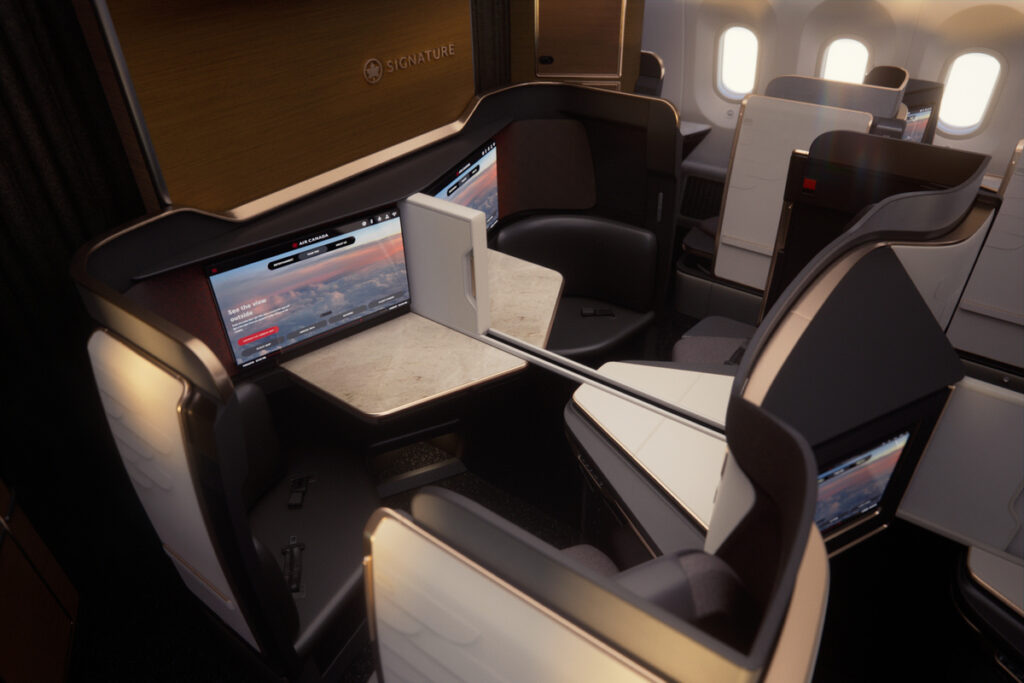
The Aurora is a Collins Aerospace platform developed with Air Canada and design partner Acumen specifically for the narrower A321 cross-section. Suites sit 1-1 in an inward-facing herringbone: your seat is angled toward the aisle with your back to the window. Every one of the 14 suites has direct aisle access and no one to climb over.
Specs: 32" pitch, 21" width, fully flat at 180°, 19" 4K touchscreen, Bluetooth audio, 110V AC, USB-C, wireless charging, adjustable armrest on one side, personal gasper vent.
No doors. This is a deliberate design decision rather than a certification delay — Air Canada and Collins concluded the suite shell plus a moveable privacy divider delivers enough separation, and that fitting doors would have cost either aisle width or bed length. If you are comparing against American's A321XLR, that is the headline difference between the two Aurora installations.
✅ Best Signature Picks
3F and 5F are the two best suites on the aircraft. They combine the quiet mid-cabin position — far enough back to escape the forward galley and lavatory, far enough forward to escape the Economy divider — with good window alignment. That last point matters more than it sounds: window alignment is inconsistent through this cabin, and on the A side the mid-cabin suites are the worst offenders.
1A and 1F are the next best. Both are well-aligned and, being at the very front, are the furthest possible from Economy boarding traffic. The trade-off is the forward galley and the single forward lavatory immediately ahead of you — expect activity during boarding and meal service.
Seats with trade-offs
Every even-numbered row (2, 4, 6) on both sides has a restricted window view — the suite shell lands between the two window apertures. 3A, 5A and 7A/7F have poor alignment for the same structural reason. None of these are bad seats; the lie-flat bed, screen and service are identical. You simply will not get much of a view.
🚫 The One to Actually Avoid
7A is designated as the pilot augmented-rest seat. On sectors flown with an augmented flight crew it can be blocked from sale or reassigned, and even when it is sold you may be seated next to crew rotating through rest. It also has poor window alignment and sits against the Economy divider. It does have three overhead gasper vents, which is a genuine quirk if you run hot — but it is not worth the reassignment risk if you have another option.
7F is the mirror position without the crew-rest designation: still against the divider, still poor window alignment, more cabin traffic than anything forward of it.
Economy — Collins Meridian+ (3-3)
168 Meridian+ slimline seats in a standard 3-3, rows 12 through 39. Seat letters run A-B-C on the left and D-E-F on the right. Standard pitch is 31", width 18", recline 5". Every seat gets a 13.3" 4K screen, Bluetooth audio, AC and USB-C power, a four-way adjustable headrest and a bi-fold table.
There is no branded extra-legroom cabin, but there are three distinct pitch bands, and knowing where they are is most of the value in this cabin.
| Rows | Pitch | Notes |
|---|---|---|
| 12 | Bulkhead | Most legroom in the cabin |
| 13–15 | 34" | Three full rows of extra legroom |
| 16–18 | 31" | Standard |
| 19–20 | 35" | Overwing exit rows — the most legroom in the standard cabin |
| 21–39 | 31" | Standard, with structural exceptions below |
✅ Best Economy Picks
- Rows 19 and 20 are the best seats in Economy at 35" pitch, with 19A/19F and 20A/20F the picks. Standard exit-row trade-offs apply: no underseat storage at takeoff and, in some cases, limited recline.
- Row 12 (the bulkhead) has the most legroom of all, but three trade-offs the other extra-pitch rows don't have: the screens are wall-mounted rather than in a seatback, the armrests are fixed (row 12 is the only Economy row without adjustable armrests), and there is no underseat storage.
- Rows 13, 14 and 15 at 34" are the sweet spot for most people — nearly exit-row legroom with a normal seatback screen, normal armrests and normal storage.
- 32A/32F, 34A/34F and 36A/36F are the best-aligned window seats on the aircraft. If you want the view rather than the legroom, these are the six seats to target.
🚫 Economy Seats to Avoid
Rows 29 and 30 at A and F. This is the standout trap on this aircraft and the one most likely to catch people out. A door structure intrudes at these two rows, which does three things: it narrows the seats below the 18" standard, it removes the windows entirely — 29A, 29F, 30A and 30F have no adjacent window at all — and, unlike a normal exit row, it delivers no extra legroom in exchange. You are paying window-seat prices for a windowless, narrowed seat. The B/C/D/E seats in these two rows are narrowed too, though at least they were never going to have a view.
25A/25F and 27A/27F have poor window alignment — the aperture sits behind your shoulder.
38C is immediately adjacent to the aft lavatory bank: noise, odours and a permanent queue in the aisle beside you. 37C, 37D and 38D are the second ring of the same problem.
Row 39, the last row, combines everything you don't want: narrowed seats from the fuselage taper, no recline, the three aft lavatories directly behind, and the aft galley behind the B and E positions.
Signature vs Economy at a Glance
| Feature | Signature Class | Economy |
|---|---|---|
| Seats | 14 | 168 |
| Rows | 1–7 | 12–39 |
| Layout | 1-1 inward herringbone | 3-3 |
| Seat | Collins Aurora lie-flat suite | Collins Meridian+ slimline |
| Pitch | 32" (fully flat bed) | 31"; 34" rows 13–15; 35" rows 19–20 |
| Width | 21" | 18" |
| Recline | 180° | 5" |
| Privacy | Suite shell + moveable divider (no door) | Open cabin |
| IFE screen | 19" 4K | 13.3" 4K |
| Power | 110V AC + USB-C + wireless | AC + USB-C |
| Aisle access | 100% — all 14 suites | 0% — 3-3 layout |
| Wi-Fi | Free for Aeroplan members | Free for Aeroplan members |
Quick-Pick Summary
| Traveller | Pick |
|---|---|
| Solo, lie-flat priority | 3F, then 5F. Mid-cabin quiet plus the only decent window alignment. |
| Couple in Signature | Aurora is 1-1 — there is no paired seat. You will be across the aisle from each other. Take 3F + 3A if you want to be level. |
| Couple in Economy | A+B or E+F. In a 3-3 there is no true couple seat; taking window+middle at least means only one stranger. |
| Family of three | A full half-row (A-B-C or D-E-F) in rows 13–15 — extra legroom without row 12's fixed armrests and bulkhead restrictions. |
| Maximum legroom | 19A/19F or 20A/20F at 35". Row 12 has more, but with wall-mounted screens and fixed armrests. |
| Best view | 32, 34 or 36 at A or F — the only genuinely well-aligned windows in the cabin. |
| Light sleeper in Economy | Rows 21–24, window side. Clear of the galley/lav block at the rear and the divider at the front. |
| Avoid at all costs | 29A, 29F, 30A, 30F — narrowed, windowless, and no legroom compensation. |
Routes
The A321XLR opens thin transatlantic markets from Eastern Canada that could not sustain a widebody, alongside domestic transcontinental work. Twelve routes are scheduled across the 2026 summer and winter seasons.
From Montreal: Toulouse (from 15 June), Palma de Mallorca — the debut new route — Calgary (from 17 June), Berlin (from 18 July), Nantes (from 22 July), Vancouver, Lyon (from 7 September), Porto (from 12 September), and Los Angeles.
From Toronto: London Heathrow (from 31 August), Manchester (from 25 October), Copenhagen (from 27 October).
How This Compares to Other A321XLR Operators
The A321XLR market has split into two philosophies. American and United went premium-heavy — 20 Business plus 12 Premium Economy, with a smaller Economy cabin. Iberia and Aer Lingus went leaner: 14–16 Business, no Premium Economy, and a large Economy cabin. Air Canada has taken the lean route.
The seat differs too. Iberia and JetBlue use the Thompson Vantage Solo, Aer Lingus a staggered Thompson Vantage with throne seats, and American the same Collins Aurora platform as Air Canada — but with sliding doors, where Air Canada has deliberately gone doorless. If you have a choice of operator on an overlapping route, the hardware is a real part of the decision.
FAQ
Is the Air Canada A321XLR flying passengers yet?
Yes. Revenue service began 9 June 2026, and the first transatlantic sector, Montreal–Toulouse, operated on 15 June 2026. Berlin, Nantes, Lyon, Porto, Palma, London Heathrow, Manchester and Copenhagen have followed or are scheduled through late 2026, alongside domestic transcontinental flying.
Is Signature Class on the A321XLR the same as on the 777 or 787?
No. The brand is the same but the seat is different. The widebodies use the older Collins Super Diamond in a forward-facing 1-2-1. The A321XLR uses the new Collins Aurora — a narrowbody-specific suite in an inward-facing 1-1, with a 19" 4K screen and wireless charging.
Do the suites have doors?
No, and that is by design rather than a certification delay. Air Canada specified the Aurora without doors, relying on the suite shell and a moveable privacy divider. American's version of the same seat does have doors.
Why are rows 29 and 30 worth avoiding?
A door structure intrudes at those two rows. The A and F seats have no adjacent window at all, the seats are narrower than the 18" standard, and there is no extra legroom to compensate — the worst combination on the aircraft.
Is there a Premium Economy cabin?
No. The A321XLR is a two-class aircraft: 14 Signature suites and 168 Economy. The closest thing to a premium seat in the back is rows 13–15 at 34" or the 35" exit rows 19 and 20.
Where are the lavatories?
One forward, ahead of row 1 and shared with the Signature cabin, and three aft behind row 39 alongside the rear galley. That aft block is what makes 38C, 38D and the whole of row 39 uncomfortable.