Turkish Airlines Airbus A330-300 Seat Selection Guide (2026)
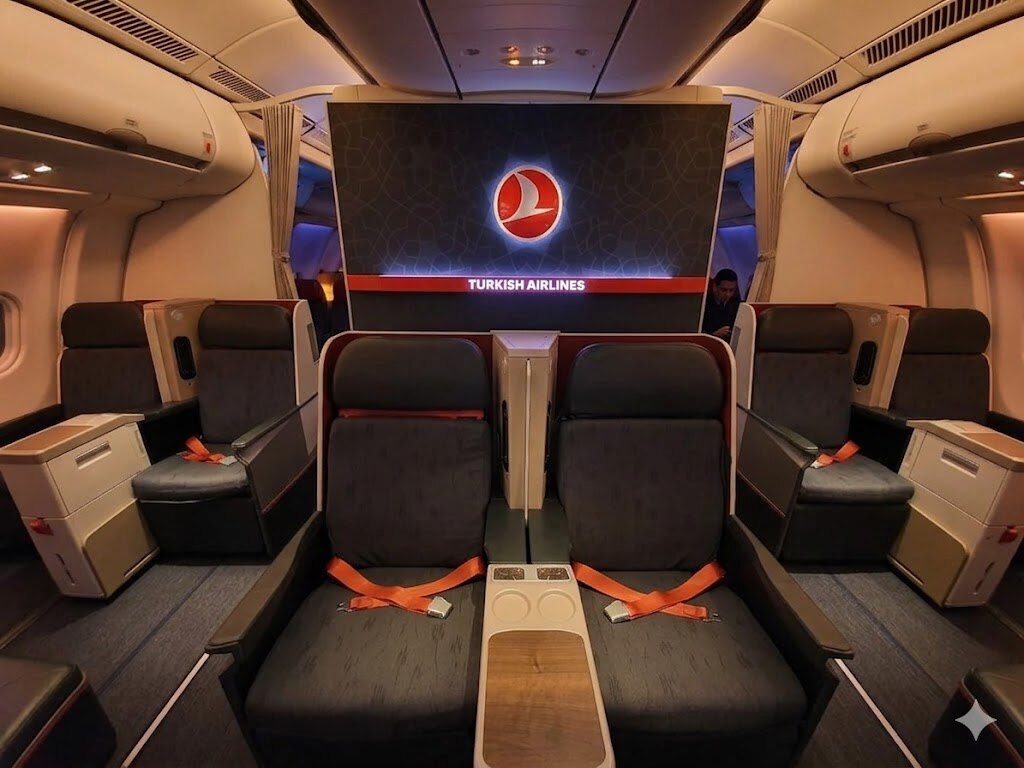
Turkish Airlines flies its Airbus A330-300 in two distinct cabin configurations, and which one you draw is a genuine version lottery. Both share a 2-2-2 staggered flat-bed Business cabin and a 2-4-2 Economy cabin, but the seat counts, row ranges and best-seat picks differ enough that it pays to check before you choose. This guide maps both configurations row by row, based on SeatCompare's own research and analysis.
⚠️ Version lottery: Use the tabs above the seat map to switch between the 28J (Config 333) and 40J (Config 33S) layouts. The seat product is essentially identical — both are 2-2-2 staggered flat-beds with the same Panasonic IFE and WiFi. The difference is cabin scale: a 28-seat Business (5 rows) versus a 40-seat Business (7 rows).
Quick Verdict
| Aircraft | Airbus A330-300 (twin-aisle widebody) |
| Fleet size | ~36 aircraft across two configurations |
| Configurations | Config 333 (~29 aircraft) and Config 33S (~7 aircraft) |
| Cabin layout | Business 2-2-2 staggered flat-bed; Economy 2-4-2 |
| Version lottery | Yes — 28-seat Business (5 rows) vs 40-seat Business (7 rows) |
| Best seats (Business) | Forward true-window seats: 1A/1K, 3A/3K |
| Best seats (Economy) | True-window seats (A & K); extra-legroom bulkhead (row 39 on 28J, row 28 on 40J) |
| Seats to avoid | Row 8 A/B/J/K bulkhead (no underseat storage); mid-cabin galley/lavatory rows; rear-lavatory rows |
| IFE | Panasonic eX2 AVOD seatback screens (on-demand) |
| Power | In-seat power throughout |
| WiFi | Panasonic eXConnect satellite WiFi |
The Version Lottery: 28J vs 40J
This is the single most important thing to know before you book or select a seat on Turkish's A330-300. The aircraft comes in two cabin builds, and they are not interchangeable.
Config 333 — the common one (~29 aircraft)
- 28 Business seats across 5 rows (rows 1-5).
- 261 Economy seats across rows 8-44.
- Confirmed true-window Business seats: 1A/1K, 3A/3K.
Config 33S — the larger Business build (~7 aircraft)
- 40 Business seats across 7 rows (rows 1-7).
- 265 Economy seats across rows 8-43.
- Confirmed true-window Business seats: 1A/1K, 3A.
The quickest tell is the size of the Business cabin: the 40-seat version has seven rows and feels noticeably denser and longer than the 28-seat version's five rows. If your booking shows Business rows running to 6 and 7, you are on the 40J (Config 33S). If Business stops at row 5, you are on the 28J (Config 333). Economy passengers can also check the rear: Config 333 Economy runs to row 44, while Config 33S ends at row 43.
Which is better? The seat product is essentially identical — both are 2-2-2 staggered flat-beds with the same Panasonic IFE and WiFi. The 28-seat cabin (Config 333) is marginally more intimate and the one you are most likely to fly given fleet numbers. The 40-seat cabin (Config 33S) packs more passengers into Business, so it can feel busier at meal and boarding times, but the per-seat experience is the same. In Economy, both are 2-4-2 at the same pitch and width. Bottom line: there is no meaningful product downgrade in either direction — this lottery is about cabin scale, not seat quality.
Cabin-by-Cabin Analysis
Business Class
Both configurations use a 2-2-2 staggered flat-bed layout. "Staggered" means the centre seat pairs are offset from the window pairs rather than lining up dead level — this buys each seat a little more shoulder room and a small footwell, but it has one classic drawback: the window-seat passenger cannot step directly into the aisle without passing the seat beside them. There are no doors and no fully private suites here; this is a comfortable, lie-flat older-generation business product rather than a herringbone suite.
- Best — 1A / 1K (both configs): forward true-window seats in the first row. Furthest from galley traffic, quick to deplane.
- Config 333 (28J): 1A/K and 3A/K are the standout forward window seats — true window alignment, away from the bulkhead and galley.
- Config 33S (40J): 1A/K and 3A are the standout forward window seats. Avoid 6J/K and 7E, which sit at the rear of the larger Business cabin beside the lavatory.
- Good — aisle seats throughout for direct access without climbing over a neighbour, and centre pairs (D/E) for couples travelling together.
- Note: seats directly behind a galley or at the front bulkhead can catch crew noise and galley light during meal service. Window seats in a staggered layout require stepping around the aisle neighbour.
Features: lie-flat beds in 2-2-2 stagger, Panasonic eX2 AVOD seatback entertainment, in-seat power, and Panasonic eXConnect satellite WiFi. Business pitch is generous (commonly ~46-52" depending on stagger position) with full recline to a flat bed.
Economy Class
Economy is 2-4-2 on both configurations: seats A-B by the left window, the D-E-F-G block in the centre, and J-K by the right window. Pitch sits at roughly 31-33 inches with a seat width around 17.5 inches — standard widebody long-haul economy.
- Best — window pairs (A-B and J-K). The two-seat sides are the prize of a 2-4-2 cabin: a window and an aisle for a pair with no one to climb over.
- Config 333 (28J): rows 30, 32, 34, 36 and 38 in A & K have the best glass alignment. The extra-legroom bulkhead is row 39 (A, B and D-G); 40A and 41K are also good.
- Config 33S (40J): rows 33, 35 and 40 in A & K. The extra-legroom bulkhead is row 28 (A, B, J and K) — the standout legroom pick on this build.
- Good: aisle seats in the centre block (D and G), and window-pair seats further back that are still clear of the rear galley.
- Avoid — centre seats E and F in the four-across middle block: trapped between two neighbours with no window. The least desirable seats in the cabin.
- Avoid — row 8 A/B/J/K (both configs): the front bulkhead row has no under-seat storage for take-off and landing and attracts bassinet-using families.
- Avoid — mid-cabin galley and lavatory rows: rows 23-25 on Config 333, rows 24-27 on Config 33S — catch galley light, lavatory traffic and queueing through the night.
- Avoid — rear lavatory rows: on Config 333, 42A/B and rows 43-44 in D-F (and 39J/K); on Config 33S, rows 41-43 — reduced or no recline against the rear bulkhead plus lavatory noise and traffic.
Features: Panasonic eX2 AVOD seatback screens with on-demand content, in-seat power, and Panasonic eXConnect satellite WiFi. Both configs are functionally identical in Economy.
Cabin Features Comparison
| Feature | Config 333 (28J) | Config 33S (40J) |
|---|---|---|
| Business seats | 28 | 40 |
| Business rows | 1-5 (5 rows) | 1-7 (7 rows) |
| Business layout | 2-2-2 staggered flat-bed | 2-2-2 staggered flat-bed |
| Economy seats | 261 | 265 |
| Economy rows | 8-44 | 8-43 |
| Economy layout / pitch | 2-4-2 · ~31-33" | 2-4-2 · ~31-33" |
| Confirmed Business windows | 1A/K, 3A/K | 1A/K, 3A |
| Extra-legroom Economy bulkhead | Row 39 (A,B,D-G) | Row 28 (A,B,J,K) |
| Best Economy windows (A & K) | Rows 30/32/34/36/38 | Rows 33/35/40 |
| Fleet count | ~29 aircraft | ~7 aircraft |
Quick-Pick Summary by Traveller Type
| Traveller | Best pick | Why |
|---|---|---|
| Solo Business | 1A or 1K | Forward, true window, quick exit |
| Business couple | Centre pair D/E in any row | Two seats side by side, no aisle between |
| Solo Economy | Window-pair A or K (forward) | Window with an adjacent aisle, one neighbour |
| Economy couple | A-B or J-K window pair | A private two-seat side, no middles |
| Family with infant | Row 8 bulkhead (bassinet positions) | Bassinet fitting and extra legroom |
| Legroom priority | Bulkhead: row 39 (28J) or row 28 (40J) | Extra pitch at the cabin bulkhead |
| Avoid at all costs | E/F centre seats; last rows by rear galley | No window, hardest to exit, noise |
How to Tell Which Version You're On
- Count the Business rows. Five rows (ending at row 5) = Config 333 (28J). Seven rows (ending at row 7) = Config 33S (40J).
- Check where Economy ends. Row 44 is the last Economy row on Config 333; row 43 is the last on Config 33S.
- Look at the seat-selection map when you book. A denser, longer Business cabin signals the 40-seat 33S build.
- When in doubt, the common draw is Config 333 — roughly 29 of these in the fleet versus 7 of the 33S, so the odds favour the 28-seat version.
Frequently Asked Questions
Does Turkish Airlines' A330-300 have lie-flat Business class?
Yes. Both configurations use a 2-2-2 staggered lie-flat Business seat. There are no closing-door suites — this is a comfortable older-generation flat-bed product, with true window alignment on the confirmed window seats.
How many configurations does the Turkish A330-300 have, and which is more common?
Two. Config 333 has 28 Business and 261 Economy seats and makes up the bulk of the fleet (~29 aircraft). Config 33S has 40 Business and 265 Economy seats (~7 aircraft). You are most likely to fly Config 333.
What is the Economy layout and seat pitch?
Economy is 2-4-2 on both builds (A-B by the left window, D-E-F-G in the centre, J-K by the right window). Pitch is roughly 31-33 inches and width about 17.5 inches.
Which Economy seats should I avoid?
Avoid the centre E and F seats in the four-across middle block (no window, hardest to exit) and the last rows by the rear galley and lavatories, where recline can be limited and traffic and noise are highest.
Are there bassinet or bulkhead seats?
Yes — the first Economy row (row 8) is a bulkhead with bassinet positions and extra legroom, but no under-seat storage during take-off and landing. It is a good choice for families with infants.
Is there WiFi and seatback entertainment?
Yes. Both configurations have Panasonic eX2 AVOD seatback screens with on-demand entertainment and Panasonic eXConnect satellite WiFi, plus in-seat power throughout.
Comparable Guides
- Turkish 777-300ER Seat Map & Best Seats (2026) — Turkish's older widebody
- Turkish 787-9 Dreamliner Seat Map & Best Seats (2026) — TK's best widebody Business
- Turkish A350-900 Seat Map & Best Seats (2026) — TK's newest widebody
- Turkish A321neo Seat Map & Best Seats (2026) — TK's narrowbody
Seat data based on SeatCompare's own research and analysis. Configurations and retrofit status change over time — always check your specific aircraft at booking.