Thai Airways 777-300ER Seat Selection Guide (2026)
Quick Reference
| Feature | 2-Class (most common) | 3-Class (LHR/NRT/KIX) |
|---|---|---|
| Royal First | — | 8 seats |
| Royal Silk Business | 42 seats, 1-2-1 staggered | 40 seats, 1-2-1 staggered |
| Economy | 306 seats, 3-3-3 | 255 seats, 3-3-3 |
| Total | 348 | 303 |
| Business seat product | Stelia Solstys | Stelia Solstys |
| Business pitch | 61" | 61" |
The Version Lottery
Not all Thai 777-300ERs are created equal.
2-Class (42J/306Y — 348 seats): This is the standard layout you'll get on most routes. No First Class. 42 Royal Silk Business seats split across two cabins, plus 306 Economy seats in 3-3-3. If you're flying Bangkok to Frankfurt, Sydney, Copenhagen, or anywhere else in the long-haul network, this is almost certainly your aircraft.
3-Class (8F/40J/255Y — 303 seats): The premium configuration, reserved for London Heathrow, Tokyo Narita, and Osaka Kansai. An 8-seat Royal First Class cabin sits at the front, followed by 40 Royal Silk seats and 255 Economy seats. Six aircraft carry this layout against 28 in the two-class fit. It is also the only one of the two with Wi-Fi: the 348-seat aircraft has no connectivity recorded at all, while this one carries THAI Sky Connect, sold by the flight. If Wi-Fi matters, that is the whole lottery.
How to tell which you've got: Check your seat map when booking. If Business starts at row 11 with nothing ahead of it, you're on the 2-class. If you see a small cabin starting from row 1, that's Royal First — you're on the 3-class.
One important caveat: Thai Airways is notorious for equipment swaps. Even if your booking shows the 3-class configuration, you could end up on a 2-class aircraft on the day. The silver lining is that the Business Class seat is identical on both — the only thing that changes is whether Royal First exists at the front.
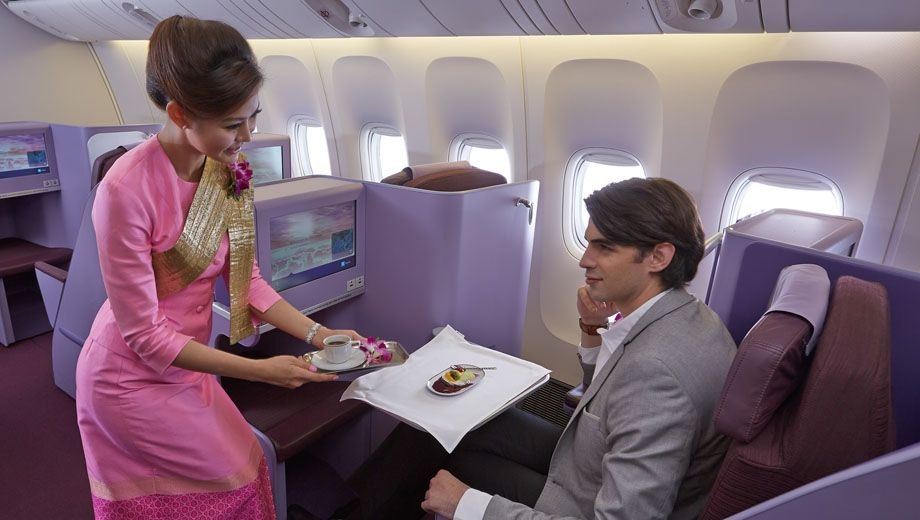
Royal Silk Business Class (1-2-1 Staggered)
Thai's 777-300ER Royal Silk uses the Stelia Solstys staggered seat — the same product found on Asiana's A380. It's not the newest seat in the sky, but it gets the fundamentals right: every seat has direct aisle access and converts to a fully lie-flat 180° bed (180cm length) with 61 inches of pitch.
The cabin is split into two sections, and choosing the right one matters as much as choosing the right seat.
The split differs between the two aircraft, and this is where most advice about this jet goes wrong.
On the 348-seat two-class aircraft — front cabin rows 11–17: 24 seats between doors 1 and 2. This is the larger, busier section — closer to the boarding door, the forward galley, and the lavs between the two cabins.
On the 348-seat aircraft — rear cabin rows 18–22: 18 seats between doors 2 and 3. Smaller, noticeably quieter, and the strong preference of frequent TG flyers. Row 18 is a centre pair only. If you can get a seat here, take it.
On the 303-seat three-class aircraft the split is completely different: just eight seats in rows 11 and 12 ahead of the galley and lavatory bank, then 32 seats in rows 14 to 21 behind it. The eight-seat forward mini-cabin is the quietest Royal Silk on either aircraft. There is no row 13 on either version.
Understanding the Stagger
Like all staggered products, the window seats alternate between being tucked against the fuselage (private, with a console shielding you from the aisle) and positioned closer to the aisle (exposed, less cosy). The centre pairs alternate too — "honeymoon" seats sit close together, while "divorce" seats are separated by a wide console. Getting this wrong can mean the difference between a peaceful overnight flight and feeling like you're sitting in the aisle.
Read the letter, not the row number. Which rows carry which position is inverted between the two aircraft — the A/K rows are 11, 14, 16, 18 and 20 on the 303-seat jet and 12, 15, 17, 19 and 21 on the 348-seat one — so any advice framed as "odd rows" or "even rows" is wrong on one of them. The letters do not move:
- A and K are always the true window seats, tucked against the fuselage.
- B and J are always the window seats set inboard toward the aisle — a window, but you sit closer to the aisle than to it.
- E and F are always the close centre pair — the honeymoon seats.
- D and G are always the separated centre pair, with a wide console between you.
Best Seats for Solo Travellers
Any A seat: the true window seat on the left side, tucked against the fuselage with maximum privacy. On the 348-seat aircraft those are 12A, 15A, 17A, 19A and 21A; on the 303-seat aircraft they are 11A, 14A, 16A, 18A and 20A.
Any K seat: the true window seat on the right side, similarly private. On the 348-seat aircraft those are 12K, 15K, 17K, 19K and 21K; on the 303-seat aircraft they are 11K, 14K, 16K, 18K and 20K.
19A, 21A or 21K on the 348-seat aircraft combine window privacy with the quieter rear mini-cabin. On the 303-seat aircraft the equivalent is 11A or 11K, in the eight-seat cabin ahead of the galley — though 12A and 12K are rated poorly there and are the pair to skip.
Best Seats for Couples
Any E/F centre pair — the honeymoon configuration, where the two seats sit close together rather than either side of a wide console. In the quieter rear cabin of the 348-seat aircraft that means 20E/F or 22E/F; on the 303-seat aircraft, 14E/F, 16E/F, 18E/F or 20E/F. A D/G pair is the opposite arrangement and is the better choice if you would rather not be shoulder to shoulder.
Seats to Think Twice About
🚫 Row 11 (bulkhead): You get extra legroom, but the IFE is in the armrest rather than the seatback and the galley/entrance buzz is constant. Fine for a daytime flight — less ideal for sleeping.
🚫 Row 17: Last row of the front cabin and right next to the mid-cabin lavatories. On an overnight BKK–Europe flight, you'll hear every flush and every queue conversation.
🚫 Row 19: First row of the rear cabin. Tall passengers love the extra legroom, but you're trading quiet for space — the galley is right behind the divider.
🚫 Any B or J seat: these are the aisle-exposed window positions. You technically have a window, but you're sitting closer to the aisle than to it. Far less private. On the 348-seat aircraft they are rows 11, 14, 16, 20 and 22; on the 303-seat aircraft, rows 12, 15, 17, 19 and 21.
A Note on Storage
The Stelia Solstys shows its age here. Storage is genuinely limited — a slim pocket next to the seat and the footwell area, and that's about it. If you're someone who likes to spread out with a laptop, book, snacks, and noise-cancelling headphones, you'll feel the squeeze. Stash what you can in the overhead bin before settling in.
Royal First Class (3-Class Only)
If you're lucky enough to be on one of the three 777-300ERs configured with Royal First — operating to London, Tokyo Narita, and Osaka — this is one of the best-value First Class products in Star Alliance. Just 8 seats in a small, exclusive cabin at the very front. You get a personal mattress pad, Porsche Design amenity kit, dedicated crew, and a meal service several notches above Royal Silk.
The space and privacy jump from Royal Silk to Royal First is dramatic. If you're flying one of these routes on points, it's worth checking availability.
Economy Class (3-3-3)
Here's where Thai quietly beats most of the competition. While BA, Cathay, Qatar, and almost every other major carrier has crammed 10 seats across the 777 cabin (3-4-3), Thai still runs 9-abreast (3-3-3). That means no dreaded middle-of-four seat and noticeably wider seats at approximately 18 inches. If you're flying Economy long-haul on a 777, this is one of the better options out there.
Seat pitch is 32 inches in most rows — standard for long-haul Economy. The front Economy cabin (rows 31 onwards, immediately behind Business) may offer a slightly more generous 34-inch pitch, though this varies by specific aircraft.
Best Economy Seats
Row 31 (bulkhead) — but only on the 348-seat aircraft: extra legroom at the front of Economy and first to be served from the forward galley. The trade-off: IFE screens are in the armrest rather than the seatback, and overhead bins may be reserved for crew use.
On the 303-seat three-class aircraft the same row number is one of the worst in Economy. There it backs onto a lavatory bank: six of its nine seats rate as seats to avoid, 31A has a misaligned window on top of it, and the whole of row 32 behind it cannot recline. Take 31D, 31E or 31F there, or move back.
Exit row seats: the legroom jackpot, but often blocked for advance selection and released at check-in. They are in different places on the two aircraft — rows 40 and 41 on the 348-seat jet, rows 33 and 48–49 on the 303-seat one. Note that 33A and 33K on the 303-seat aircraft have no window at all, a blank stretch of wall, despite sitting in an otherwise well-rated forward mini-cabin.
Any window seat in the front Economy cabin if you want the potential 34-inch pitch zone.
Economy Seats to Avoid
🚫 The back of the bus: rows 71 and 72 on the 348-seat aircraft, rows 59 and 60 on the 303-seat one. Close to rear lavatories and galley noise, and the fuselage taper means those rows lose their C and H seats and the aisle narrows — aisle passengers get clipped by every passing trolley.
🚫 Seats with no window at all. On the 348-seat aircraft: 35A, 35K, 40A and 40K. On the 303-seat aircraft: 33A and 33K. None of these carries a warning on the booking map, so all of them read as ordinary window seats when you pick. 32A and 32K on the 348-seat jet do have a window, but it sits too far behind the seat to use.
🚫 Rows immediately in front of exit rows: Limited or no recline.
🚫 Row 31 if you have large carry-on luggage: The overhead bins are sometimes crew-only, forcing you to stash your bag rows away.
777-300ER vs A350-900: Which Thai Aircraft Should You Pick?
If you have a choice between routes, both the 777-300ER and A350-900 deliver a very similar Business experience — 1-2-1 staggered, direct aisle access, lie-flat beds. The 777-300ER has a wider fuselage, so it feels marginally more spacious. The A350-900 is the newer, quieter aircraft with lower cabin altitude and better humidity — you'll feel fresher on arrival. In Economy, the 777-300ER wins outright thanks to 3-3-3 seating on the wider body.
The one to avoid is the 777-200ER. It has an older 2-2-2 angled-flat Business product that doesn't go fully flat, no direct aisle access from window seats, and it's being phased out. If your booking shows a 777-200ER, consider changing flights.
FAQ
Does the 777-300ER have Premium Economy?
Not yet. Thai has announced plans to add Premium Economy to the 777-300ER fleet, but as of early 2026 the retrofit hasn't happened. On some Scandinavian routes (BKK–ARN, BKK–CPH), the rear Business cabin is sold as a premium economy product — meaning you get a lie-flat seat but with economy-level catering and service. It's one of the stranger configurations in the sky.
Is the Business seat the same on both versions?
The seat is. The Stelia Solstys 1-2-1 staggered seat and its 61-inch pitch are the same on both. The cabin is not, and the differences matter more than the seat: the 303-seat aircraft splits Royal Silk into an eight-seat mini-cabin in rows 11–12 and a 32-seat cabin in rows 14–21, where the 348-seat aircraft runs 24 seats in rows 11–17 and 18 in rows 18–22. The rows carrying the true-window A and K positions are inverted between them. And only the 303-seat aircraft has Wi-Fi.
How many 777-300ERs does Thai operate?
Thirty-four on the current cabin plans: 28 in the 348-seat two-class fit and 6 in the 303-seat three-class fit with Royal First. The active fleet fluctuates, so treat those as the split rather than a headcount on any given day.
Which routes get the 777-300ER?
Primarily long-haul European routes: London, Frankfurt, Paris, Munich, Stockholm, Copenhagen, Zurich, and select Asian/Australian destinations. The A350-900 is gradually taking over some of these, particularly to Europe.