Garuda Indonesia 737-800 Seat Selection Guide (2026)
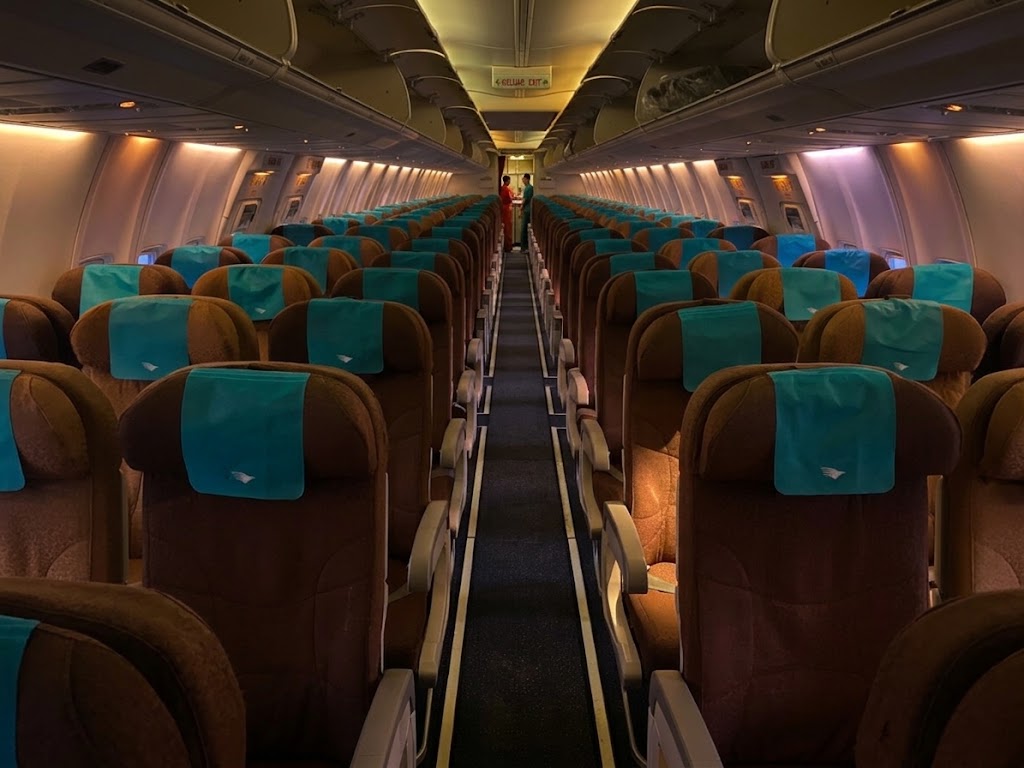
Garuda Indonesia flies two Boeing 737-800s. One has twelve Business seats and 150 in Economy; the other has eight and 162. That sounds like a small difference until you look at where the extra twelve Economy seats came from: Garuda took them out of the legroom in the front half of the cabin.
On the 170-seat aircraft, rows 22 to 31 measure about 29 inches — roughly three inches tighter than the rows behind them. Sitting further forward costs you legroom on that jet. That is the opposite of what almost every traveller assumes, and it is invisible on a booking page.
✈️ Quick Verdict
- Aircraft: Boeing 737-800, two configurations
- Configurations: 162 seats (12C + 150Y) · 170 seats (8C + 162Y)
- Fleet: 32 aircraft fly the 162-seat layout; no count is published for the 170-seat one
- Version lottery: Yes — and it decides your Economy legroom, not just your Business odds
- Best outcome: the 162-seat jet: more Business seats and no tight forward-cabin block
- Best Business seats: 6A, 6C, 6H, 6K on both — the front row leads the cabin
- Best Economy seats: 31A/31C/31H/31K on the 162-seat jet; 33A/33C/33H/33K on the 170-seat jet (second exit row, full recline)
- Economy seats to avoid: row 21 on both (cramped bulkhead), rows 45–46 (162-seat) or 47–48 (170-seat)
- The trap: rows 22–31 on the 170-seat jet are ~29", three inches tighter than the rear cabin
- IFE & Wi-Fi: Panasonic eX2 (162-seat) or Thales (170-seat). No Wi-Fi is recorded on either.
The Version Lottery
Both aircraft start Business at row 6 and Economy at row 21, and both skip row 24. What changes is how many rows go where.
| 162-seat | 170-seat | |
|---|---|---|
| Total seats | 162 | 170 |
| Business | 12, rows 6–8, 2-2 | 8, rows 6–7, 2-2 |
| Economy | 150, rows 21–46 | 162, rows 21–48 |
| Forward Economy pitch | About 30", close to the cabin norm | About 29" — three inches tighter than the rear |
| Rear Economy pitch | About 31–32" | About 31–32" |
| Overwing exit rows | 30 and 31 | 32 and 33 |
| Economy bulkhead | Row 21, 44cm (17in) to the wall | Row 21, 40cm (16in) to the wall |
| Seats flagged for tight pitch | None | 54 — rows 22 to 31 |
| Fleet count published | 32 aircraft | None |
⚠️ The forward-cabin trap
On the 170-seat aircraft, the nine rows behind the bulkhead are the tightest seats on the jet. Rows 22, 23, 25, 26, 27, 28, 29, 30 and 31 measure about 29 inches; rows 34 to 48 measure about 32. Fifty-four of the 162 Economy seats sit in that block. If you are choosing between "near the front" and "legroom" on this aircraft, they are opposites — and if you have a choice, the rear cabin is the better seat.
How to Tell Which Version You’re On
| What you see on the map | Version | Why it works |
|---|---|---|
| Business has three rows (6, 7, 8) | 162-seat | Twelve Business seats instead of eight |
| Business has two rows (6, 7) | 170-seat | And Economy runs two rows deeper at the back |
| Economy ends at row 46 | 162-seat | The 170-seat jet ends at row 48 |
| The exit rows are 30 and 31 | 162-seat | On the 170-seat jet they are 32 and 33 |
The exit-row check is the most reliable one, because the exits are in the same physical place on both aircraft — the row numbers shift only because the 170-seat jet fits two more rows in front of them. Row 24 does not exist on either version.
Business Class — both versions
A four-across 2-2 recliner cabin: A and C on the left, H and K on the right. Three rows on the 162-seat jet, two on the 170-seat one. It is a regional Business product, not a flat bed, and the seats are the same on both aircraft.
✅ Best seats
- 6A, 6C, 6H, 6K — the front row on both versions. Nothing ahead of you but the bulkhead, and all four rate at the top grade on both aircraft.
- 7A, 7K on the 170-seat jet — the rear row of its two-row cabin, rated green with the same well-aligned window as row 6.
🚫 Seats to avoid
- Row 8 on the 162-seat jet — not bad, simply unremarkable: the rearmost Business row, closest to the Economy curtain and the forward galley traffic that passes it.
Economy — 162-seat jet (150 seats, rows 21–46)
Six across in 3-3: A, B, C on the left and H, J, K on the right. Twenty-five rows, evenly pitched, with the overwing exits at rows 30 and 31.
✅ Best seats
- 31A, 31B, 31C, 31H, 31J, 31K — the best Economy row on the aircraft. Exit-row legroom and a full recline, because there is no exit row behind it to keep clear.
- 30C, 30H — the aisle seats in the first exit row. They get the legroom and, unlike 30A/30B/30J/30K, they are not the ones that have to stay upright.
- 42A, 42K and 44A, 44K — the best-aligned windows in the rear cabin, and far enough forward of the rear lavatories to stay quiet.
- 25A, 25K — well-aligned windows near the front, if you want to be off quickly.
🚫 Seats to avoid
- Row 21 — the bulkhead, and a bad one. The wall is 44cm (17in) away, closer than most bulkheads, so you get less legroom than the ordinary row behind you, plus no underseat storage and the tray table in the armrest. Row 22 is a better seat in every measurable way.
- 30A, 30B, 30J, 30K — exit-row legroom, but they may not fully recline because row 31 behind them needs a clear path. Row 31 gives you both.
- 29A, 29B, 29J, 29K — in front of the exit row, so restricted recline with no legroom in return. The worst combination on the aircraft.
- 26A — no usable window; the window sits well behind the seat. 27A and 27K are misaligned too.
- Rows 45 and 46 — the rear lavatory and galley bank. Row 46 is the last row and none of its six seats reclines.
Economy — 170-seat jet (162 seats, rows 21–48)
Same six-across arrangement, two rows deeper, and split into two pitch zones that a booking page will not show you. Rows 22 to 31 are about 29 inches; rows 34 to 48 are about 32. The exits are at rows 32 and 33.
✅ Best seats
- 33A, 33B, 33C, 33H, 33J, 33K — the best row on the aircraft, for the same reason as row 31 on the other version: exit-row legroom with a full recline behind it.
- 32C, 32H — the aisle seats in the first exit row, which keep their recline where 32A/32B/32J/32K do not.
- 44A, 44K and 46A, 46K — well-aligned windows in the deeper-pitch rear cabin. On this aircraft the back half is genuinely the better half.
- Any row from 34 back — three inches more legroom than rows 22–31, for the same price.
🚫 Seats to avoid
- Rows 22 to 31 — the tight block. About 29 inches, three less than the rear cabin, across all 54 seats.
- Row 21 — the bulkhead is 40cm (16in) to the wall, tighter still, with no underseat storage and the tray in the armrest.
- 29A, 29K — no window at all, wall only, and inside the tight block.
- 31A, 31B, 31J, 31K — in front of the exit row, so restricted recline, in the tight block, with nothing gained.
- Rows 47 and 48 — the rear lavatory and galley bank. Row 48 is the last row with no recline.
✅ If you have a free choice on the 170-seat jet
Take row 33 first, then anything from row 34 back. Rows 44 and 46 have the best windows. The only reason to sit in rows 22–31 is to be off the aircraft a minute earlier, and it costs three inches of legroom for the whole flight to buy it.
Cabin Features Compared
| 162-seat | 170-seat | |
|---|---|---|
| Business | 12 seats, 2-2, rows 6–8 | 8 seats, 2-2, rows 6–7 |
| Economy rows | 21–46 (25 rows) | 21–48 (27 rows) |
| Pitch, forward Economy | About 30" | About 29" |
| Pitch, rear Economy | About 31–32" | About 31–32" |
| Exit rows | 30 and 31 — take 31 | 32 and 33 — take 33 |
| Bulkhead distance to wall | 44cm (17in) | 40cm (16in) |
| Windowless seats | 26A | 29A, 29K |
| Misaligned windows | 27A, 27K | 28A |
| Last row | 46 — no recline | 48 — no recline |
| IFE | Panasonic eX2, on demand | Thales, on demand |
| Wi-Fi | None recorded | None recorded |
Quick-Pick Summary
| Traveller | 162-seat | 170-seat |
|---|---|---|
| Solo, Business | 6A or 6K | 6A or 6K |
| Couple, Business | 6A/6C or 6H/6K | 6A/6C or 6H/6K |
| Legroom priority, Economy | Row 31 (all six seats) | Row 33 (all six seats) |
| Legroom, second choice | 30C or 30H | 32C or 32H |
| Best window, Economy | 42A, 42K, 44A, 44K | 44A, 44K, 46A, 46K |
| Quiet, Economy | Rows 32–44 | Rows 34–46 |
| Off the aircraft first | Rows 22–23 — no pitch penalty | Rows 22–23 — but three inches tighter |
| Avoid at all costs | Rows 21, 29, 45, 46 | Rows 21, 22–31, 47, 48 |
Known Quirks
| Quirk | What it means for seat choice |
|---|---|
| Row 24 does not exist | Both versions run 23 straight to 25. It is not a booking error and it does not identify the version. |
| The bulkhead is the worst row, not the best | Row 21 on both aircraft has less legroom than the ordinary row behind it. This is unusual and it is measured, not estimated. |
| The first exit row is the wrong one | Row 30 (162-seat) and row 32 (170-seat) have the legroom but restricted recline in the window and middle seats. The row behind has both. |
| The exits do not move; the numbers do | The overwing exits sit in the same place on both aircraft. They are rows 30/31 on one and 32/33 on the other purely because the 170-seat jet fits two more rows in front of them. |
| Published fleet counts disagree | The published per-configuration count for the 162-seat layout is 32, while Garuda’s published fleet total is forty-six 737-800s. This guide quotes neither as a total and gives identification tells instead. |
FAQs
Q: How do I tell which 737-800 I’m getting?
A: Count the Business rows. Three rows (6, 7 and 8) means the 162-seat jet; two rows (6 and 7) means the 170-seat one. As a cross-check, Economy ends at row 46 on the first and row 48 on the second.
Q: Is the front of the cabin really tighter?
A: On the 170-seat aircraft, yes. Rows 22 to 31 measure about 29 inches across all 54 seats, against about 32 inches for rows 34 to 48. The 162-seat aircraft does not have this split — its forward rows are about an inch tighter than the rear, which is normal.
Q: Which is the best Economy row?
A: Row 31 on the 162-seat jet and row 33 on the 170-seat jet. Both are the second of the two overwing exit rows, which means exit-row legroom with a full recline. The first exit row of each pair has to stay upright.
Q: Is the bulkhead row worth taking?
A: No. Row 21 on both aircraft is a cramped bulkhead — 44cm (17in) to the wall on the 162-seat jet and 40cm (16in) on the 170-seat one, which is closer than most bulkheads. You also lose underseat storage and the tray moves into the armrest. Row 22 is better.
Q: Is there Wi-Fi?
A: No Wi-Fi is recorded on either configuration. Both have seatback IFE on demand — Panasonic eX2 on the 162-seat jet, Thales on the 170-seat one.
Q: Which seats have no window?
A: 26A on the 162-seat jet, and 29A and 29K on the 170-seat one. 27A/27K and 28A respectively have a window that sits out of line with the seat.
Related Guides
- Garuda Indonesia A330-300 seat guide — the long-haul Business lottery
- Garuda Indonesia 777-300ER seat guide — the fleet’s only First Class cabin
- Malaysia Airlines 737-800 seat guide — the nearest regional comparison
- Japan Airlines 737-800 seat guide — a two-class 737-800 with a very different pitch profile
- Aeroméxico 737-800 seat guide — another aircraft where the first exit row is the wrong one