Emirates Just "Finished" 100 Retrofits. Its Cabin Lottery Has Never Been Worse.
Published July 22, 2026 · Cabin Report · ~5 min read
The headline out of Dubai this month sounds like closure: Emirates has completed cabin retrofits on 100 wide-body aircraft — 47 A380s and 53 Boeing 777s — as of mid-July 2026. A round number, a milestone video, a pat on the back for one of the largest cabin overhauls in aviation history.
For anyone actually booking an Emirates flight, it means the opposite of closure. The retrofit isn't collapsing the version lottery. It's multiplying it.
Here's the problem in one sentence: on the same route, under the same flight number, at the same price, you can now end up in one of three completely different generations of Emirates cabin — and from August 2026, that third tier is a brand-new product that makes the first 100 retrofits look dated.
The three Emirates you can now board
Strip away the marketing and the wide-body fleet splits into three tiers.
Tier 1 — Legacy (not yet touched). With 219 aircraft in the full programme and roughly 100 done, well over half the fleet still flies the old interior: no Premium Economy, the older Business Class seat, the previous-generation ice screens. If you land on one of these, the most valuable cabin on the aircraft — Premium Economy — simply doesn't exist on your flight.
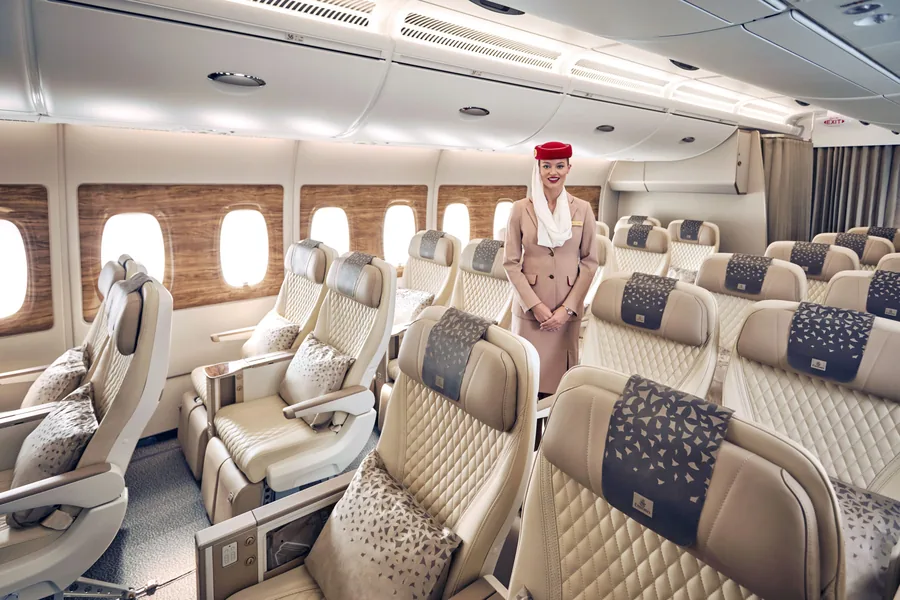
Tier 2 — Phase-one retrofit (the 100 just completed). These are the jets everyone's celebrating. Four-class layout, refreshed interiors, and crucially the addition of Emirates' Premium Economy cabin — 56 seats at the front of the main deck on the A380, plus more Business seats and updated finishes. On the 777, the retrofit brings a 1-2-1 Business layout with up to 38 seats, "virtual windows" on the centre suites, and up to 260 next-generation Economy seats. This is the product most people picture when they think "new Emirates."
Tier 3 — Next-generation (from August 2026). This is the twist. The next 111 aircraft — 60 A380s and 51 777s — don't just get the phase-one product. They get a further upgrade: Panasonic's Astrova in-flight entertainment system, complimentary Starlink Wi-Fi, a new onboard lounge, a Business Class seat inspired by the leather "S Lounge" design already flying on the A350, and a Recaro Premium Economy seat with a mechanical recline. In other words, the moment Emirates "finishes" tier two, tier three lands and leapfrogs it.
So by late 2026, "I flew the new Emirates A380" could mean three genuinely different experiences. That's not a rounding error. That's the entire point of checking before you book. The Emirates A380 seat map shows every layout and how to tell which one you're on.
Emirates cabin tiers at a glance
- Tier 1 (Legacy): ~119 wide-bodies · No Premium Economy · Old Business seat · Older ice screens
- Tier 2 (Phase-one retrofit): 100 done (47 A380 + 53 777) · Four-class · Premium Economy added · 1-2-1 Business on 777
- Tier 3 (Next-gen, from August 2026): 111 planned (60 A380 + 51 777) · Astrova IFE · Starlink Wi-Fi · New Business seat · Recaro Premium Economy · Onboard lounge
The A380 has a lottery within the lottery
Even inside the retrofitted fleet, the A380 forks again.
Most retrofitted A380s keep the signature four-class layout — First, Business, Premium Economy, Economy. But Emirates has also started converting a batch of two-class A380s — no First Class at all. The first of these launched on the Dubai–Birmingham route, reconfigured to 76 Business, 56 Premium Economy and 437 Economy after engineers stripped out 120 upper-deck Economy seats to make room. Fifteen of these two-class conversions are planned.
For a traveller, that's a meaningful fork. Chasing a First Class Apartment on a route that's quietly switched to a two-class A380 is a wasted search. The tail number decides whether the cabin you want is even on the aircraft.
Why "check the route" doesn't work
The instinct is to assume the best jets fly the marquee routes. It's not reliable. Emirates rotates airframes, and retrofitted and legacy aircraft frequently share the same route on different days — one long-haul sector might get a refurbished A380 while an identical-length route to another city still runs the old cabin. Route lists go stale within weeks.
The one tell that actually works is the seat map at booking. Premium Economy exists only on retrofitted aircraft. So:
- Premium Economy cabin shown in the seat map → retrofitted jet (tier two or three).
- No Premium Economy → legacy aircraft, old Business, old screens.
That single check is worth more than any route table. It won't yet distinguish tier two from tier three — the seat map alone won't flag whether you're getting Astrova and Starlink — but from August it's worth cross-referencing aircraft age and Wi-Fi provider on the sectors where the next-gen jets debut.
SeatCompare tip: Before you book Emirates, pull the seat map. Premium Economy in the map is the fastest proof you're on a retrofitted jet. From August 2026, cross-check the airframe against Starlink availability to identify the tier-three next-gen build.
What this means for your booking
The clean story — "Emirates finished its retrofit" — is the wrong takeaway. The accurate one is messier and more useful:
- More than half the wide-body fleet is still the old product. Don't assume Premium Economy is available just because it's a big Emirates route.
- The seat map is your verification tool. Premium Economy in the map means a modern cabin. No Premium Economy means legacy.
- From August 2026, a third tier arrives that beats the very retrofits being celebrated this month — so "new" is about to fragment again.
- On the A380 specifically, confirm it's still four-class before hunting for First.
A completed milestone, in Emirates' case, is the moment the fleet becomes harder to read, not easier. Which is exactly why you check the cabin, not the carrier.
Fleet figures reflect Emirates' mid-July 2026 retrofit update. Configurations, timelines and next-gen rollout dates can change; always confirm the live seat map when booking.