Emirates Just Made Premium Economy the Main Event
Published September 4, 2026 · Cabin Report · ~5 min read
The Short Version
What happened: On 3 September 2026 Emirates unveiled a Premium Economy seat with a full-height, electrically operated privacy screen between every seat — a first for the cabin class.
Where it flies: Newly delivered Airbus A350s only, in a 28-seat 2-3-2 cabin.
The catch: Emirates operates four different Premium Economy layouts. Three of them are unaffected, and the airline has not named the first aircraft or route to carry the new seat.
For twenty years the aircraft arms race was fought at the front of the plane — first class showers, doored suites, ever-flatter business beds. Emirates has just spent its innovation budget four rows further back, and the choice says more about where airline profits now come from than any suite launch of the last decade.
What Emirates actually announced
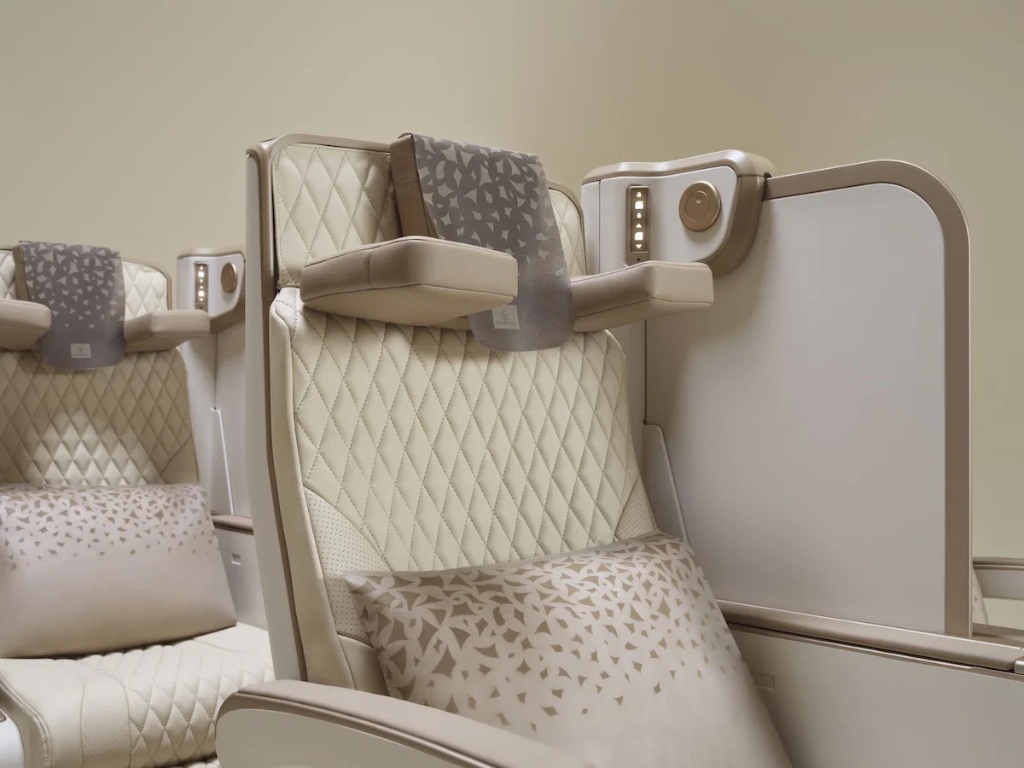
The headline feature is a privacy divider that runs the full height of the seat and is raised, lowered and locked electrically from the passenger control unit. Dividers between Premium Economy seats are not new — hard-shell cabins have had fixed wings for years. A powered one that extends to full seat height, and that the passenger controls, is new.
Around it sits a genuinely comprehensive spec. This is Emirates' first fully powered Premium Economy product, with preset lounge and meal positions. It carries the U-Dream leather headrest with adjustable wings that Emirates introduced in Economy, plus a deployable leather footrest. Wireless charging arrives in the cabin for the first time, alongside USB-C at every seat and a tray table with an integrated phone holder for use as a second screen. Entertainment runs on a 13.3-inch 4K HDR touchscreen, and the newest A350s add left and right exterior camera views to the existing forward and downward feeds.
The physical dimensions are unchanged: 20 inches wide, up to 39 inches of pitch, cradle recline that does not intrude on the row behind, in a 2-3-2 cabin of 28 seats.
Parsing the "world's first"
Emirates' claim is carefully worded, and worth reading precisely: the world's first electrically powered Premium Economy seat with a full-height adjustable privacy screen. The privacy screen is the first. Powered Premium Economy recline is not — Japan Airlines put an electrically reclining Premium Economy seat into service on its A350-1000 well before this, and it also had substantial fixed partitions.
That is not a gotcha. It is the useful distinction for anyone deciding whether the cabin is worth a fare premium: the recline mechanism is catching up with a competitor, while the divider is the part nobody else has.
Which aircraft get it — and which don't
This is where the announcement gets less generous than the photography suggests. Emirates sells Premium Economy across four broadly different cabins:
| Aircraft | PE seats | Layout | New seat? |
|---|---|---|---|
| A350 (long-haul config) | 28 | 2-3-2, four rows | Yes — newly delivered aircraft |
| A350 (initial batch) | 21 | 2-3-2, three rows | No |
| A380 (three-class) | 56 | 2-4-2 | No |
| 777 (retrofitted) | 24 | 2-4-2 | No |
A 28-seat 2-3-2 cabin is four rows of seven, which matches Emirates' long-haul A350 configuration rather than the 21-seat, three-row cabin on its first batch of A350s. Emirates did not name the first aircraft, route or departure date to carry the new seat, so for now there is no reliable way to book it deliberately.
The wider point for passengers: the 2-3-2 A350 cabin was already the better bet before any of this, because seven-abreast rows contain one true middle seat instead of the two you get in the eight-abreast A380 and 777 cabins. The privacy screen widens a gap that already existed.
Why the middle of the cabin is suddenly worth this much money
Post-pandemic passenger growth has flattened into low single digits. Airlines that spent five years chasing volume are now chasing yield instead, and Premium Economy is the most efficient place to find it: the fare commonly runs somewhere between one and a half and three times economy, while the seat consumes only modestly more floor space and service cost than an economy seat does. Premium cabins as a whole now account for roughly a quarter of global passenger revenue, and at the carriers that have leaned hardest into the strategy the share of passenger revenue coming from premium products has reached about half.
At the same time business class is being unbundled — sliced into tiers with and without doors, with and without the wider seat, priced separately. That compresses the gap from above while products like this one push up from below. The distance a passenger has to cross to justify a Premium Economy fare keeps shrinking; the distance from Premium Economy to the cheapest business fare does too.
The Gulf angle
Emirates launched Premium Economy in 2022 and has spent the years since expanding it across the fleet. Its two closest regional rivals still do not sell the cabin at all, which makes a marquee Premium Economy product a differentiator neither can answer quickly. Elsewhere the holdouts are folding — Turkish Airlines, a vocal sceptic for years, has reversed course and is targeting a launch around 2028, starting on new A350s.
Which is also the risk. If every long-haul carrier expands Premium Economy at once, they end up competing for the same finite pool of travellers willing to pay up, and the yield premium that justified the investment starts to erode. In that world the differentiation has to be real and, crucially, findable at the point of booking. A privacy screen you cannot confirm your aircraft has is worth very little at the moment you are choosing a fare.
What to do with this if you're booking
Until Emirates identifies the routes, treat the new seat as a bonus rather than something to pay for. If Premium Economy comfort is the priority, the decision that actually moves the needle today is aircraft type, not seat generation: choose an A350 rotation over an A380 or 777 one and you drop from an eight-abreast row to a seven-abreast row, which is a bigger practical difference than any headrest.
Within the 28-seat cabin, the row that looks best on a booking map is the one to avoid. Premium Economy occupies rows 14 to 17, and row 14 is the bulkhead — extra legroom, and a lavatory door immediately in front of it, which means queue traffic, light and noise for the whole flight. The seats to take are 15A and 15K: two windows each, and no bulkhead or lavatory penalty. Our full A350-900 guide has the rest of the cabin row by row.
And if you are flying Emirates on anything other than an A350, the more useful read is our piece on the retrofit cabin lottery — because the gap between the three generations of Emirates cabin currently flying is far wider than the gap this announcement closes.
We'll update this piece — and the affected seat guides — once Emirates confirms which aircraft are flying the new seat and where.