easyJet A319 Seat Map & Best Seats (2026)
Updated August 2026 · Verified seat-level data
easyJet operates around 80 Airbus A319s across its three AOCs — easyJet UK, easyJet Europe (Austrian AOC) and easyJet Switzerland. It's the smallest aircraft in the fleet and, increasingly, the rarest: easyJet confirmed in 2025 that the A319 will leave the fleet entirely by the end of FY29, with the first three retirements happening during 2026 and larger A320neo and A321neo aircraft taking their place.
For passengers, the A319 is the quiet win of the easyJet fleet. It carries 156 people instead of the A320's 186, across 26 rows instead of 31. Boarding is faster, deplaning is faster, and even the back of the cabin is only ten rows behind the wing. It also has two extra-legroom exit rows instead of the usual pair-plus-one arrangement — and one of them is measurably better than the other.
Quick Verdict
| Layout | All-Economy, 3-3 (ABC–DEF) |
| Total seats | 156 (rows 1–26) |
| Fleet | ~80 aircraft, retiring by FY29 |
| Seat model | Recaro SL3510 slimline (some aircraft still Weber AI-1000) |
| Seat width | 18" (46 cm) |
| Standard pitch | 28" (71 cm) |
| Exit row pitch | ~35" (89 cm) — rows 10 and 11 |
| Recline | None — all seats fixed and pre-reclined |
| Version lottery | Yes — Recaro vs legacy Weber seats |
| IFE / power / WiFi | No screens, no power or USB, AirFi local portal only |
| Best seats | 11A, 11F (exit row, two windows, aft of both doors) |
| Seats to avoid | 26A, 26B, 26C, 26F |
Flying easyJet but not sure which aircraft? See all easyJet seat maps: easyJet swaps aircraft, and the layouts differ.
The Version Lottery: Recaro vs Weber
Two seat types, same seat map
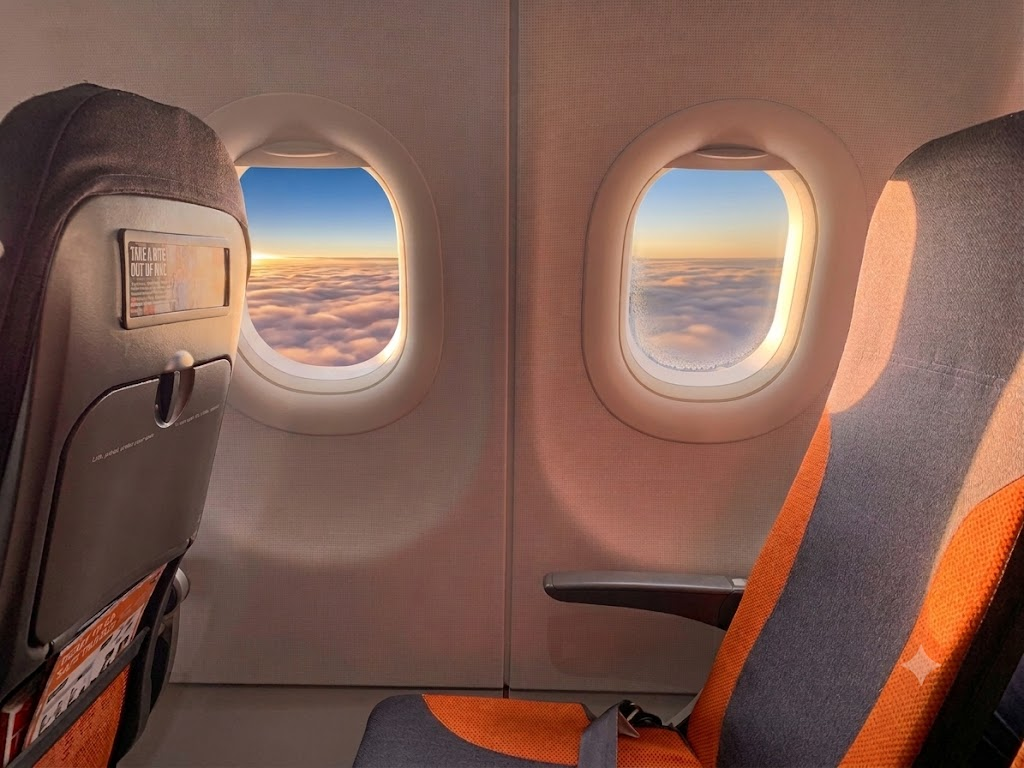
Most A319s were retrofitted with Recaro SL3510 slimline seats. A minority still carry the original Weber AI-1000. At an identical 28" pitch, the Recaro's netting-filled backrest gives visibly more knee clearance than the Weber's foam one. Same seat count, same row numbers, same 3-3 layout, no recline on either.
How to tell which you're on: you generally can't before boarding, and easyJet doesn't distinguish them at the seat-selection stage. Once on board, the Recaro is the slim navy-and-orange seat with a thin, hard-shell back and a literature pocket mounted high near the headrest. The Weber is chunkier, with the pocket in the traditional low position behind the tray table. If you draw a Weber aircraft and you're tall, this is the one occasion where buying up to an exit row genuinely pays.
The second lottery is the aircraft itself. With A319s leaving the fleet through 2029, easyJet increasingly swaps A319 rotations onto 186-seat A320s. If your booking changes aircraft type, your seat number moves — an A319 row 11 exit seat does not map onto the A320, where the exit rows are 12 and 13. Re-check your seat assignment after any schedule change.
Seat Tiers & Pricing
Three categories, all the same physical seat. Only the location and the bundled perks differ.
XL Extra Legroom — Rows 1, 10, 11
The genuinely spacious seats: row 1 at the forward bulkhead, and rows 10 and 11 at the overwing exits (~35" pitch, roughly 7" more than standard). The XL fare bundles Speedy Boarding and the right to bring a large cabin bag (56 × 45 × 25 cm) into the overhead bin. Typically £10–£30+ per seat, dynamically priced.
Up Front — Rows 2–5
Standard 28" pitch with no extra legroom. You're paying for Speedy Boarding, the large cabin bag, and being among the first off. Typically £8–£20+ per seat.
Standard — Rows 6–26
The default. Pre-select for a small fee (typically £3–£10), or accept a free assignment at check-in.
Row-by-Row Analysis
Row 1 — XL Extra Legroom (and the A319's forward asymmetry)
Row 1 on the A319 is not laid out like the A320's, and this trips people up. On the A319 the forward lavatory sits on the left, ahead of 1A/1B/1C, while the galley sits on the right, ahead of 1D/1E/1F behind a solid bulkhead panel.
1A, 1B, 1C (left / lavatory side): no bulkhead panel directly ahead — just the lavatory module — so knee room is excellent. The cost is that you're staring at a toilet door for the whole flight, with a queue forming in front of you on anything over two hours.
1D, 1E, 1F (right / galley side): a solid bulkhead in front means no under-seat storage at all and no stretching your legs forward, though legroom is still better than standard. 1F is the pick of the three: the bulkhead only covers about 95% of the width, leaving a genuine gap of extra floor space on the right-hand side.
All of row 1 shares the same trade-offs: tray tables live in the armrests (so the armrests are fixed and the effective seat width is slightly narrower), nothing can go under the seat in front during taxi, takeoff and landing, and you're beside both the galley noise and the lavatory traffic. Best pick: 1F for the extra floor gap without a toilet door in your eyeline. 1C if you want the aisle and maximum knee room.
Rows 2–5 — Up Front Zone
Standard 28" pitch, forward of the wing, quiet ride, first off the plane. Two window notes matter here:
- 2A and 2F are the weakest windows on the aircraft's forward half. The window is set behind the seat, so you have to lean back to see out.
- 3A and 3F are among the best windows on the whole aircraft — clean, centred alignment.
Best pick: 3A or 3F. If you're buying Up Front for a view, pay for row 3, not row 2.
Rows 6–9 — Forward Standard Cabin
Ordinary 28" seats at standard prices, but positioned forward of the wing with no galley or lavatory nearby. Good overhead bin availability if you board reasonably early. 7A and 7F each get two windows rather than one, making them the best-value view on the aircraft. Row 9 sits immediately ahead of the first overwing exit and, because nothing on easyJet reclines anyway, carries none of the usual pre-exit-row penalty — it's a perfectly normal row.
Best pick: 7A or 7F.
Best seats: 11A and 11F
Row 11 sits aft of both overwing exits — the same ~35" pitch as row 10 without the draft, and 11A/11F each have two windows. It's exit-row legroom and the best view in the cabin at once. If they're gone: 11C/11D, then 10C/10D.
Rows 10 and 11 — XL Extra Legroom (Overwing Exits)
The A319 has two overwing exits, positioned ahead of row 10 and ahead of row 11. Both rows get roughly 35" pitch — about 7" more than standard, which on a three-hour flight is a different aircraft entirely. But the two rows are not equal, and the difference is bigger than most people realise.
Row 11 is the standout, and it's the best row on the aircraft. It sits aft of both exit doors, so it's the least draft-exposed of the two. And 11A and 11F each have two windows rather than one — you get exit-row legroom and the best view in the cabin simultaneously.
Row 10 sits between the two exit doors. You get the same 35" pitch, but the window seats 10A and 10F are sandwiched between both hatches, and passengers consistently report a cold draft there on winter routes. 10C and 10D are the clean picks in row 10 — full exit-row legroom, aisle access, no draft.
Exit row requirements: 16 or older, physically capable, not travelling with an infant or in a group needing assistance, and willing to help in an emergency. No under-seat storage during taxi, takeoff and landing; tray tables are in the armrests.
Rows 12–19 — Mid Cabin
The bulk of the aircraft, all identical at 28" pitch. Nothing to avoid and nothing special, with two exceptions worth targeting:
- 14A/14F, 17A/17F and 19A/19F each get two windows.
- 18A and 18F have the cleanest single-window alignment in the rear half.
Best pick: 17A or 17F — two windows, still well forward of the rear galley.
Rows 20–24 — Rear Standard Cabin
Still ordinary, but the window quality becomes uneven:
- 20A and 20F have poor window alignment — the worst A/F pairing outside row 2. Skip if a view matters.
- 21A and 21F are excellent — clean alignment, and the last genuinely great window seats on the aircraft.
- 22A and 22F get two windows.
- Rows 23 and 24 are unremarkable but perfectly fine.
Best pick: 21A or 21F.
Row 25 — Approaching the Rear Module
The fuselage begins to taper here, and 25A is measurably narrower than a standard seat. On the right-hand side, 25D, 25E and 25F back onto the rear galley — expect trolley noise, bright service lighting, and crew movement throughout the flight. 25B and 25C are the least-affected seats in the row.
Row 26 — the row to avoid
| 26A | No window at all — wall only. Also narrower than standard, and lavatory traffic behind. |
| 26B | Immediately adjacent to the rear lavatory door — noise, odours, a permanent queue at your shoulder. |
| 26C | Same lavatory adjacency, plus the galley directly behind. |
| 26D | Lavatory traffic and galley noise behind, but not directly adjacent to either. |
| 26E | Galley noise behind. The least-bad seat in the row. |
| 26F | No window at all — wall only, plus galley noise behind. |
Nothing reclines anywhere on easyJet, so row 26 at least escapes the usual "last row doesn't recline" penalty. Everything else about it is bad. If you're assigned row 26, 26E is the seat to take.
Cabin Features
| Seat model | Recaro SL3510 slimline (minority: Weber AI-1000) |
| Pitch | 28" standard / ~35" rows 1, 10, 11 |
| Width | 18" (rows 25–26 A/F narrower) |
| Recline | None — fixed, pre-reclined |
| Adjustable armrests | Yes, all rows except row 1 (fixed, tray tables inside) |
| Personal air vent | Yes, all seats |
| Seatback screen / streamed IFE | No / No |
| WiFi | AirFi local portal only — no internet |
| AC power / USB / Bluetooth | No |
| Lavatories | 1 forward (left side) + rear module |
Quick-Pick Summary
| Traveller | Pick | Why |
|---|---|---|
| Maximum legroom | 11A / 11F | 35" exit pitch, two windows, aft of both doors — no draft |
| Legroom, no window needed | 10C / 10D | Same 35" pitch, aisle access, dodges the exit-door draft |
| Best cheap window | 7A / 7F | Two windows, forward cabin, standard pricing |
| Best rear-half window | 21A / 21F | Cleanest alignment behind the wing |
| Couple | 11A + 11B | Exit-row pitch; B is a middle but the roomiest middle on the plane |
| Family with infant | Rows 6–8 | Forward, quiet, away from galleys; row 1 and exit rows barred with infants |
| First off the plane | 1C or 1F | Row 1, aisle or extra-gap window, front door exit |
| Cheapest acceptable | Rows 12–19 aisle | Standard price, nothing wrong with them |
| Avoid entirely | 26A, 26B, 26C, 26F | No windows, lavatory doors, galley |
A319 vs A320: Which easyJet Aircraft Do You Want?
| A319 | A320 | |
|---|---|---|
| Seats | 156 (rows 1–26) | 186 (rows 1–31) |
| Standard pitch | 28" | 29" |
| Exit rows | 10 and 11 | 12 and 13 |
| Row 1 forward layout | Lavatory left, galley right | Door left, bulkhead right |
| Worst row | 26 (no windows at A/F) | 31 (no windows, narrower) |
| Boarding / deplaning | Faster — 30 fewer passengers | Slower |
The A320 gives you an inch more pitch; the A319 gives you a shorter cabin, a faster turnaround, and a rear section that's less punishing because there simply isn't as much aircraft behind you. If you have the choice and you're sitting in the back half, take the A319.
Related easyJet Guides
- easyJet Airbus A320 Seat Selection Guide (2026) — 186 seats, exit rows 12–13, the SpaceFlex row 31 problem.
- easyJet Airbus A321neo Seat Selection Guide (2026) — 235 seats, the largest aircraft in the fleet.
Frequently Asked Questions
What are the best seats on the easyJet A319?
11A and 11F. They sit in the second overwing exit row at roughly 35" pitch, aft of both exit doors so there's no draft, and each has two windows rather than one.
Which easyJet A319 seats should I avoid?
26A and 26F have no window at all, and 26B and 26C sit against the rear lavatory door. 20A and 20F have poor window alignment, and 25A is narrower than standard.
Do easyJet A319 seats recline?
No. Every seat on every easyJet aircraft is fixed and pre-reclined, on both the Recaro SL3510 and the older Weber AI-1000.
Where are the extra legroom seats on the easyJet A319?
Row 1 at the forward bulkhead, and rows 10 and 11 at the two overwing exits (~35" pitch). All are sold as XL Extra Legroom with Speedy Boarding and a large cabin bag included.
Is there power or WiFi on the easyJet A319?
No power, no USB and no seatback screens. WiFi is an AirFi local content portal only — there is no internet access in flight.
Seat ratings and layout details reflect SeatCompare's own research and analysis. Verify seat assignments at booking; configurations can change.