China Airlines 777-300ER Seat Selection Guide (2026)
Quick Verdict
Aircraft: Boeing 777-300ER — 10 aircraft, one configuration
Config: 358 seats — 40 Business, 62 Premium Economy, 256 Economy
Layout: Business 1-2-1 reverse herringbone · Premium Economy 2-4-2 · Economy 3-4-3 (2-4-2 at rows 70–72)
Seat letters: A B C / D E F G / H J K — I is skipped. Rows 13, 17–19, 44 and 55–59 do not exist
Version lottery: No. All ten aircraft carry the identical cabin
Best in Business: 10A and 10K — front row, and the only "great" windows in the cabin. 21D/21G and 22D/22G for couples
Best in Premium Economy: Rows 33, 34 and 35 — the only three rows in the cabin with no flag against them
Best in Economy: 40C, 40H, 60C, 60H for legroom · 51A/K, 53A/K, 72A/K for the best windows · 72A+72C for a couple
Seats to avoid: 40A and 40K (no window, door intrusion) · all of rows 36 and 37 in Premium Economy · row 16 in Business · 53H/J/K and 54G
IFE: Panasonic eX3 on demand · WiFi: Panasonic Ka-band, 10–40 Mbps, fleetwide
The exit row shows extra legroom on all ten seats. Two of them have no window and a door in the way.
Row 40 is the first row of economy on China Airlines' 777-300ER, sitting behind the premium economy cabin at doors L3 and R3. Every one of its ten seats carries extra legroom, and on a booking map it is the row that lights up.
40A and 40K are rated avoid. Both have no window at all — wall only, not a misaligned window or a restricted view, but no window in the seat position. And both have an exit door protruding into the seat: door L3 takes about 10% of 40A's width from 30cm ahead, door R3 takes about 15% of 40K's. You are paying attention to the legroom and buying a windowless seat with a door in your shoulder.
Row 40 in one line: take 40C or 40H. Aisle seat, the full extra legroom, keeps its underseat storage, and neither the missing window nor the door intrusion applies. The only flag on them is a bassinet position further forward.
The rest of the row splits three ways. 40D, 40E, 40F and 40G have the most raw legroom on the aircraft — 76cm, a full 30 inches, from seat to bulkhead wall — but they lose underseat storage entirely, the tray table and screen live in the armrest so the seat is narrower than it looks, and there is lavatory traffic immediately ahead. 40D and 40G are also bassinet positions. 40B and 40J are middle seats with the legroom and none of the bulkhead penalties. 40A and 40K are the ones to leave.
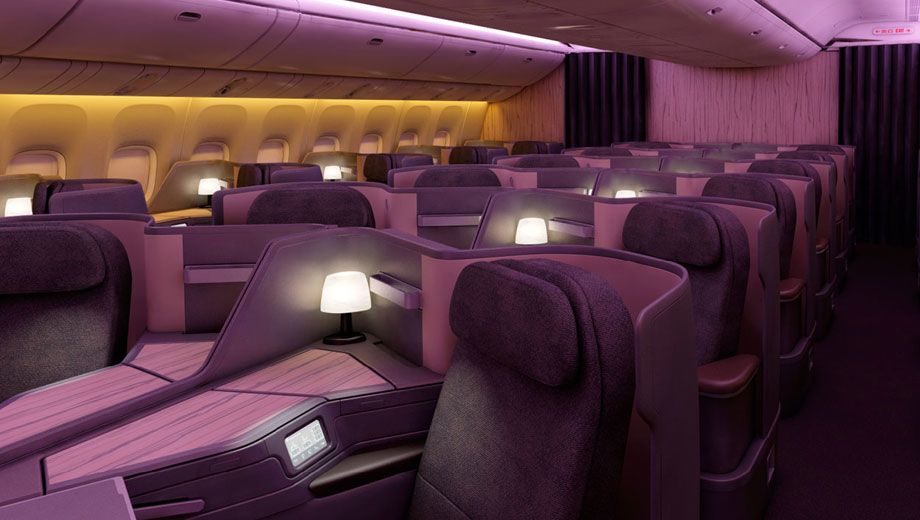
Business — 40 Super Diamond suites, rows 10 to 23
China Airlines fits the 777-300ER with 40 Collins Aerospace Super Diamond seats in a reverse-herringbone 1-2-1, and the geometry confirms it: the four columns alternate rotation by about 31 degrees in each row. Every one of the 40 seats has direct aisle access — there is no seat in this cabin you have to climb out of, and no bad seat in the structural sense. China Airlines quotes 22 inches of width, 60 inches of pitch and a 78-inch bed.
The cabin is split in two. The forward cabin is rows 10 to 16 (there is no row 13), 24 seats. The mid cabin is rows 20 to 23, 16 seats. Rows 17, 18 and 19 do not exist.
Row 16 is the business-class trap. 16A, 16D, 16G and 16K are the last row of the forward cabin and sit immediately against the lavatory bulkhead — noise, odours and a queue forming beside you for twelve hours. They are rated avoid, they cost exactly what row 12 costs, and nothing on the seat map says so. Row 15 is a softer version of the same problem and is rated caution.
The picks. 10A and 10K are the front row of the aircraft and the only two business seats whose window rating is "great" rather than "average" — best view in the cabin, no lavatory, nothing ahead of you. In the mid cabin, rows 21, 22 and 23 are all clean. Row 20 is a bassinet row — 20A, 20D, 20G and 20K all carry bassinet positions, so if you are travelling for sleep, take 21 or 22 instead.
Travelling as a pair? The D and G seats are the centre pair. In a reverse herringbone they angle away from each other, so they are companionable rather than intimate, but they are the only two seats in any row you can talk across. 21D+21G or 22D+22G are the cleanest. Travelling alone? Take a window — A or K — where the seat angles away from the aisle entirely.
Premium Economy — 62 seats, and 14 of them back onto the toilets
This is the reason to fly China Airlines' 777. Sixty-two premium economy seats in a 358-seat aircraft is one of the largest premium economy cabins proportionally of any carrier, and it is a real product: 19 inches wide, 38 to 39 inches of pitch, arranged 2-4-2 across eight rows, with a leg rest and a fixed-back shell — the seat slides forward into its own shell when you recline, so nobody reclines into you and you cannot recline into anyone.
It also contains the single worst-value block of seats on the aircraft.
Rows 36 and 37 — all 14 seats — are rated avoid. Every one is immediately adjacent to a lavatory. That is 23% of the premium economy cabin: you pay a premium economy fare and get the toilet block.
Row 37 is also a partial row. It has no A and no C — a lavatory occupies the left-hand pair — so it runs D E F G / H K only. If you are shown a "window seat" in row 37, it is 37K, and it is against the lavatory.
The picks: rows 33, 34 and 35. They are the only three rows in the cabin with nothing flagged against any seat — no lavatory, no bassinet, no window problem. For a couple, the outer pairs are A+C on the left and H+K on the right: two seats, no stranger, one of you on the window and one on the aisle. For four travelling together, the centre block D E F G in any of those rows.
Row 30 is the bulkhead row and it is a genuine trade. You get extra legroom, but no underseat storage at all, and the tray table and screen fold out of the armrest, which narrows the seat you actually sit in. 30C, 30D, 30F and 30H are bassinet positions — families get priority and you may be asked to move. If you want row 30, take 30A, 30E, 30G or 30K, which have the legroom without a bassinet clipped to the wall in front of you.
One more to know: 32A and 32K. Rated caution, and the reason is specific — the window is set behind the seat, so you lean backwards to look out rather than sideways. Every other window pair in rows 30 to 35 is normally aligned.
Economy — 256 seats, 3-4-3, and 17 inches wide
Be clear-eyed about this cabin. China Airlines fits the 777-300ER economy at ten abreast, 3-4-3, which puts the seat at 17 inches wide against 32 inches of pitch. The pitch is normal for a long-haul economy cabin. The width is at the narrow end, and on a twelve-hour flight to Taipei that is the number you will feel. If width matters to you more than anything else, China Airlines' A330-300 is 2-4-2 at 18 inches — a wider economy seat on the regional aircraft than on the flagship.
Economy runs in two physical cabins: rows 40 to 54 forward and rows 60 to 72 aft. Rows 44 and 55 to 59 do not exist.
The legroom seats
There are two rows with extra legroom, and row 60 is the better of the two. It is the first row of the rear cabin and has only six seats — 60A, 60B, 60C, 60H, 60J, 60K — because the centre block is given over to the exits. All six carry extra legroom, and unlike row 40, none of them has a missing window or a door intruding into the seat. The only marks against it: 60A and 60K have a window rated "poor" rather than absent, and 60C and 60H have a bassinet position behind them.
The seat nobody books: 61E and 61F. Because row 60 has no centre seats, the centre block of row 61 — 61D, 61E, 61F, 61G — opens onto empty floor and carries extra legroom. 61D and 61G are bassinet positions; 61E and 61F are not. Two adjacent centre seats with extra legroom, no bassinet and no lavatory: for two people travelling together who want the space without the exit row, they are the best value in the cabin.
The best windows
Six seats in economy have a window rated "great" rather than "average": 51A, 51K, 53A, 53K, 72A and 72K. They are ordinary economy seats at ordinary prices, and they simply line up with the window better than their neighbours. If you are choosing a window seat and have no other constraint, choose one of those — with one caveat below about row 53.
Going the other way, 42A, 60A, 60K, 64A and 64K have windows rated poor. They are windows, just badly aligned ones.
A couple at the back gets a private pair
The 3-4-3 layout does not hold all the way to the tail. Rows 70, 71 and 72 are 2-4-2 — the fuselage has narrowed and letters B and J are gone, so the outer blocks are just A+C and H+K. Two seats. No third person.
That makes 72A and 72C, or 72H and 72K, one of the quietly best bookings on the aircraft for two people: a private pair, and 72A and 72K carry one of the six "great" window ratings in economy. Nothing in the data flags a lavatory or galley problem at row 72, which is unusual for a last row — though as with any last row it is worth a look at the map before you commit, and one report suggests the final row of each zone may lack an AC outlet.
Economy seats to avoid
40A and 40K — covered above, the headline trap. 53H, 53J and 53K are rated avoid, immediately against a lavatory, which is why the "great window" at 53A and 53K comes with a caveat: 53A is fine, 53K is against the toilet. 52H, 52J, 52K and 53G are rated caution for the same lavatory one row further away. 54G is against a lavatory with a galley behind it, and 54D, 54E and 54F get the galley noise and light during meal service. Row 54 is also a partial row — six seats, A B / D E F G, with no H, J or K.
Cabin features at a glance
| Business | Premium Economy | Economy | |
|---|---|---|---|
| Seats | 40 | 62 | 256 |
| Rows | 10–16, 20–23 | 30–37 | 40–54, 60–72 |
| Layout | 1-2-1 | 2-4-2 | 3-4-3 |
| Pitch | 60in / 78in bed | 38–39in | 32in |
| Width | 22in | 19in | 17in |
| Aisle access | 100% — all 40 | 50% | 41% |
| Recline | Full flat bed | Fixed shell + leg rest | Standard |
Quick picks by traveller
| If you are… | Book | Why |
|---|---|---|
| Solo in Business | 10A or 10K | Only "great" windows in the cabin, front row, no lavatory |
| A couple in Business | 21D+21G or 22D+22G | The centre pair, clean of lavatories and bassinets |
| In Premium Economy | Row 33, 34 or 35 | The only three unflagged rows in the cabin |
| A couple in Premium Economy | 34A+34C or 34H+34K | Outer pair — window and aisle, no stranger |
| After legroom in Economy | 60C or 60H | Extra legroom, aisle, and none of row 40's problems |
| After a window in Economy | 51A, 51K, 53A or 72A | Rated "great" rather than "average" window alignment |
| A couple in Economy | 72A+72C or 70H+70K | Rows 70–72 are 2-4-2 — a private pair, no third seat |
| Two together wanting space | 61E+61F | Extra legroom from row 60's missing centre block, no bassinet |
| Travelling with an infant | 40D, 40G, 61D or 61G | Bassinet positions with the most floor space |
| A family of four | D E F G, rows 45–50 | Four across, nothing flagged, mid-cabin |
There is no version lottery — and that is worth knowing
China Airlines operates ten 777-300ERs and every one of them is configured 40J / 62W / 256M. There is no retrofit programme splitting the fleet, no sub-variant, no second cabin layout. Seat 34A is the same seat on all ten aircraft.
That is unusual enough on a widebody fleet to be worth stating plainly, because it means you can select a seat months ahead and an equipment swap will not move you into a different product. Contrast China Airlines' own A330-300, where four aircraft have angle-flat business beds and eight have recliners, or the A321neo, where two aircraft have no business class at all.
The 777-300ER is the aircraft on China Airlines' longest routes, including Los Angeles, San Francisco and New York JFK from Taipei. If your itinerary shows a 777-300ER, this is the cabin you are getting.
Frequently asked questions
Is China Airlines' premium economy on the 777 worth paying for?
On this aircraft, more than usual. Economy is 3-4-3 at 17 inches wide; premium economy is 2-4-2 at 19 inches with 38 to 39 inches of pitch and a fixed-back shell, so you gain both width and the certainty that nobody reclines into you. The upgrade buys a genuinely different seat rather than a few inches of legroom. Just avoid rows 36 and 37, which are against the lavatories.
Which business class seat should I pick for sleeping?
Rows 21 and 22. All 40 seats are the same Super Diamond product with the same 78-inch bed, so the difference is entirely about what is around you. Rows 21 and 22 have no lavatory adjacency and no bassinet position, which rows 15, 16, 20 and 23 each have in some form. Row 10 is equally quiet and has the best windows, but it is the first row, so it catches boarding and galley activity.
Are 40A and 40K really that bad?
They have no window — not a small window or a badly aligned one, but wall where the window should be — and an exit door that protrudes into 10 to 15% of the seat width from about 30cm ahead. You keep the extra legroom. If legroom is the only thing you care about and you would rather not look out, they are defensible. For most people the same legroom at 40C or 40H, with a normal seat and underseat storage, is the better trade.
Where are the bassinet positions?
Business: 20A, 20D, 20G and 20K. Premium economy: 30C, 30D, 30F and 30H. Economy: 40D and 40G at the front of the forward cabin, and 61D and 61G at the front of the rear cabin. If you want an infant-free zone, the mid economy rows 45 to 52 and business rows 21 and 22 are furthest from any of them.
Does the 777-300ER have WiFi?
Yes — Panasonic Ka-band satellite WiFi across the whole fleet, in the 10 to 40 Mbps range, which is enough to stream. Worth knowing that China Airlines' A330-300 has no WiFi at all, so if connectivity matters, the aircraft type on your booking decides it.
Is there a bad seat in business class?
Not structurally — all 40 seats have direct aisle access and the identical bed. But rows 15 and 16 are next to lavatories, with row 16 rated avoid, and that is a real twelve-hour problem on a Taipei–New York sector. Structurally identical does not mean equally pleasant.