Air New Zealand A321neo Seat Selection Guide (2026)
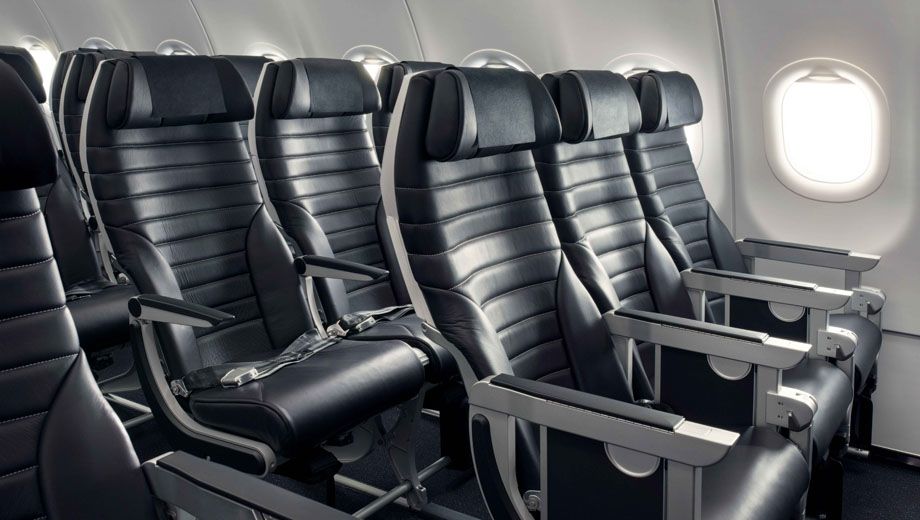
Quick Verdict
Aircraft: Airbus A321neo · 10 in the fleet · all-economy, no business class
Layout: 3-3 throughout, rows 1–37 · International: 214 seats, 9 aircraft · Domestic: 217 seats, 1 aircraft
Version lottery: Yes. The international jet has seatback screens, WiFi and a paid Space+ product. The domestic jet has none of the three.
Best seats: 17A–17F (exit row, 39.0″ international / 37.8″ domestic) · then 2A–5F
Seats to avoid: Row 16 (no meaningful recline) · Row 26 (a stub row at the door — two seats internationally, both recline-limited; four domestically) · 8D/8E/8F and 9D/9E/9F if you thought you were buying legroom
Pitch range: 29.1″ to 39.0″ — a ten-inch spread inside a single-class cabin
Row 8 is two different aeroplanes
Air New Zealand sells extra legroom on its international A321neo under the name Space+. On most aircraft an extra-legroom block is a clean rectangle: rows 1 to 8, say, every seat. Here it is not.
Air New Zealand's own seat map marks Space+ on rows 2 to 7 across the full width of the cabin, and then on 8A, 8B, 8C and 9A, 9B, 9C only. Seats 8D, 8E, 8F and 9D, 9E, 9F are ordinary economy.
The gap that creates is not small. In row 8, the three seats on the port side have 83 cm (32.7 inches) of pitch. The three seats on the starboard side of the same row have 76 cm (29.9 inches). That is 2.8 inches of legroom decided entirely by which side of the aisle you are on, in a row where every seat carries the same number.
The trap: a passenger who has been told "the front of the cabin has more room" and picks 8D or 8F on a map that shows rows 2 to 9 as one visual block gets a standard 29.9-inch seat — the same as row 15.
The second trap: Space+ is not one product. Rows 2 to 5 are 83 cm on both sides. 6D–7F drop to 81 cm. And 9A, 9B and 9C are Space+ at 81 cm — you pay the same premium for two centimetres less than the row in front. If you are buying Space+, buy rows 2 to 5, or 6A–8C.
The version lottery: 214 versus 217
Air New Zealand runs the A321neo in two configurations that look nearly identical on a seat map — same 37 rows, same 3-3 layout, same two exit rows at 17 and 27 — and are meaningfully different to sit in.
| Feature | International (214) | Domestic (217) |
|---|---|---|
| Aircraft | 9 | 1 |
| Seatback screens | Yes — 10.0″, Panasonic on demand | None |
| WiFi | Inmarsat satellite | None recorded |
| USB power | USB and USB-C in the monitor | None listed |
| Space+ extra legroom | Rows 2–7 + 8A/B/C + 9A/B/C | Not sold |
| Exit row 17 pitch | 99 cm / 39.0″ | 96 cm / 37.8″ |
| Row 16 recline | Limited | None at all |
| Row 25 | A/B/C only — lavatory to starboard | Full 3-3 |
| Row 26 | 26B and 26C only | 26B, 26C, 26D, 26E |
| Row 27 exit | 27A–27E, plus 28F | 27A–27F |
| Row 37 | Full 3-3 | A/B/C only — galley to starboard |
| Typical routes | Tasman and Pacific — Sydney, Brisbane, Melbourne, Gold Coast, Nadi | Auckland, Christchurch, Wellington, Queenstown, Dunedin |
The short version: if you are crossing the Tasman you get a screen, WiFi and the option to pay for legroom. If you are flying Auckland to Christchurch on the single domestic aircraft, you get none of the three — but the front rows are more generous than standard and Air New Zealand does not charge a Space+ premium for them, because the product does not exist domestically.
International A321neo: row-by-row pitch
These are Air New Zealand's own published per-seat figures, converted to inches. Where the two sides of the aisle differ, both are shown.
| Row | A / B / C | D / E / F | Notes |
|---|---|---|---|
| 1 | Bulkhead | Bulkhead | Immovable armrests, no under-seat stowage |
| 2–5 | 32.7″ Space+ | 32.7″ Space+ | The best Space+ seats on the aircraft |
| 6–7 | 32.7″ Space+ | 31.9″ Space+ | Starboard side already 0.8″ behind |
| 8 | 32.7″ Space+ | 29.9″ standard | 2.8″ apart in the same row |
| 9 | 31.9″ Space+ | 29.9″ standard | Weakest Space+ seats you can buy |
| 10–15 | 29.9″ | 29.9″ | Standard economy |
| 16 | 29.9″ | 29.9″ | Limited recline — sits in front of the exit row |
| 17 | 39.0″ EXIT | 39.0″ EXIT | Best legroom on the aircraft. Immovable armrests |
| 18–24 | 29.1″ | 29.9″ | Starboard now the better side |
| 25 | 29.1″ | — lavatory | 25D/E/F do not exist. 25C is a narrow seat |
| 26 | 26B, 26C only — 29.1″ | — | Limited recline, two seats at the door |
| 27 | EXIT | 27D, 27E EXIT — no 27F | Second exit row. Immovable armrests |
| 28 | 29.1″ | 29.9″ — 28F is an exit seat | 28E is narrow with an immovable armrest |
| 29–34 | 29.1″ | 29.9″ | — |
| 35 | 29.9″ | 29.9″ | 35A narrow |
| 36 | 29.9″ | 29.1″ | 36A, 36C, 36F narrow |
| 37 | 29.1″ | 29.1″ | Last row, lavatory behind. 37A, 37C, 37D, 37F narrow |
The rear cabin reverses the front
Notice what happens at row 18. Through the front of the cabin the port side — A, B, C — is the generous one, by anything from nothing to 2.8 inches. From row 18 back to row 34, that flips: D, E and F get 29.9 inches while A, B and C get 29.1.
The reason is the starboard lavatory that replaces 25D, 25E and 25F. It shifts the whole starboard seat track aft relative to the port one, and it also puts the starboard door about half a row behind the port door — which is why 27F does not exist and 28F is flagged as an exit-row seat instead. If you are in the back half of this aircraft and have a free choice, take the starboard side.
28F: the exit-row seat that does not look like one
Air New Zealand's seat map flags 28F as an exit row seat, with the immovable armrest that goes with it. Every other exit seat on the aircraft sits in row 17 or row 27, where you would expect to find them. 28F sits in the middle of an ordinary-looking row 28, because the starboard door is offset aft.
Worth knowing in both directions. If you want exit-row space on the starboard side and row 27 is gone, 28F is the one nobody thinks to look at. If you have a bag you want under the seat in front and a fixed armrest would bother you, 28F is not the ordinary window seat it appears to be. And its neighbour 28E is a narrow seat with an immovable armrest — the same width penalty without the legroom benefit.
Domestic A321neo: row-by-row pitch
One aircraft, 217 seats, no Space+, no screens, no WiFi. The pitch pattern is its own.
| Row | A / B / C | D / E / F | Notes |
|---|---|---|---|
| 1 | Bulkhead | Bulkhead | Immovable armrests |
| 2–9 | 31.9″ (see note) | 31.9″ | Extra pitch, and no premium charged |
| 10 | 31.9″ | 31.1″ | Starboard begins to fall away |
| 11–12 | 31.9″ | 29.9″ | 2″ apart in the same row |
| 13 | Not published | 29.9″ | — |
| 14–15 | 29.9″ | 29.9″ | — |
| 16 | 29.9″ | 29.9″ | No recline at all |
| 17 | 37.8″ EXIT | 37.8″ EXIT | Best legroom on the aircraft |
| 18–25 | 29.1″ | 29.1″ | The tightest block on the aircraft |
| 26 | 26B, 26C — 29.1″ | 26D, 26E — 29.1″ | No 26A or 26F. 26C and 26D are narrow |
| 27 | EXIT | EXIT | Full six-seat exit row. Immovable armrests |
| 28–36 | 29.9″ | 29.9″ | Better than rows 18–25. 35C/35D/36C/36D narrow |
| 37 | 29.1″ | — galley | 37D/E/F do not exist. 37C narrow |
A note on rows 2–8 on the domestic aircraft. Air New Zealand's own seat map quotes 81 cm (31.9″) for both sides of these rows. Our own measurement of the same aircraft puts the A/B/C side at 32.7″ and the D/E/F side at 31.9″. On the international aircraft the two agree to the centimetre, so this is a genuine disagreement rather than a rounding artefact. Either way the conclusion is the same: on the domestic jet, the A/B/C side of rows 2 to 8 is equal at worst and possibly three-quarters of an inch better. If you are choosing, sit on the port side.
Row 16 is the seat nobody warns you about
Row 16 has 29.9 inches of pitch, which is a perfectly ordinary number, and it sits directly in front of the exit row. Air New Zealand's own per-seat data marks all six seats in row 16 as "Limited recline" on the international aircraft and "No recline" on the domestic one.
Nothing on the graphical seat map tells you this. Row 16 looks like row 15 and row 14. It is the only block of six seats on the aircraft where the seat does not go back at all, and it is one row ahead of the best seats on the aeroplane. Sit in 17, not 16.
The same logic applies at the second exit. On the international aircraft, 26B and 26C are also marked limited recline — and there are only two of them, stranded at the door with the exit row behind. On the domestic aircraft row 26 has four seats and no recline restriction listed, but 26C and 26D are flagged as narrow.
Quick-pick by traveller
| If you are… | Take | Why |
|---|---|---|
| Tall, and not paying extra | 17A or 17F | 39.0″ international, 37.8″ domestic — the best on the aircraft |
| Buying Space+ (international) | Rows 2–5, any seat | 32.7″ on both sides — the only rows where it is |
| Buying Space+ on a budget row | 8A, 8B or 8C | Full 32.7″, and the last row where the port side still has it |
| On the domestic jet | Rows 2–8, A/B/C | Extra pitch, port side, and no Space+ premium to pay |
| In the back half (international) | D, E or F, rows 28–34 | 29.9″ against 29.1″ on the other side of the aisle |
| In the back half (domestic) | Rows 28–36, either side | 29.9″ — better than rows 18–25 at 29.1″ |
| A couple | 26B/26C on the international | The only two-seat row on the aircraft — but accept the limited recline |
| Flying with a child | Rows 10–15 | Standard pitch, full recline, not an exit row |
| Wanting to avoid a mistake | Not row 16 | The only row on the aircraft with no meaningful recline |
How to tell which A321neo you are on
- The route decides it. International-configured aircraft fly the Tasman and Pacific — Sydney, Melbourne, Brisbane, Gold Coast, Nadi. The single domestic aircraft works the main trunk between Auckland, Christchurch, Wellington, Queenstown and Dunedin.
- Count row 37. If the seat map offers 37D, 37E and 37F, it is the 214-seat international aircraft. If row 37 stops at 37C, it is the 217-seat domestic one.
- Look at row 25. International: 25A, 25B and 25C only, because a lavatory occupies the starboard side. Domestic: a full row of six.
- Look for Space+. If the map lets you buy Space+, it is an international aircraft. The domestic configuration does not sell it.
Related guides
- Air New Zealand 787-9 seat guide
- Air New Zealand 777-300ER seat guide
- Jet2 A321neo seat guide
- easyJet A321neo seat guide
- Wizz Air A321neo seat guide
Frequently asked questions
Which rows are Space+ on Air New Zealand's A321neo?
On the international 214-seat aircraft: rows 2 to 7 in full, plus 8A, 8B, 8C and 9A, 9B, 9C. Seats 8D, 8E, 8F and 9D, 9E, 9F are standard economy despite being in the same rows. The domestic 217-seat aircraft does not sell Space+ at all.
What is the best seat on the Air New Zealand A321neo?
Row 17, any seat. It is the forward exit row and Air New Zealand publishes 99 cm (39.0 inches) of pitch on the international aircraft and 96 cm (37.8 inches) on the domestic one — the most legroom in the cabin, and it costs less than Space+ on most fare types.
Which seats should I avoid?
Row 16 above all — Air New Zealand marks it "limited recline" internationally and "no recline" domestically. Then 26B and 26C on the international aircraft, which are also recline-limited and stranded at the door, and any of the narrow-width seats: 25C, 28E, 35A, 36A, 36C, 36F, 37A, 37C, 37D and 37F internationally.
Does the Air New Zealand A321neo have seatback screens?
The nine international aircraft do — 10-inch Panasonic screens on demand, with USB and USB-C in the monitor bezel, plus Inmarsat WiFi. The single domestic aircraft has neither screens nor WiFi listed; bring your own device and something to charge it with.
Why is 28F an exit-row seat?
Because the starboard door on the international aircraft sits about half a row behind the port door. That is also why 27F does not exist. Air New Zealand flags 28F as an exit-row seat with an immovable armrest — it has the space, but not the ordinary window-seat behaviour you would expect from its position.
Does the A321neo have business class?
No. Air New Zealand fitted this aircraft as all-economy from tip to tail in both configurations. On the international aircraft the closest thing to a premium cabin is the Space+ block in rows 2 to 9.
Which side of the aisle is better?
It changes halfway down the aircraft. Forward of row 18 the port side — A, B, C — has equal or more pitch, by up to 2.8 inches at row 8. Through rows 18–24 and 28–34 on the international aircraft the starboard side is better by 0.8 inches. On the domestic aircraft the port side is better forward and the two are equal from row 28 back.
Related Guides
- Air New Zealand 787-9 Seat Selection Guide (2025)
- Air New Zealand Boeing 777-300ER Seat Map & Best Seats (2026)
- Jet2 A321neo Seat Map & Best Seats (2026)
- easyJet Airbus A321neo Seat Selection Guide (2026)
- Wizz Air A321neo Seat Selection Guide (2026)
- Air New Zealand A320 Seat Map & Best Seats (2026)
- Air New Zealand A320neo Seat Map & Best Seats (2026)
- Air New Zealand ATR 72-600 Seat Map & Best Seats (2026)