Air India Puts First Class on Sydney — But Not on Every Flight (2026)
Quick Verdict
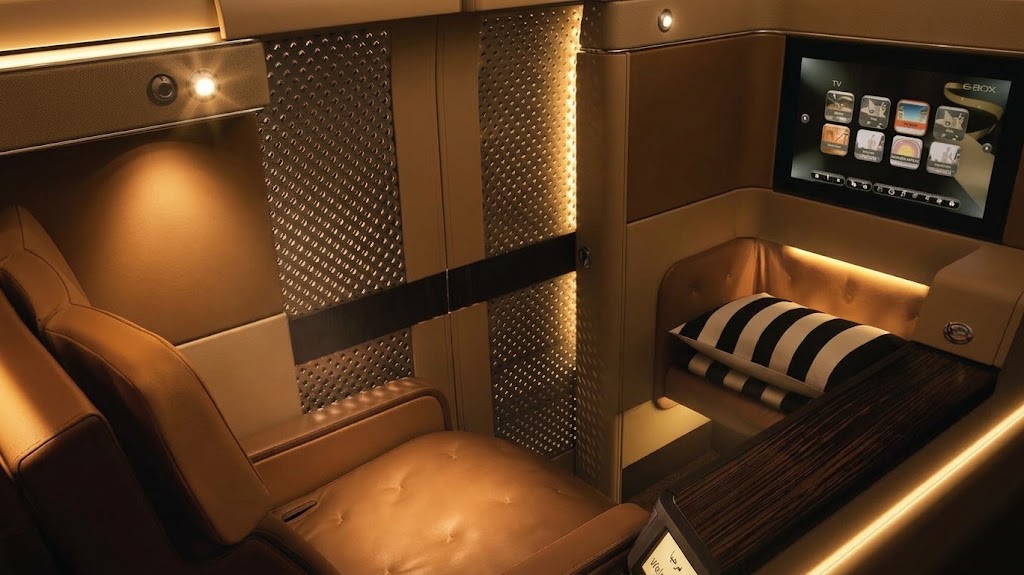
Air India is moving its Delhi–Sydney flagship, AI301 and AI302, off the Boeing 787-8 and onto an ex-Etihad Boeing 777-300ER — eight First Class suites and 40 fully flat business seats in 1-2-1, where the 787-8 has 18 business seats in 2-2-2 and no First Class at all. For roughly the first month only some days of the week get the 777. From 1 January 2027 every rotation does.
The catch is behind the curtain: economy goes from 3-3-3 on the 787-8 to 3-4-3 on the 777, at 31-inch pitch and 17.3 inches wide. If you fly at the front this is a large upgrade. If you fly at the back, the 787-8 days are the better booking.
Best seats: First 2A/2K · Business solo 5A, 5K, 9A, 9K, 14A, 14K · Business couples 5E/5F or 9E/9F · Economy row 16 windows and 35E/35F.
Avoid: the whole of row 15 in business, 7E/7F, First 1D/1G, and in economy rows 17, 18, 30, 31, 32, 34 and 46.
1. What is actually changing
Air India is re-equipping its Delhi–Sydney service with one of the Boeing 777-300ERs it took over from Etihad Airways. These aircraft still wear Etihad's original interior, which is why the change is so large: the cabin was built for a carrier that sold a first class product, and Air India has not stripped it out.
That gives Sydney a First Class cabin for the first time. It also roughly doubles the business cabin, from 18 seats to 40, and moves it from a 2-2-2 layout — where only twelve of the eighteen seats have direct aisle access — to a staggered 1-2-1 where every seat has its own aisle.
It is the second Australian route to get this treatment. Delhi–Melbourne switched to the same aircraft type on 1 July 2026, which we covered in Air India Summer 2026 Fleet Changes. Sydney is the sequel, and it arrives with the same question attached: on any given day, is the 777 really the aircraft that shows up?
2. Which flights get the 777, and when
This is the part no booking page explains. The switch is phased, and for about a month the same flight number is two different aircraft depending on the day.
| Phase | What flies | First Class? |
|---|---|---|
| Now to early December 2026 | 787-8 on all seven weekly rotations | No |
| Early December to 31 December 2026 | 777-300ER on three days a week (filed as days 1, 4 and 6 — Monday, Thursday, Saturday); 787-8 on the rest | Only on the 777 days |
| From 1 January 2027 | 777-300ER daily on AI301/302 | Yes |
| From mid-December 2026 | Frequency rises from 7 to 11 weekly; the four extra rotations are AI303/304 on the 787-8 | No, on the extra flights |
Two dates to watch. Air India's route announcement puts the first 777 service on 5 December and the move to eleven weekly flights at the same time; the schedule filings put the first 777 rotation on 3 December and the frequency increase on 16 December. The difference is a couple of days either way, so if you are booking the very start of December, check the aircraft type on your own date rather than trusting a start date you read anywhere, including here.
The timings themselves do not change. AI302 leaves Delhi at 01:30 and reaches Sydney at 19:45; AI301 leaves Sydney at 22:30 and lands in Delhi at 06:05 the next morning. The additional flights, AI304 out and AI303 back, operate in daylight at the Sydney end — AI304 arrives at 08:10, AI303 departs at 09:50 — and those are the ones staying on the 787-8.
So the useful shorthand for the handover month is simple: if your flight number is AI301 or AI302, there is a chance of the 777. If it is AI303 or AI304, there is not.
3. What you actually get, cabin by cabin
| 777-300ER (ex-Etihad) | 787-8 (today) | |
|---|---|---|
| First | 8 suites, rows 1–2, 1-2-1, sliding doors, 81in pitch, 80.5in bed, 29.8in wide | None |
| Business | 40 seats, rows 5–15 with no row 13, staggered 1-2-1, every seat on an aisle, no doors, 73in pitch, 76in bed, 20in wide | 18 seats, rows 1–3, 2-2-2; twelve of the eighteen have direct aisle access |
| Premium economy | None | None |
| Economy | 280 seats, rows 16–46, 3-4-3, 31in pitch, 17.3in wide | 241 seats, rows 11–40, 3-3-3 |
| Total | 328 | 259 |
Read that bottom half carefully, because the headline and the experience point in opposite directions. The 777 adds 69 seats to the aircraft, and it adds most of them by putting a tenth seat in every economy row. A 3-4-3 777 economy cabin at 31 inches is a tighter place to spend thirteen hours than a 3-3-3 787 cabin, whatever the brochure says about the suites at the front. The full row-by-row picture for both aircraft is in our Air India 777-300ER seat guide and our Air India 787-8 seat guide.
4. How to tell which aircraft you are on
There are two 777-300ER layouts in the Air India fleet, and only one of them is the aircraft described here. Three checks, in order of reliability.
- Count the economy row. Ten seats across, lettered A C D E F G H J K, is the ex-Etihad cabin. Nine across is either the legacy 777 or the 787-8.
- Look at the business layout. 1-2-1 with letters A, C, D, E, F, G, H and K is the ex-Etihad cabin. 2-3-2 with letters A to G is the legacy 777, whose business seats are angled, not fully flat. 2-2-2 across three rows is the 787-8.
- Check the registration. The ex-Etihad airframes sit in the VT-AEK to VT-AEP range. The legacy 777s are mostly VT-ALA to VT-ALU.
Aircraft swaps out of Delhi are common, so do this again about 24 hours before departure rather than only at booking. A swap between the two 777 layouts is the one that costs you most: you would keep your seat number and lose the flat bed.
5. Best and worst seats on the 777
First Class. Take 2A or 2K. Both sit against two windows and are the furthest from the forward galley and lavatory, which is the one real noise source in a cabin of eight. Couples want 2D and 2G, where the divider lifts out. Skip 1D and 1G: the galley and lavatory are directly ahead of them.
Business, travelling alone. 5A, 5K, 9A and 9K are the picks, with 14A and 14K behind them. In the staggered layout these are the seats set away from the aisle, so nobody passes at your shoulder.
Business, travelling as two. 5E and 5F, or 9E and 9F. If those have gone, 6D/6G and 8D/8G put you across the aisle from each other rather than side by side.
⚠️ The trap. Row 15 is the last business row and backs onto the cabin divider and the service area behind it. 7E and 7F are the bassinet position with a lavatory ahead. Both show as ordinary business seats on the map and are the two bookings to undo.
Economy. The front row of the cabin, row 16, is the one to chase at the windows — 16A, 16C, 16H and 16K, or 16B and 16J. Avoid 16D, 16E, 16F and 16G in the same row, which have a lavatory behind them. Mid-cabin, 35D to 35G have extra space, and 35E or 35F beat 35D and 35G because the latter pair are the bassinet seats. Rows 26, 28 and 40 are worth a look at A and K.
Economy rows to skip: all of row 17 and row 18 (a lavatory cluster behind, and row 18 only has four seats), 19A and 19K and 19D to 19G at the exit, rows 30 and 31 which back onto lavatories, row 32 and row 34 which are partial rows, 33A and 33K where the door intrudes, and row 46 at the rear galley.
6. What to do if you are already booked
If you hold a business class ticket on AI301 or AI302 in December, you have something worth acting on: the same cabin class is a 2-2-2 seat on some days and a private 1-2-1 flat bed on others, for the same fare. Look at the days either side of your date before you commit, and reselect your seat once the aircraft changes — a 787-8 seat number carries over to a 777 map as something quite different.
If you are in economy, the same logic runs backwards. The 787-8 rotations and the new AI303/304 flights keep the 3-3-3 cabin, and in December you can still choose them.
On First Class, one caution. The suites exist on the aircraft, but Air India has not published where it puts them on sale route by route, and a cabin being fitted is not the same as a fare being offered. Check whether a First fare is actually quoted for your date before you plan around it.
Frequently asked questions
Does Air India fly first class to Sydney?
It will. The ex-Etihad Boeing 777-300ER taking over AI301 and AI302 has eight First Class suites, starting on selected days in early December 2026 and on every rotation from 1 January 2027. The 787-8 flying the route today has no First Class cabin.
Which Air India flights to Sydney have the 777?
AI301 and AI302 only. During the December handover they are filed for the 777 on three days a week and the 787-8 on the other four. The extra flights added in mid-December, AI303 and AI304, stay on the 787-8.
Is the Air India 777 business class fully flat?
On the ex-Etihad aircraft, yes: 40 fully flat seats in a staggered 1-2-1 layout, 73 inches of pitch and a 76-inch bed, with direct aisle access from every seat. Air India's other 777-300ER layout has 35 angled seats in 2-3-2, which is why identifying the aircraft matters.
Is economy better on the 777 or the 787?
The 787-8, for most people. It is nine seats across in 3-3-3; the ex-Etihad 777 is ten across in 3-4-3 at 31-inch pitch and 17.3 inches wide. The 777 is the better aircraft at the front and the tighter one at the back.
How many seats does the Air India 777-300ER have?
The ex-Etihad layout has 328: 8 First, 40 business and 280 economy. The legacy layout has 347, made up of 4 First, 35 business and 308 economy.
Can my aircraft change after I book?
Yes, and on Delhi departures it happens often enough to plan for. Check the aircraft type about 24 hours before departure and reselect your seat if it has changed, because seat numbers do not mean the same thing across the three cabins Air India could put on this route.
Configurations, schedules and seat availability reflect Air India's published position and filed schedules as of 9 October 2026. Start dates for the aircraft change differ slightly between the route announcement and the schedule filings, and aircraft assignments change — always confirm the seat map at booking and again before departure.