United's A321neo "Coastliner" Changes the Transcon Game — Here's What We Know
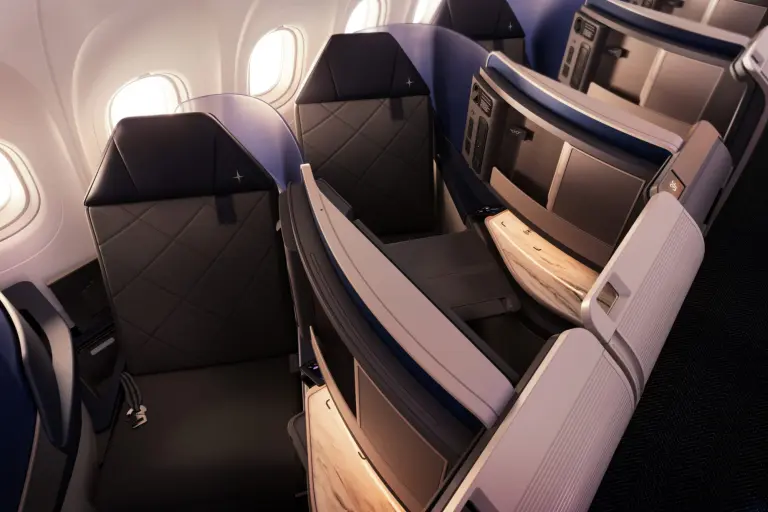
What is the Coastliner?
The Coastliner is a dedicated subfleet of Airbus A321neos configured specifically for high-yield coast-to-coast routes. Internally coded the A321LF, it replaces the ageing Boeing 757-200s that have long served these premium corridors.
United plans 50 Coastliner aircraft in total, with the first entering service in summer 2026 and around 40 expected to be flying by early 2028. Each aircraft wears a custom Coastliner livery — you'll be able to spot them from the gate.
The cabin layout: 161 seats across three classes
This is where it gets interesting. United's standard A321neo carries 200 seats in a two-class domestic layout (20 First + 180 Economy). The Coastliner strips that back to 161 seats and introduces a genuine three-class cabin:
- 20 Polaris suites — all-aisle-access lie-flat seats, expected to be a herringbone-style design consistent with the Polaris brand. This is the first time Polaris has appeared on a narrowbody aircraft.
- 12 Premium Plus seats — United's premium economy product, also a first on a narrowbody. This is the same cabin class usually reserved for international widebody flights like the 787 and 777.
- 129 Economy seats — including a meaningful allocation of Economy Plus, with seatback entertainment, power at every seat, and larger overhead bins.
The aircraft also features a self-service snack bar behind the premium cabins — a touch borrowed from United's widebody playbook.
Ground experience: Polaris Lounge access
Perhaps the biggest surprise: passengers flying Polaris on Coastliner routes will have access to United Polaris Lounges. This is a first for domestic travel on United, and closes a gap that has existed for years. American has offered Flagship Lounge access on transcon routes, and Delta provides Delta One Lounge access — United was the odd one out until now.
Routes
The Coastliner will primarily operate between Newark (EWR) and the West Coast — Los Angeles (LAX) and San Francisco (SFO). These routes collectively carry over 10,000 passengers daily and are among the most lucrative domestic corridors in the US. Many passengers on these routes connect onward to Asia-Pacific, making the Coastliner a key piece of United's global network strategy.
There is speculation that Coastliner service could eventually expand to routes like Boston, Washington DC, and potentially even Philadelphia.
How does it compare to competitors?
The US transcon premium market is in a fascinating period of transition, with all three legacy carriers retooling simultaneously:
| Feature | United Coastliner A321neo | American A321XLR | Delta A321neo |
|---|---|---|---|
| Aircraft | A321neo (A321LF) | A321XLR | A321neo |
| Business seats | 20 Polaris (lie-flat) | 20 Flagship Suite (lie-flat, doors) | 16 Delta One (lie-flat) |
| Premium Economy | 12 Premium Plus | — (not confirmed) | 12 Premium Select |
| Economy | 129 | ~118 | 120 |
| Total seats | 161 | ~150 | ~148 |
| Lounge access | Polaris Lounge | Flagship Lounge | Delta One Lounge |
| Status | Summer 2026 launch | In service | Delayed (seat certification issues) |
| Fleet size | 50 planned | 50 (also transatlantic) | 21 planned |
American's A321XLR offers suites with closing doors in a 1-1 layout — the most private option. However, AA is using the A321XLR for both transcon and transatlantic duty, splitting the fleet across missions. United's Coastliner is exclusively a domestic animal, while United's A321XLR fleet (also 50 aircraft) will handle the transatlantic routes separately.
Delta's situation is notable for the wrong reasons: the airline has been struggling with seat certification for its premium A321neo configuration. Some aircraft have reportedly been parked for over a year while awaiting certification. Delta has signalled it may initially deploy some of these aircraft with 44 First Class seats in non-transcon markets while the certification process continues.
What this means for seat selection
When the Coastliner enters service, here's what passengers should know:
Check your aircraft assignment. Not every EWR–LAX/SFO flight will be a Coastliner. United will continue mixing aircraft types on these routes, so the experience will depend on which subfleet you draw. This is a version lottery situation — use a tool like Find My Seat on SeatCompare.ai to check your specific flight.
Polaris on a narrowbody will feel different. The seats should be lie-flat with direct aisle access, but the A321 fuselage is narrower than a 787 or 777. Expect the suite to feel more compact than international Polaris, even if the core functionality is the same.
Premium Plus is the sleeper pick. Twelve premium economy seats on a 5–6 hour transcon flight, with the same product class usually reserved for 10+ hour international flights, could be excellent value — especially for travellers who want more comfort than Economy Plus but don't need a flat bed on a daytime flight.
Economy Plus allocation matters. With 129 economy seats, the Economy Plus section should still be substantial. Specific row recommendations will follow once the seat map is confirmed.
The bigger picture
The Coastliner is United's most aggressive move yet to capture the premium transcon traveller — the Silicon Valley executives, Wall Street commuters, and connecting international passengers who have historically had to choose between JetBlue Mint, Delta One, and AA Flagship on these routes.
With 50 dedicated narrowbody aircraft, Polaris Lounge access, and a three-class cabin, United is making a clear statement: domestic flying can — and should — match the international premium experience.
We'll publish a full seat guide for the United A321neo Coastliner once the seat map is confirmed and the first aircraft enter service.
Have a seat question? Use Find My Seat to check your specific flight, or browse our United Airlines seat guides for current aircraft.