Philippine Airlines A350-1000 Seat Selection Guide (2026)
✈️ Quick Verdict
Aircraft: Airbus A350-1000 — one configuration, three aircraft
Config: 382 seats: 42 Business + 24 Premium Economy + 316 Economy
Version lottery: No. All three aircraft are identical. The lottery here is which aircraft type operates your flight — the A350-1000 or the 777-300ER it displaces
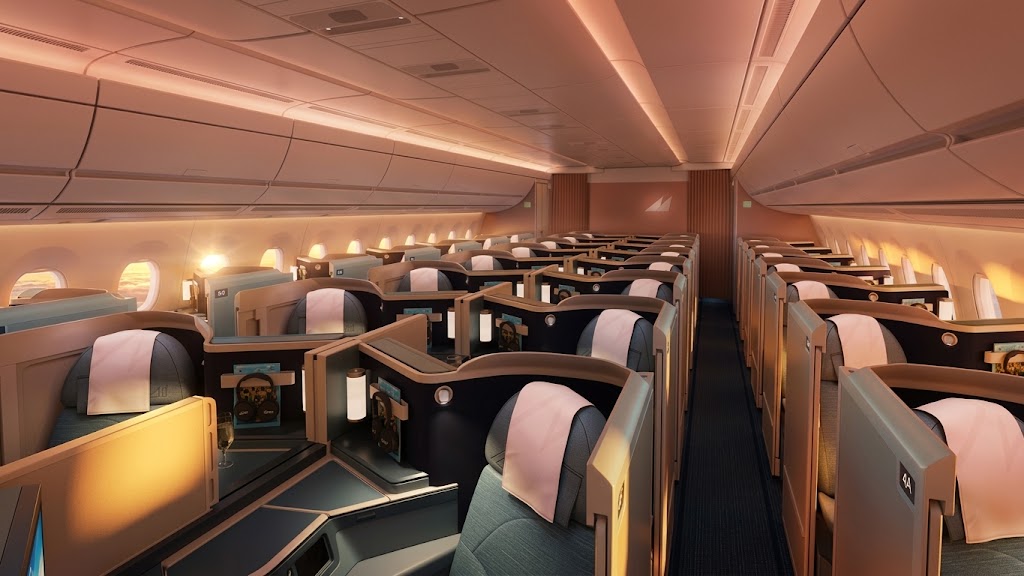
Business: Reverse herringbone, 1-2-1. All 42 seats face the windows and have direct aisle access. There is no bad seat in the cabin
The seat to know about: 21H and 21K — the premium economy bulkhead, with less room than a normal seat while the other six in the row get more
Best seats: Business rows 2–9 · Premium Economy row 22 · Economy 31C, 31H, 32C, 32H
Seats to avoid: Row 44 (all ten) · 51D–51G · row 69 · 10A and 10K in Business
IFE & WiFi: Safran Rave gate to gate · Inmarsat GX Ka-band, 10–40 Mbps
The flagship, and the question is which aircraft you get
The A350-1000 is Philippine Airlines' newest and largest aircraft, and it has been taking over the marquee long-haul routes from the 777-300ER. There are three of them, all built to the same 382-seat plan, so there is no version lottery within the type. The uncertainty is upstream: on a route the A350-1000 shares with the 777-300ER or the A350-900, the aircraft assigned to your date decides which product you actually fly.
That matters more than usual here, because the three types are not equivalent. The A350-1000 gives you a reverse-herringbone business cabin with no bad seat in it — and an economy cabin at ten abreast, which the A350-900 in the same fleet is not.
| Cabin | Seats | Rows | Layout | Notes |
|---|---|---|---|---|
| Business | 42 | 1–11 | 1-2-1 reverse herringbone | All face the windows, all direct aisle access |
| Premium Economy | 24 | 21–23 | 2-4-2 | Three rows only |
| Economy | 316 | 31–69 | 3-4-3 | High density, ten abreast |
Business class — the easy cabin
Forty-two seats in a 1-2-1 reverse herringbone over rows 1 to 11. Every seat is angled to face the windows, every seat has direct aisle access, and nobody has to climb over anyone. That is unusual enough that the honest advice is: take whatever is available.
- A and K are the window seats, angled outward. D and G are the centre pair, which is the choice for two people travelling together.
- Rows 2 to 9 are the sweet spot — away from both ends of the cabin.
- 1A and 1K are bassinet positions, so families with infants have priority and you may be asked to move.
- 10A and 10K have the lavatories behind them, though they are curtain-separated and this cabin does not generate much queuing.
- Row 11 is 11D and 11G only — a two-seat mini row at the very back of the cabin. Quiet, and the last pair to be taken.
- 3D is one of the seats the airline holds for passengers with nut allergies, so it may not be selectable.
Premium economy — three rows, and a split bulkhead
Twenty-four seats in a 2-4-2 layout over rows 21 to 23. It is a small cabin and only one of its three rows is free of a structural catch.
The trap: 21H and 21K
Row 21 is the bulkhead, which normally means extra room, and six of its eight seats get exactly that. 21H and 21K do not. The wall in front of them is about 25in away, which is less than a normal seat pitch — so the two seats that look like the best in the cabin on a booking map are the tightest in it. 21C, 21E, 21F and 21H are also bassinet positions.
- Row 22 is the row to take. No bulkhead penalty, no limited recline, and no lavatory against it. 22C is held for passengers with nut allergies, so it may not be selectable.
- Row 21: take A, C, D, E, F or G for the extra room. Avoid H and K.
- Row 23 backs onto the economy bulkhead and has limited recline on all eight seats, plus infant noise from the bassinets behind it.
Economy — ten abreast, and where the good seats hide
Three seats, four seats, three seats: 3-4-3, lettered A B C | D E F G | H J K, over rows 31 to 69. Ten abreast on an A350 is a dense choice, and it is worth knowing before you book that the A350-900 in the same fleet is not laid out this way. Within the cabin there are four seats that are genuinely better than the rest and one row that is genuinely worse.
The best free seats: 31C, 31H, 32C and 32H
Row 31 is the forward bulkhead and does not have ten seats — the outboard blocks are two wide instead of three. That leaves 31C and 31H with an empty seat position beside them, on top of the bulkhead legroom. Row 31 also has no lavatory against it, which the second bulkhead cannot say.
Immediately behind, 32C and 32H sit behind that shorter row and inherit its space. They pay the same price row 31 does — no underseat storage, because there is no seat in front of them, and the tray comes out of the armrest — but they carry no bassinet mount and have no lavatory near them, which row 31 cannot quite say and row 51 certainly cannot.
The second bulkhead is not the equal of the first
Row 51 follows the mid-cabin doors and shows up on a booking map as another extra-legroom row. It is a much worse row than 31. 51D, 51E, 51F and 51G sit directly against the lavatories; 51A and 51K catch the queuing traffic and have the window set behind the seat; and the whole row is drawn set inboard of the normal window line to clear the door structure. 52A and 52K behind it inherit the shorter-row space with none of the lavatory problems — they lose underseat storage and take the tray in the armrest like any bulkhead seat, and that is the whole of the cost.
Row 44 is the worst row on the aircraft
All ten seats back onto the mid-cabin lavatories and none of them reclines properly. Row 43 is the row ahead and has the same lavatories against A, B, C, H, J and K — and 43A, 43B and 43C are held for passengers with nut allergies, so they may not be selectable in any case.
The back
Rows 66, 67 and 68 lose their F seat, which leaves 66G, 67G and 68G with an empty position beside them. 66G and 67G are the two worth having; 68G has the same extra space but sits close enough to the rear lavatories to catch the queuing. Rows 67 and 68 have those lavatories against H, J and K, and row 69 is three centre seats that do not recline.
Windows sit out of line at 34A/K, 38A/K, 42A/K, 51A/K, 55A/K, 59A/K, 63A/K and 67A/K — sixteen window seats where the glass is set behind the seat.
Quick picks by traveller
| You are | Take | Why |
|---|---|---|
| In business, solo | 2A, 2K through 9A, 9K | Window-facing, mid-cabin, away from both ends |
| In business, as two | D and G, rows 2–9 | The centre pair, both with their own aisle |
| Buying premium economy | Row 22 | The only row in the cabin with no structural catch |
| Wanting premium economy legroom | 21A, 21C, 21D, 21E, 21F, 21G | Bulkhead room — but not 21H or 21K |
| After free economy space | 32C, 32H | Shorter row ahead, no bulkhead penalty |
| Wanting an empty seat beside you | 31C, 31H, 66G, 67G | The row is missing a seat in that position |
| A couple in economy | A/B or J/K, rows 33–42 | Outboard pair, clear of both lavatory banks |
| Travelling with an infant | Rows 31 or 51 | Bassinet mounts at 31D, 31F, 51D and 51F |
| Avoiding the worst | — | Row 44, 51D–51G, row 69 |
Comparable guides
- Philippine Airlines A350-900 seat guide
- Philippine Airlines 777-300ER seat guide
- Philippine Airlines A321 seat guide
- Philippine Airlines A330-300 seat guide
- Etihad A350-1000 seat guide
Frequently asked questions
Does the Philippine Airlines A350-1000 have a version lottery?
No. All three aircraft are built to the same 382-seat plan — 42 Business, 24 Premium Economy, 316 Economy. The uncertainty is which aircraft type flies your route on your date, since the A350-1000 has been displacing the 777-300ER on the longest services.
Which are the best business seats?
Any of them, genuinely. The cabin is a 1-2-1 reverse herringbone where all 42 seats face the windows and all 42 have direct aisle access with no one to climb over. Rows 2 to 9 are the sweet spot; 1A and 1K are bassinet positions, 10A and 10K have the lavatories behind, and row 11 is a two-seat mini row of 11D and 11G.
Is the A350-1000 economy cabin 3-3-3 or 3-4-3?
Ten abreast, 3-4-3. That is the denser of the two A350 economy layouts, and it is not what Philippine Airlines does on its A350-900s. If economy width matters to you, the aircraft type operating the flight is worth checking before you book.
Which premium economy seats should I avoid?
21H and 21K. They are bulkhead seats, so a booking map presents them as extra-legroom seats, but the wall is about 25in ahead — less than a normal seat pitch, and less room than an ordinary premium economy seat. The other six seats in row 21 do get the extra space. Row 23 has limited recline on all eight seats, which leaves row 22 as the row to take.
Which economy seats have extra space?
31C and 31H have an empty seat position beside them at the forward bulkhead; 32C and 32H sit behind that shorter row and inherit its legroom, at the cost of underseat storage and a tray in the armrest; and 66G and 67G have an empty position beside them near the back. Row 51 is the other bulkhead but sits against the lavatories, so 52A and 52K are the better choice there.
Are any seats blocked for allergies?
Seats 3D in Business, 22C in Premium Economy and 43A, 43B and 43C in Economy are held for passengers with nut allergies, so they may not appear as selectable when you choose seats.