JetBlue BlueFirst: The New First Class, and the Two Inches It Takes From Main (2026)
✈️ Quick Verdict
What it is: BlueFirst, a domestic first class of 12 seats (three rows) on the A220 and A320 and 16 seats (four rows) on the A321, in 2-2, unveiled 1 September 2026
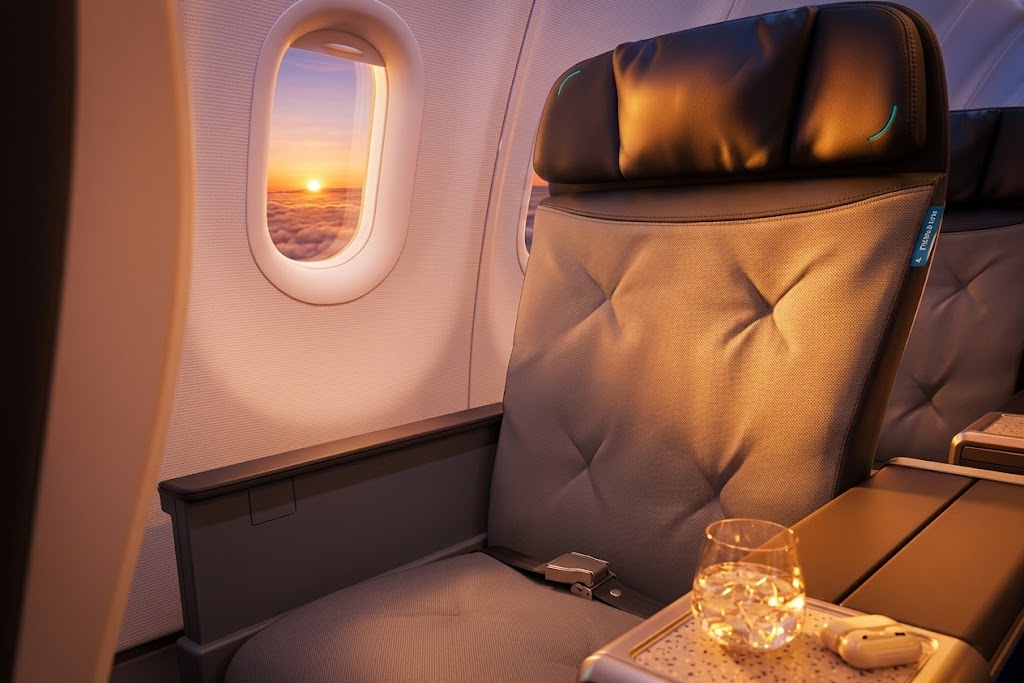
The seat: up to 37 inches of pitch, 5 inches of recline, a 13.3-inch seatback screen, USB-A, USB-C and 110-volt power
What it costs everyone else: standard Main pitch falls to 30 inches, from 32 today and 34 in the era when JetBlue sold itself on legroom
EvenMore shrinks too: on the A320 the extra-legroom section goes from five rows to three, at around 35 inches
Which aircraft: every non-Mint A220, A320 and A321. Mint aircraft are untouched
When: on sale autumn 2026, first cabins flying before the end of the year, roughly 20 aircraft a month, most of the fleet done by the end of 2027
What to do about it: on a 30-inch cabin, an exit row or an EvenMore seat stops being a nice-to-have. On the A220, take the A/B pair — it is the one JetBlue economy seat this change does not really damage
The trade JetBlue has made
JetBlue unveiled BlueFirst on 1 September 2026: a conventional domestic first-class recliner in a 2-2 layout, fitted to the aircraft that do not carry Mint. It slots into a four-tier cabin hierarchy that now reads Main, EvenMore, BlueFirst, Mint.
Nothing about the product itself is surprising. What makes it worth a page on this site is the arithmetic behind it. A fuselage does not get longer because an airline adds a cabin. Twelve first-class seats at 37 inches occupy roughly the length of five economy rows, and that length has to be found somewhere behind them.
JetBlue has been careful not to publish a Main pitch figure, but it published two numbers that produce one. BlueFirst is quoted at up to 37 inches of pitch and at up to seven inches more legroom than a Main seat. Subtract one from the other and Main lands at 30 inches.
That is a two-inch cut from the 32 inches JetBlue flies today, and a four-inch cut from the 34 inches it built its brand on. It is also the number at which JetBlue stops being distinguishable from the rest of the US domestic market, which sits around 30 to 31 inches. The onboard announcement that used to tell passengers they had the most legroom in coach has quietly been retired.
What BlueFirst actually is
| Layout | 2-2, no middle seat |
| Seat count | 12 on the A220 and A320 (three rows) · 16 on the A321 (four rows) |
| Pitch | Up to 37 inches — around seven more than a Main seat after the retrofit |
| Recline | 5 inches. A recliner, not a lie-flat — that is still Mint |
| Seat platform | Collins Aerospace MiQ, with cushions co-developed with Tuft & Needle |
| Screen | 13.3-inch seatback display with Bluetooth audio pairing |
| Power | USB-A, USB-C and a 110-volt outlet at every seat |
| Wi-Fi | Free Fly-Fi, as in every other JetBlue cabin |
| Ground benefits | Group 1 boarding, dedicated bin space, priority check-in, expedited security at 30+ airports, two free checked bags, priority bag delivery |
| Food | FirstFare on flights of 899 miles or more — entree, side and dessert in a bento-style box |
| Drink | Sommelier-selected wines, Cometeer coffee, Smith Teamaker teas, glassware, and cocktails ordered from the seatback screen |
One limitation is structural rather than editorial: the non-Mint aircraft do not have galley ovens. Whatever arrives in the bento box arrives cold, and no amount of curation changes that. If a hot meal is part of what first class means to you, this is a recliner with a tray, not a domestic first class in the legacy-carrier sense.
Where the space comes from
It is worth being precise here, because there are two separate cuts and they land on different passengers.
The first-class rows come out of EvenMore. On the A320, the extra-legroom section drops from five rows to three, at around 35 inches. Those front rows were always the ones JetBlue sold hardest, and there will now be fewer of them on an aircraft with a new cabin in front competing for the same wallet.
The pitch cut comes out of Main. Standard economy goes to 30 inches across the retrofitted fleet. This is the change that affects the most people and the one that is easiest to miss when booking, because nothing on a seat map looks different — the rows are simply closer together.
Put together, an aircraft that used to offer 42 extra-legroom seats and 120 seats at 32 inches becomes one with 12 first-class seats, a smaller extra-legroom block, and a standard cabin two inches tighter. The total seat count on the retrofitted A320 has not been settled publicly, and accounts of it disagree, so we are not publishing row numbers for the new cabin until a verified seat map exists.
What it means for choosing a seat
1. Extra legroom stops being optional
At 32 inches, a JetBlue Main seat was tolerable for a transcon and EvenMore was a genuine upgrade you could reasonably skip. At 30 inches on a five-hour JFK to LAX sector, the calculation changes. If you are over about six feet, treat the EvenMore or exit-row fee on a retrofitted aircraft as part of the fare rather than an extra — and book it early, because there are now fewer of those rows to go round.
2. The A220 survives this best
The A220-300 is the one JetBlue type with a 2-3 layout, and the A/B pair has no middle seat. It also has the widest seats in the fleet at around 18.6 inches. Pitch is only one of the two dimensions that decide whether a seat is bearable, and width is the one the retrofit does not touch. On a route where the A220 and the A320 both operate, the A220 is now a materially better economy aircraft than it was a week ago, purely because the gap widened.
3. The row behind first class is worth a look
Any new cabin divider creates a bulkhead row behind it. That row typically loses under-seat storage and gains a wall ahead with nothing that can recline into it — and on a 30-inch cabin, the second of those is worth more than it used to be. Whether JetBlue sells that row as EvenMore or as Main is not yet clear, and it is one of the first things to check on the seat map once retrofitted aircraft start appearing in the booking flow.
4. For the next 18 months, check the aircraft
This is a textbook version lottery. Installations run at roughly 20 A320-family aircraft a month, oldest A320s first, with around a quarter of the non-Mint fleet expected done by the end of 2026 and the majority by the end of 2027. Until the programme finishes, the same flight number on the same route can give you a 32-inch cabin one week and a 30-inch cabin with a first-class section the next.
There is no fare-class signal for this. The only reliable check is the seat map at the moment of booking: if the aircraft has rows of four at the front, it is retrofitted, and everything behind them is at 30 inches.
What is not settled yet
- An official Main pitch figure. JetBlue has not published one. Thirty inches is what its own BlueFirst numbers imply and what the retrofit requires geometrically, but the airline has not stated it directly.
- Total seat counts. Accounts of the retrofitted A320 do not agree on whether the aircraft keeps its 162-seat total or lands nearer 150.
- EvenMore counts on the A220 and A321. The five-to-three reduction is an A320 figure. The other two types have not been broken out.
- Seat width in BlueFirst. Described as wider than Main, but no figure has been given.
- Launch routes. BlueFirst is intended for all markets JetBlue serves that Mint does not, with specific routes to follow.
We will publish row-by-row guidance for the retrofitted cabins when verified seat maps exist, and update the affected aircraft guides at the same time.
The bigger picture
JetBlue spent two decades selling a single proposition: the economy seat is better here. That proposition has been eroding for years — 34 inches became 32 when the A320s were restyled from 150 seats to 162 — but BlueFirst is the point at which it formally ends. The airline is no longer competing on the seat everyone sits in. It is competing, like everyone else, on the seat a minority pays extra for.
That is a defensible commercial decision. Domestic first class is where the margin is, and JetBlue posted an operating loss in its most recent quarter. But it does change the answer to the question this site exists to answer. Until now, "fly JetBlue" was itself reasonable seat-selection advice on a US domestic route. From the end of 2026 it is not, and the advice becomes the same as it is on American, Delta and United: work out which cabin you are actually buying, and check the seat map before you pay.
Frequently asked questions
Is my flight affected yet?
Only if the aircraft has already been through the retrofit. The first cabins enter service before the end of 2026 and the programme runs into 2028. Aircraft with Mint are not part of it at all.
Is BlueFirst lie-flat?
No. It is a recliner with 5 inches of recline and up to 37 inches of pitch. Lie-flat on JetBlue remains Mint, on the A321neo and A321LR.
Does EvenMore still exist?
Yes, and it sits between Main and BlueFirst in the new four-tier structure. There is simply less of it — three rows rather than five on the A320.
Is 30 inches unusually tight?
No, and that is the point. It is the standard US domestic figure. American and United sit around 30 inches, Delta around 31. What has changed is that JetBlue no longer sits above them.
Which JetBlue aircraft now has the best economy seat?
The A220-300, on the strength of its 2-3 layout and 18.6-inch width. See also our guides to the A320, the A321 domestic and A321 Mint.