Delta 767-300ER Seat Map & Best Seats (2026)
Updated May 2026 · Verified seat-level data
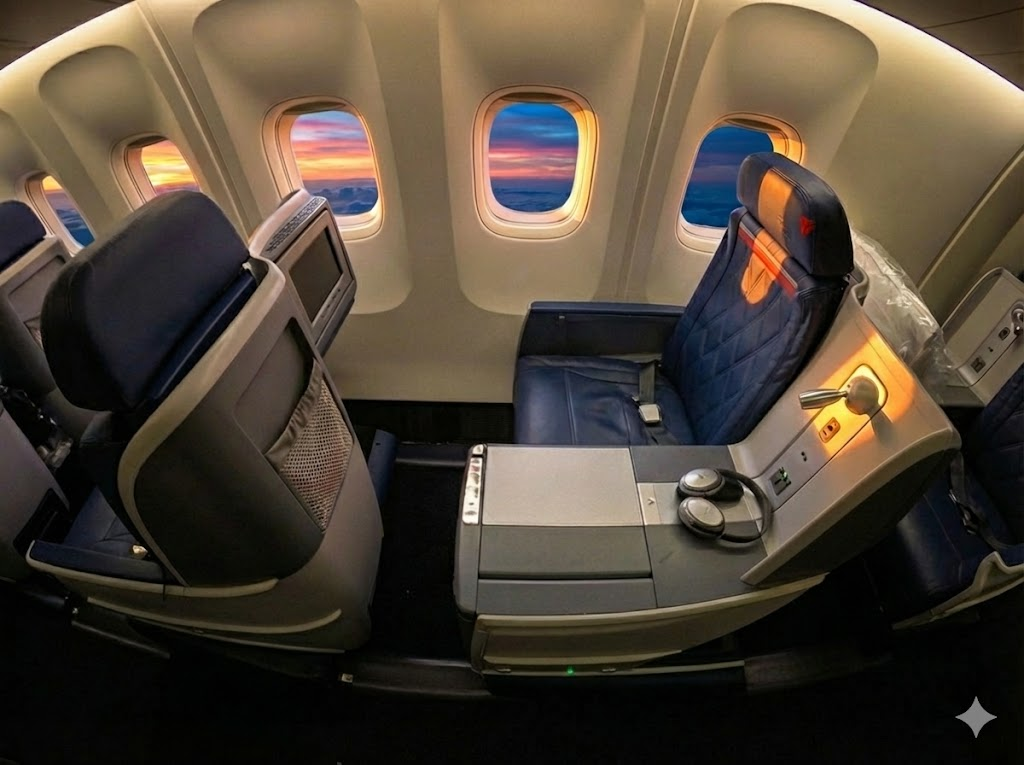
Delta's Boeing 767-300ER operates a mix of transatlantic routes plus select domestic and Hawaii services. There are two active configurations — 76K and 76L — creating a real version lottery where the cabin mix and seat quirks vary meaningfully by aircraft. Across both versions, Delta One uses Thompson Vantage lie-flat seats in a staggered 1-2-1 layout with direct aisle access for every passenger.
How this guide is structured: we break the 767-300ER down by variant, show you how to identify yours from the seat map, then give best/avoid seat picks by cabin.
Important: Delta is gradually retiring the 767-300ER fleet through 2028–2030. Configurations are no longer being modified. Row numbers and seat letters in this guide are verified against seat-level data as of May 2026.
✈️ Quick Verdict
- Best variant overall: 76K — only one with Premium Select
- Best cabin on either variant: Delta One (lie-flat + every-seat aisle access)
✅ Top picks
- Delta One: odd-row windows (3A, 3D, 5A, 5D, 7A, 7D) for the "true window" position; on 76L, 9A / 9D for great window alignment
- Premium Select (76K only): 21A / 21F — full underseat storage, window position, no missing-window risk
- Economy (76K): 40A / 40G, 43A / 43G, 45A, 50A / 50G — great window alignment
- Economy (76L): Row 27 entire row — exit row, extra legroom, no recline penalty
🚫 Watch out for
- 76K Premium Select 22A and 22F have no window — wall view only
- 76K mid-cabin lav island at rows 33–35 — partial rows and lav-adjacent seats throughout
- 76L front Economy is staggered — row 16 has only C/D/E, rows 20–21 have only A/B/F/G
- 76K row 55 and 76L row 42 — last rows are centre-only (C/D/E) with rear lavs at the window positions
✈️ Flying this aircraft soon? Enter your flight number for seat-specific advice. Find My Seat →
Delta 767-300ER Versions at a Glance
| Variant | Frames | Delta One | Premium Select | Comfort+ | Main Cabin | Total | Notes |
|---|---|---|---|---|---|---|---|
| 76K | 28 | 26 | 18 | 21 | 151 | 216 | The mainstream config — has Premium Select |
| 76L | 3 | 36 | — | 32 | 143 | 211 | More Delta One seats, no Premium Select, complex front Economy layout |
Fleet note: Delta plans to retire all 767-300ERs from international long-haul service by 2028 and from the fleet entirely by 2030.
How to Identify Your Version
| Indicator | 76K | 76L |
|---|---|---|
| Total seats | 216 | 211 |
| Delta One seats | 26 | 36 |
| Premium Select cabin | Yes (18 seats, rows 20–22) | No |
| Comfort+ rows | 30–32 | 16–22 (staggered) |
| Delta One ends at row | 7 | 9 |
| Last row in cabin | Row 55 (centre-only) | Row 42 (centre-only) |
Quick check on the seat map:
- See 2-2-2 Premium Select between Delta One and Economy → 76K
- See Delta One running through row 9 with no Premium Select → 76L
- See partial rows in front Economy where row 16 is just C/D/E and rows 20–21 are just A/B/F/G → 76L
Seat Map Summary
76K configuration (216 seats)
| Cabin | Rows | Layout | Letters | Notes |
|---|---|---|---|---|
| Delta One | 1–7 | Staggered 1-2-1 | A | B-C | D | 26 seats; Thompson Vantage; row 7 is centre-pair only (7B/7C) |
| Premium Select | 20–22 | 2-2-2 | A-B | C-D | E-F | 18 seats; Collins MiQ; 22A and 22F have no window |
| Comfort+ | 30–32 | 2-3-2 | A-B | C-D-E | F-G | 21 seats; 34" pitch; mid-cabin lav cluster behind |
| Main Cabin | 33–55 | 2-3-2 | A-B | C-D-E | F-G | 32" pitch; mid-cabin lav island spans 33–35; row 55 is centre-only |
76L configuration (211 seats)
| Cabin | Rows | Layout | Letters | Notes |
|---|---|---|---|---|
| Delta One | 1–9 | Staggered 1-2-1 | A | B-C | D | 36 seats; Thompson Vantage; row 9 has best window alignment |
| Comfort+ / front Economy | 16–22 | 2-3-2 (staggered) | A-B | C-D-E | F-G | Mid-cabin lav island creates partial rows: 16 = C/D/E only; 20–21 = A/B/F/G only |
| Main Cabin | 23–42 | 2-3-2 | A-B | C-D-E | F-G | 32" pitch; row 27 is exit row; row 42 is centre-only |
Delta uses A, B, C, D, E, F, G letters on this aircraft. There is no H seat anywhere in the cabin.
Delta One Business Class
Both variants feature the same Thompson Vantage seat in a staggered 1-2-1 layout. Every seat has direct aisle access and converts to a fully flat bed.
Specifications:
- Layout: A | B-C | D (4 seats per row)
- Seat width: 20"
- Bed length: ~76" fully flat
- Screen: 10.1" touchscreen
- Power: Universal 110V AC + 2× USB-A
- Adjustable armrest on aisle side only
The staggered layout — why odd rows beat even rows:
- Odd-row window seats (1A is bulkhead exception, then 3A, 5A, 7A…): the seat sits closer to the window with the side console between you and the aisle — more private
- Even-row window seats (2A, 4A, 6A, 8A): the seat sits closer to the aisle with the console on the window side — less private, more foot traffic exposure
- Centre pairs: all have aisle access; B + C work as couple seats
✅ Best Seats — Delta One
| Variant | Category | Seats | Reason |
|---|---|---|---|
| Both | Best window privacy | 3A, 3D, 5A, 5D | Odd-row "true window" position with console buffering the aisle |
| 76L | Best window overall | 9A, 9D | Last Delta One row + great window alignment |
| Both | Couples | 3B + 3C, 5B + 5C | Centre pair, both aisle-accessible |
| Both | Quick exit | Last Delta One row windows (76K: row 6 / 76L: row 8) | Avoid the very last row — galley/bassinet adjacency |
🚫 Seats to Avoid — Delta One
| Variant | Seats | Reason |
|---|---|---|
| Both | Row 1 (1A, 1B, 1C, 1D) | Bulkhead near forward galley/lav; lav noise |
| Both | 2A, 4A, 6A, 8A (76L) / 2A, 4A, 6A (76K) | Even-row windows — closer to aisle, less private |
| 76K | 7B, 7C | Last Delta One row, centre-pair only, bassinet position behind |
| 76L | 9B, 9C | Centre pair adjacent to bassinet; window pair (9A/9D) is the better pick in this row |
Premium Select (76K only)
The 76K is the only 767-300ER with Premium Select, positioned between Delta One and the Main Cabin.
Specifications:
- Layout: 2-2-2 (rows 20–22), letters A-B | C-D | E-F
- Seat: Collins MiQ with retractable leg/foot rest
- Width: 19"
- Pitch: 38"
- Recline: 7"
- Screen: 10" touchscreen
- Power: Shared AC + 2× USB-A
✅ Best Seats — Premium Select (76K)
| Category | Seats | Reason |
|---|---|---|
| Best overall | 21A, 21F | Window with full underseat storage; clear of the bulkhead and the missing-window row |
| Best aisle | 21B, 21E | 2-pair aisle without bulkhead trade-off |
| Couples | 21A + 21B or 21E + 21F | Window-pair sections |
🚫 Seats to Avoid — Premium Select (76K)
| Seats | Reason |
|---|---|
| 22A, 22F | No window — wall view only. Both flagged red |
| Row 20 (20A–20F) | Bulkhead — no underseat storage during takeoff/landing; tray and screen in armrest narrows seat width |
| 22B, 22E | Adjacent to a missing-window seat; last PS row near galley |
Delta Comfort+
Comfort+ is extra-legroom economy near the front of the Main Cabin. Pitch and seat are identical on both variants — the difference is where it sits in the cabin.
Specifications:
- Seat: Weber 5751
- Width: 18"
- Pitch: 34"
- Recline: 7"
- Screen: 10" touchscreen
- Power: Shared AC + USB-A
76K Comfort+ — rows 30–32
These are the rows behind the forward galley and ahead of the mid-cabin lav island. We rate the entire block cautiously because:
- Row 30 is bulkhead with cramped legroom (the partition wall is ~50cm/20" away — closer than typical bulkhead rows) and tray-in-armrest
- Row 31 is exit-row recline-limited; centre seats (31C/D/E) are lav-adjacent
- Row 32 centre seats (32B–32F) are immediately adjacent to the mid-cabin lavatories
| Best Comfort+ pick on 76K | Reason |
|---|---|
| 30A, 30G | Window with bulkhead legroom (accept tray-in-armrest trade-off) |
| 31A, 31G | Window with exit-row legroom; recline limited but not lav-adjacent |
76L Comfort+ — rows 16–22 (staggered front Economy)
This is where the live guide had it most wrong. The 76L doesn't have a clean Comfort+ block — instead, the front Economy area is built around a mid-cabin lav cluster, creating partial rows:
- Row 16: only C, D, E exist (window pairs are replaced by lavatories on both sides) — bulkhead, extra legroom, but the closest you'll get to "windowless" without it being labelled that way
- Row 17: full 7-across bulkhead; 17C, 17D, 17E are the standout extra-legroom picks
- Rows 18–19: full 7-across but C/D/E sit immediately ahead of mid-cabin lavs
- Rows 20–21: only A, B, F, G exist (centre triple replaced by lavs); window seats are extra-legroom but exit-row recline-limited
- Row 22: full 7-across, with C/D/E having extra legroom (no seatback ahead)
| Best Comfort+ picks on 76L | Reason |
|---|---|
| 17C, 17D, 17E | Bulkhead with extra legroom and full underseat (best of the centre triples) |
| 20A, 20G | Exit-row window with extra legroom; partial-row layout means no centre triple beside you |
| 22C, 22E | Centre seats with no seatback ahead — extra knee space but no underseat at takeoff |
🚫 Comfort+ seats to avoid
| Variant | Seats | Reason |
|---|---|---|
| 76K | 31C, 31D, 31E, 32B–32F | Mid-cabin lavatory directly behind |
| 76K | 33B, 33F, 34B, 34F (technically Main Cabin but adjacent) | Mid-lav island sits at C/D/E — these aisle seats face the queue |
| 76L | 18C, 18D, 18E, 19B–19F | Mid-lav directly behind |
| 76L | 20B, 20F, 21B, 21F | Mid-lav directly ahead, no centre triple beside |
Main Cabin Economy
Standard 2-3-2 layout on both variants — a passenger-friendly configuration with no middle seat in the window pair.
Specifications:
- Width: 18"
- Pitch: 32"
- Recline: 4"
- Screen: 10" touchscreen
- Power: Shared AC + USB-A
✅ Best Seats — Main Cabin
| Variant | Category | Seats | Reason |
|---|---|---|---|
| 76L | Best in cabin | Row 27 (any seat) | Exit row — extra legroom, full recline, the entire row rates green |
| 76K | Great window alignment | 40A, 40G, 43A, 43G, 45A, 50A, 50G | These have the best window-to-seat alignment in the cabin |
| 76L | Great window alignment | 30A, 30G, 32A, 32G, 37A, 37G | Verified alignment |
| Both | Couples | Any A + B or F + G pair in standard rows | 2-seat sections, no middle seat |
🚫 Seats to Avoid — Main Cabin
| Variant | Seats | Reason |
|---|---|---|
| 76K | 35C, 35D, 35E | Bulkhead behind mid-cabin lavs — extra legroom but lav noise/odour, tray-in-armrest |
| 76K | 53A–53G, 54A–54G, 55C, 55D, 55E | Adjacent to rear lavatories; last row 55 is centre-only |
| 76L | 24C, 24D, 24E | Bulkhead behind mid-cabin lavs |
| 76L | 40A–40G, 41A–41G, 42C, 42D, 42E | Adjacent to rear lavatories; last row 42 is centre-only |
| Both | Centre seats (C, D, E) in any row | No window or aisle access |
Known Quirks and Practical Tips
| Issue | Detail |
|---|---|
| 76K Premium Select last row | 22A and 22F have no window — pick row 21 if window matters |
| 76K mid-cabin lav island | Sits between rows 33–35; affects 31C/D/E, 32B–F, 33B/F, 34B/F, 35C/D/E |
| 76L staggered front Economy | Rows 16, 20, 21 are partial — read the Delta seat map carefully when booking |
| Version visibility | Delta sometimes swaps subfleets close to departure; recheck your seat map 24h out |
| Last-row trap | 76K row 55 and 76L row 42 are centre-only with rear lavs at the window positions — avoid both |
| Retirement timeline | Fleet retiring through 2028–2030; no further retrofits expected |
| 76T label | Delta sometimes shows "76T" — same airframe as 76L with a pilot rest module installed, reducing some Delta One seats on certain missions |
A note on the "76Z" variant
Earlier versions of this guide and other third-party sites have referenced a "76Z" subfleet of ex-Asiana frames with 226 seats and missing-window Comfort+ seats at rows 13A/15A/17A and 13G/15G/17G. We could not verify this configuration against verified seat-level data, which catalogues only 76K and 76L for Delta's 767-300ER fleet (28 + 3 = 31 frames, consistent with Delta's fleet size). If you encounter a Delta 767-300ER seat map with 226 seats or a different layout to those described above, treat the seat numbers in this guide as approximate and verify directly on the Delta app's seat map before booking.
Best Seats Summary
| Cabin | Variant | Best Seats | Why | Avoid |
|---|---|---|---|---|
| Delta One | Both | 3A, 3D, 5A, 5D, 7A, 7D | Odd-row "true window" privacy | 1A/1B/1C/1D (lav noise); even-row windows |
| Delta One | 76L only | 9A, 9D | Last row + great window alignment | 9B, 9C (centre pair) |
| Premium Select | 76K only | 21A, 21F | Window with full underseat storage | 22A, 22F (no window); row 20 (bulkhead) |
| Comfort+ | 76K | 30A, 30G | Bulkhead window legroom | 31C/D/E, 32B–F (mid-lav) |
| Comfort+ | 76L | 17C, 17D, 17E or 20A/20G | Bulkhead extra legroom or exit-row window | 16C/D/E (lavs at sides); 20B/F (mid-lav ahead) |
| Main Cabin | 76L | Row 27 (any seat) | Exit row, all-green | Rows 40–42 (rear lavs) |
| Main Cabin | 76K | 40A/G, 43A/G, 45A, 50A/G | Great window alignment | Rows 53–55 (rear lavs); 35C/D/E (mid-lav bulkhead) |
FAQs
How do I know which 767-300ER variant I'll get?
Check the seat map in the Delta app or on Delta.com. The two configurations are easy to tell apart: 76K has a Premium Select cabin (rows 20–22, 2-2-2) between Delta One and Economy. 76L has no Premium Select and Delta One runs through row 9.
Is the 76K better than the 76L?
For most travellers, yes — 76K has Premium Select, which is a meaningful step up from Comfort+ for medium-haul transatlantic flights. The 76L has more Delta One seats (36 vs 26), which slightly improves upgrade odds, and it has the standout row 27 exit row in Economy.
What's wrong with seats 22A and 22F in Premium Select?
They have no window — just a wall section where the window should be. This is a known feature of the last row of Premium Select on 76K. If a window matters to you, pick row 21 (specifically 21A or 21F).
What does the "staggered front Economy" on 76L actually look like?
The 76L has a mid-cabin lavatory cluster that sits in the centre of the front Economy area. To make space for it, Delta removed seats in alternating positions: row 16 has only the centre triple (C/D/E), rows 20–21 have only the window pairs (A/B and F/G), and rows 17–19 and 22 are full 7-across. The Delta app shows this correctly — read the seat map, don't assume a clean grid.
Best Delta One seats for couples?
Centre pairs in odd rows: 3B + 3C or 5B + 5C. Both passengers have direct aisle access and the staggered layout puts you closer to each other than even-row centre pairs.
What's the difference between 76L and 76T?
Same airframe and seat product. "76T" indicates Delta has installed a pilot rest module on a particular flight, which can reduce the available Delta One seat count. Most passengers won't notice the difference, but if your Delta One row count looks short on a 76L, that's why.
Will Delta retrofit these with newer Delta One Suites?
Unlikely. The 767-300ER fleet is being retired by 2030, with most international long-haul rotations transitioning to A330-900s and A350s. Existing Thompson Vantage seats will remain in service until retirement.
Is the 767-300ER comfortable for transatlantic?
Delta One is competitive with most US legacy carriers' transatlantic business class. Economy is actually better than many widebodies because of the 2-3-2 layout — there's no middle seat in the window pair, and even the centre triple has only one true middle seat (D).
More Seat Guides for This Airline
- Delta A350-900 Seat Selection Guide (Delta One Suites with doors)
- Delta A330-900neo Seat Selection Guide (Delta One Suites)
- Delta 767-400ER Seat Selection Guide (similar vintage with refreshed cabin)
- Delta A330-300 & A330-200 Seat Selection Guide (older Delta One)
Comparable Aircraft
- United 767-300ER Seat Selection Guide (Polaris business comparison)
- American 787-8 Seat Selection Guide (transatlantic comparison)
- British Airways 777-200ER Seat Selection Guide (transatlantic alternative)