British Airways Concorde Seat Map & Best Seats
A note before you book. Concorde retired on 24 October 2003. This guide exists purely as a love letter to the most extraordinary passenger aircraft ever flown. If you find a way to use it, please contact us immediately.
Quick Verdict
Concorde was a single-class 100-seat supersonic jet in a narrow 2-2 layout. The best seats were 1A / 1B / 1C / 1D at the front bulkhead and 11A / 11D at the front of the rear cabin — both bulkheads carried Machmeters showing speed, altitude and distance. Avoid 10B / 10C (forward lav adjacency) and the rear aisle seats in rows 24–26 (loudest section, fuselage flex during supersonic cruise). Champagne was included.
At a Glance
| Aircraft | Aérospatiale/BAC Concorde |
| In service | 1976 – 2003 |
| Fleet size (BA) | 7 aircraft |
| Cabin | Single-class "Concorde Class" |
| Layout | 2-2 (A-B | C-D), single aisle |
| Total seats | 100 |
| Seat pitch | 37 inches |
| Seat width | 17.8 inches |
| Version lottery | No |
| Best seats | 1A/1B/1C/1D, 11A/11D |
| Seats to avoid | 10B/10C, 24–26 aisle seats |
| IFE | Audio channels only |
| Power | None |
| WiFi | Absolutely not |
| Cruising altitude | 55,000–60,000 ft |
| Cruising speed | Mach 2 (~1,350 mph) |
The Cabin
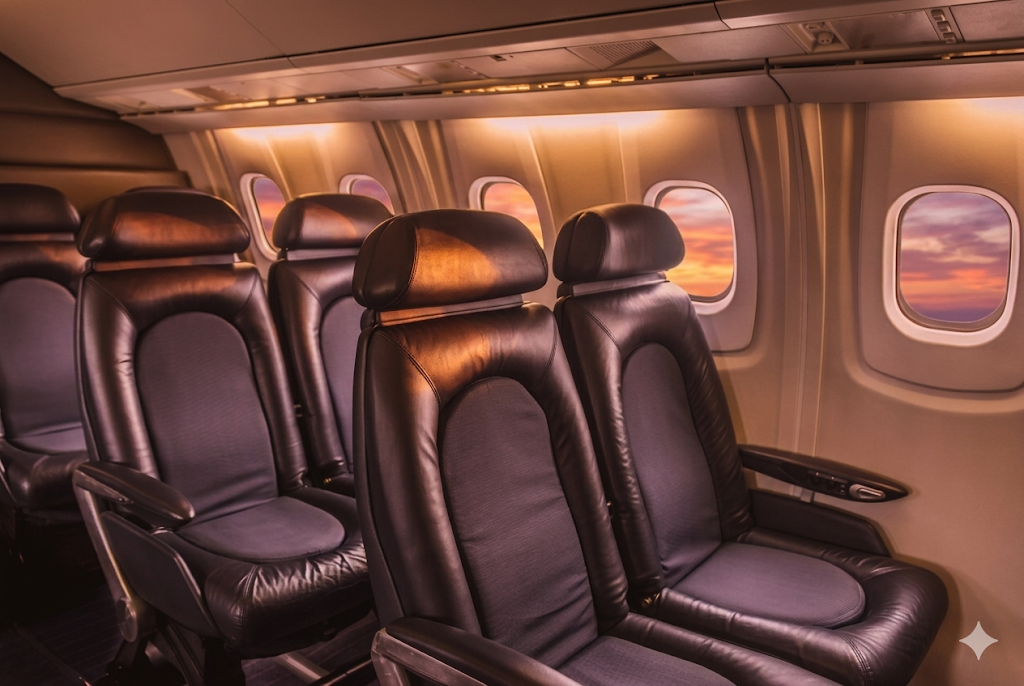
Both British Airways and Air France configured Concorde as a single class of 100 seats — four across with a central aisle. BA's layout split into 40 seats in the forward cabin (rows 1–10) and 60 in the rear (rows 11–26, with row 13 skipped). Seat letters ran A-B on the left of the aisle and C-D on the right, so A and D were windows, B and C were aisles.
The cabin was narrow by structural necessity. A wider cross-section would have added drag that compromised Concorde's ability to hold Mach 2 across the Atlantic. At 17.8 inches wide and 37 inches of pitch, the layout was more generous than World Traveller yet marginally tighter than World Traveller Plus — which, on a three-and-a-half-hour transatlantic flight fuelled by vintage Krug, was entirely sufficient.
The Seats — Project Rocket
In 1999, BA commissioned Factory Design to redesign the interior. Working with Sir Terence Conran, the resulting "Project Rocket" seats were fitted to BA's Concorde fleet from 2001 onwards — built from carbon fibre, titanium and aluminium, covered in ink-blue Connolly leather, with a cradle recline mechanism, footrest and contoured headrest. The monocoque carbon fibre back reclined around a single pivot point and weighed roughly 20% less than its predecessor.
The seats cost around £14,000 a pair. There were 50 pairs per aircraft.
Best Seats
Row 1 (1A / 1B / 1C / 1D) — the front row. The bulkhead immediately ahead carried a Machmeter displaying speed, altitude and distance-to-go. Tray tables folded down to a serious-sized dining surface, and the swing-up footrests could be removed for extra stretch room. Pick 1A or 1D for the window, but any seat in row 1 is a credible answer to "where did you sit."
Row 11 (11A / 11D) — front of the rear cabin. Another Machmeter mounted on the bulkhead ahead. Front-of-section feel, window view, and the quietest part of the rear cabin. Concorde-era regulars rated these as the prestige seats of the aft section.
Any A or D, rows 2–9 or 12–19. The windows were unusually small — about passport-sized, deliberately reduced to limit the rate of pressure loss in the event of a breach at altitude. But through them, at 55,000–60,000 feet, you could see the curvature of the Earth on the horizon. Window seats were the only way to experience that, and the forward cabin and front of the rear cabin gave you the quietest ride.
Seats to Avoid
10B / 10C. Last row of the forward cabin, both aisle seats. Immediate proximity to the forward lavatory between cabins, no window, and first in line for galley trolley traffic in a narrow aisle.
Rows 24–26 aisle seats (B / C). The narrow fuselage flexed during supersonic cruise — noticeable mainly to passengers looking along the length of the cabin from the rear. Combined with the proximity of all four Olympus 593 engines, rows 24–26 were the loudest real estate on the aircraft. The window seats (A/D) in these rows are a defensible choice if you want the engine note as part of the theatre. The aisle seats are not.
Cabin Features
| Feature | Detail |
|---|---|
| Seat product | Project Rocket (Factory Design / Britax-Contour, 2001) |
| Material | Ink-blue Connolly leather |
| Recline | Cradle mechanism |
| Footrest | Yes — swing-up, removable in row 1 |
| Tray table | Fold-out, large |
| IFE | Audio channels only |
| Power | None |
| WiFi | Still none |
| Windows | Very small — deliberate, pressure-safety design |
| Headroom | ~6ft at centre aisle |
The Experience Worth Knowing About
You could see the curvature of the Earth. At cruise altitude Concorde was close to 12 miles high, above more than 90% of the atmosphere. Turbulence was rarely encountered.
You could outrun the sun. Concorde's cruising speed exceeded the westbound progression of the solar terminator. On certain westbound evening flights from Heathrow, you could take off just after sunset and catch up with the sun, landing in daylight. BA marketed this as "Arrive before you leave."
The food was remarkable. Menus were developed with some of the best-known chefs of the era, served on Royal Doulton bone china with silver cutlery. Champagne was selected specifically for the Concorde cellar. Menus rotated weekly, the wine list monthly.
The transatlantic speed record still stands. New York to London in 2 hours 52 minutes and 59 seconds, February 1996 — a record Concorde retained through retirement and holds to this day.
Quick-Pick Summary
| Traveller type | Best pick |
|---|---|
| Window seat with Machmeter | 1A or 1D |
| Front cabin prestige | Rows 1–5, A or D |
| Rear cabin best value | 11A or 11D |
| Quietest ride | Rows 2–9 and 11–12, any seat |
| Engine note as the point | 24A or 24D |
| Bragging rights at any cost | Row 1 |
Comparable Guides
- British Airways 777-300ER Seat Selection Guide
- British Airways A380-800 Seat Selection Guide
- British Airways 787-10 Seat Selection Guide
FAQ
Is Concorde still flying?
No. BA and Air France retired their fleets in October 2003. If you're reading this and Concorde is flying again, something extraordinary has happened and we would very much like to know.
Was there a business class on Concorde?
No. Concorde operated as a single class, branded "Concorde Class" — positioned above BA's First Class.
Why is row 13 missing?
Superstition. The aircraft broke the sound barrier but skipped row 13 like every other airline.
Which cabin was better — forward or aft?
The forward cabin (rows 1–10) was generally considered preferable: quieter, less fuselage flex, Machmeter at the bulkhead. The rear gave you the engine note, which some passengers considered a feature rather than a bug.
Why were the windows so small?
At Concorde's operating altitude, a sudden cabin depressurisation would leave a very short window of useful consciousness. Smaller panes reduced the rate of pressure loss in the event of a breach.
What did a ticket cost?
A London–New York return in 2003 was approximately £8,000 — roughly £15,000 in today's money. The champagne was included.