Asiana Airlines Boeing 777-200ER Seat Selection Guide (2026)
✈️ Quick Verdict
Aircraft: Boeing 777-200ER — 300 or 302 seats across three cabin plans · eight registered aircraft
Layout: Business 1-2-1 staggered, rows 7–12 · Economy 3-3-3, A B C | D E F | G H J, rows 28–60
Version lottery: Yes — three plans, and two of them share the same 302-seat total with different economy cabins
Best seats — Business: 10A and 10J — window pods with the best window alignment in the cabin · 7E/7F and 9E/9F for two travelling together
Best seats — economy: row 47 — the exit row, extra legroom on all nine seats and a full recline
Seats to avoid: 32A — blank wall on six aircraft · 39A and 39J — blank wall on HL8254 and HL8284 · row 46 — limited recline · 28G, 28H and 28J — bulkhead legroom against a lavatory on six aircraft
Lavatories: two for Business, six or seven for 278 economy passengers
IFE: Panasonic eX2, on demand · Wi-Fi: none — no Asiana 777-200ER is fitted
The trap: the windowless seat moves between aircraft
Asiana’s 777-200ER economy cabin is 3-3-3 and 33 rows deep on every one of the eight aircraft, which makes the three cabin plans look interchangeable on a booking screen. They are not, and the clearest illustration is a single seat.
On six of the eight aircraft, 32A has no window at all — a blank stretch of fuselage wall in an otherwise ordinary window column. On HL8254 and HL8284, 32A is a perfectly good window seat, and the blank wall is at 39A and 39J instead. Advice that names 32A is right most of the time and wrong on a quarter of the fleet, which is worse than no advice at all.
The same two aircraft differ in three other places that matter more than the seat count suggests: row 46 is six seats wide instead of three, and all six have a restricted recline; row 28 loses its G seat as well as its C seat; and the cabin’s taper falls a row later, so rows 59 and 60 are the centre block only.
The three cabin plans
| Plan | Business | Economy | Aircraft | Registrations |
|---|---|---|---|---|
| 302 seats | 24 | 278 | Four | HL7755, HL7756, HL7775, HL7791 |
| 302 seats | 24 | 278 | Two | HL8254, HL8284 |
| 300 seats | 22 | 278 | Two | HL7700, HL7732 |
Eight registrations are published across the three plans, against a recorded fleet count of seven. We are not quoting a fleet total on this aircraft — the registrations are the part you can actually check, and they are what the table above is built on.
Business: a staggered 1-2-1, and the stagger decides the seat
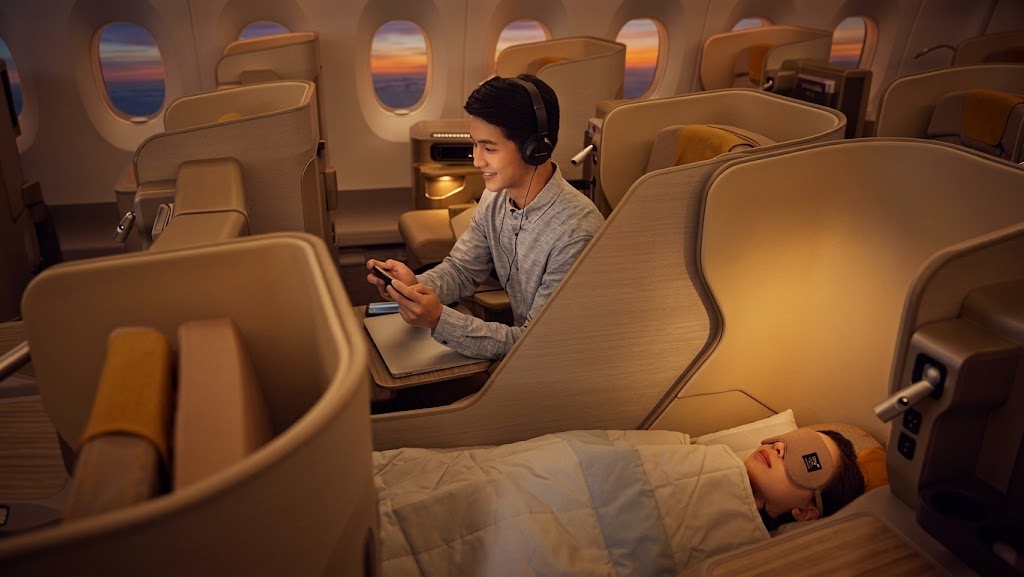
Asiana sells this cabin as Business Smartium. The seat is the Stelia Solstys, laid out 1-2-1 across six rows, and every one of the 22 or 24 pods reaches an aisle without stepping past a neighbour. That is the headline, and it is true. What the headline hides is that a staggered cabin has two kinds of row, and they are not equally good.
| Row type | Rows | Window pods | Centre pair | Best for |
|---|---|---|---|---|
| Outboard | 8, 10, 12 | A and J — set against the window, console on the aisle side | D and G — split by a console | Privacy at the window; solo travellers in the centre |
| Inboard | 7, 9, 11 | B and H — set beside the aisle, console against the window | E and F — drawn side by side | Two people travelling together |
10A and 10J are the best seats in the cabin. They are outboard pods, so the console sits between you and the aisle, and they are the only two Business seats the layout records as having the best window alignment on the aircraft. 8A and 8J are the same pod without that. 12A and 12J exist only on the 24-seat aircraft, and there they split: worth taking on HL7755, HL7756, HL7775 and HL7791, but on HL8254 and HL8284 there is a lavatory immediately beside them.
If you are travelling as two, take 7E and 7F, 9E and 9F, or 11E and 11F — the centre pairs on the inboard rows are drawn side by side with nothing between them. If you are travelling alone and want the centre, take 8D, 8G, 10D or 10G instead: those pairs are split by a console.
Row 11 is the bassinet row on all three plans, so 11B, 11E, 11F and 11H can be reassigned to a family. On the 300-seat aircraft the bassinet positions are 12D and 12G as well — and on those two aircraft row 12 has no A or J seat at all, just the centre pair.
Economy: row 47 is the seat to book
There are two exit rows in the economy cabin, and unusually for a widebody neither carries a recline restriction. Row 28 sits at the door 2 bulkhead at the front of the cabin, and row 47 sits at door 3 in the middle. Row 47 is the better of the two: all nine seats carry extra legroom, nothing is blocked in front of you, and the seat reclines normally.
Row 28 has the legroom too — 80cm (31in) to the wall on the A and B side, 79cm (31in) on the G, H and J side — but it is a bulkhead row, which means no underseat storage in front of you and a tray table folded into the armrest, so the seat itself is narrower. There is no 28C seat on any of the three plans.
Row 28 also splits between the cabin plans, and this is the second reason to check which aircraft you are on. On the four HL77xx aircraft and the two 300-seat aircraft, 28G, 28H and 28J sit with a lavatory immediately adjacent, which cancels most of what the bulkhead legroom buys — take 28A, 28B, 28D, 28E or 28F instead. On HL8254 and HL8284 that lavatory is not there, there is no 28G seat, and the whole row is clean.
Row 46 is the row to avoid. On the four HL77xx aircraft and the two 300-seat aircraft it is the centre block only — 46D, 46E and 46F — and none of the three fully reclines, because there is a wall directly behind. On HL8254 and HL8284 it is six seats wide, D through J, and all six carry the same restriction.
The back of the cabin narrows. Row 58 loses its C and G seats, row 59 is A B D E F on the HL77xx and 300-seat aircraft and the centre three on HL8254 and HL8284, and row 60 is the centre three everywhere.
There is extra pitch back there, and it needs unpicking. On the HL77xx and 300-seat aircraft, 57A, 58A, 58J, 59A and 59B all measure about 34in — two inches more than the rest of the cabin — but only 57A and 58A are clean seats. 58J and 59B have a lavatory immediately adjacent, and 59A sits in the queue for it. On HL8254 and HL8284 only 58A and 58J carry the extra pitch, and on those two aircraft both are beside a lavatory. So the extra-pitch seat worth having is 57A or 58A, and only on six of the eight aircraft.
The best-rated window seats in economy are 51A, 51J, 53A and 53J, and they are the same on all three cabin plans — the safest window pick if you have not checked the registration. 29J is the same on the HL77xx and 300-seat aircraft; 30A and 30J on HL8254 and HL8284. 38J is the opposite: its nearest window sits forward, beside the row ahead, so you lean into row 37 to see out.
Cabin features
| Business Smartium | Economy | |
|---|---|---|
| Rows | 7–12 | 28–60 |
| Layout | 1-2-1 staggered | 3-3-3, A B C | D E F | G H J |
| Seat | Stelia Solstys, lie-flat | Standard recliner |
| Direct aisle access | Every seat | 127 of 278 seats |
| Exit rows | — | Rows 28 and 47 |
| Entertainment | Panasonic eX2, on demand | Panasonic eX2, on demand |
| Wi-Fi | None fitted | None fitted |
| Lavatories | Two, or three on HL8254/HL8284 | Seven, or six on HL8254/HL8284 |
Quick picks
| Travelling as | Book | Why |
|---|---|---|
| Solo, Business | 10A or 10J | Outboard pod, console on the aisle side, best window alignment in the cabin |
| Two, Business | 7E/7F or 9E/9F | Centre pairs on the inboard rows are drawn side by side |
| Solo in Business centre | 8D, 8G, 10D or 10G | Centre pairs on the outboard rows are split by a console |
| Legroom, economy | Row 47 | Exit row, extra legroom on all nine seats, and it still reclines |
| Window, economy | 51A, 51J, 53A, 53J | Best-rated windows in the cabin, and the same on all three aircraft |
| Extra pitch at the back | 57A or 58A | About 34in — on the HL77xx and 300-seat aircraft only; the rest of that block is beside a lavatory |
| Avoid | 32A, 39A, 39J, row 46, 28G–28J, row 60 | Blank walls, restricted recline, a bulkhead row against a lavatory, and the narrowing tail |
How to tell which aircraft you are on
Two checks on the seat map, in this order.
First, look at row 46. If it is six seats wide — 46D through 46J — you are on HL8254 or HL8284, and the windowless pair is 39A and 39J. If it is three seats wide, you are on one of the other six aircraft and the seat to avoid is 32A.
Then look at row 12. If it has only two seats, 12D and 12G, you are on HL7700 or HL7732 and the cabin has 22 Business seats. If it has four, you have 24.
Row 59 confirms it: A B D E F on the HL77xx and 300-seat aircraft, the centre three on HL8254 and HL8284.
Frequently asked questions
Does Asiana’s 777-200ER have Wi-Fi?
No. No Wi-Fi is recorded on any Asiana 777-200ER in any of the three cabin plans. Entertainment is the Panasonic eX2 system, on demand at every seat, but there is no connectivity on this aircraft.
What is the best seat in Asiana Business on the 777-200ER?
10A or 10J. Both are outboard pods in the staggered 1-2-1, so the side console sits between you and the aisle rather than between you and the window, and they are the only two seats in the cabin recorded with the best window alignment.
Are all the Business seats really direct aisle access?
Yes. All 22 or 24 seats reach an aisle without stepping past anybody. That is a genuine property of the staggered 1-2-1, and it holds on all three cabin plans.
Which economy seats have no window?
It depends on the aircraft. On six of the eight, 32A has no window at all and 38J’s nearest window sits forward of the seat. On HL8254 and HL8284, 39A and 39J are the blank ones instead and 32A is fine.
Is row 28 or row 47 the better exit row?
Row 47. Both carry extra legroom and neither has a recline restriction, but row 28 is a bulkhead row, so there is no underseat storage in front of you and the tray table folds out of the armrest, which narrows the seat. On six of the eight aircraft, 28G, 28H and 28J also sit against a lavatory. Row 47 has none of those compromises.
How many 777-200ERs does Asiana fly?
Eight registrations are published across the three cabin plans, against a recorded fleet count of seven, so the two figures disagree. We quote the registrations rather than a total, because a registration is something you can check against your booking and a fleet count is not.